Rajya Sabha upset exposes fault lines in Jharkhand’s INDIA bloc
Ranchi, June 20: The defeat of Congress candidate Pranav Jha in the Rajya Sabha election and the victory of NDA-backed Independent candidate…
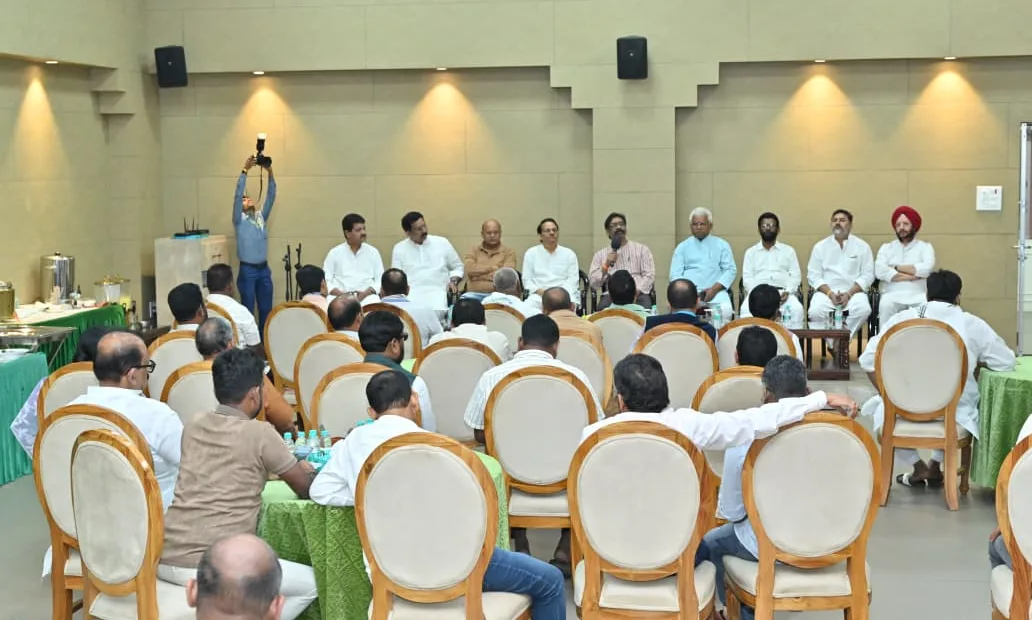
Chief Minister Hemant Soren and leaders of the INDIA bloc during a strategy meeting ahead of the Rajya Sabha elections in Jharkhand. (File Photo)
Ranchi, June 20: The defeat of Congress candidate Pranav Jha in the Rajya Sabha election and the victory of NDA-backed Independent candidate Parimal Nathwani have exposed deep cracks within Jharkhand’s ruling INDIA bloc, triggering a bitter blame game among coalition partners and raising questions about the alliance’s internal cohesion.
What was expected to be a comfortable victory for the ruling alliance has instead turned into a political embarrassment, with alliance constituents publicly accusing one another of betrayal, cross-voting and sabotage.
While JMM has sought to strike a cautious tone and called for a review of the outcome, Congress and RJD leaders have launched a war of words that has laid bare the tensions simmering beneath the coalition’s surface.
A Result That Defied Expectations
The ruling alliance entered the Rajya Sabha contest with confidence, backed by its numerical strength in the 81-member Jharkhand Assembly.
JMM nominee Baijnath Ram secured victory as expected. However, the defeat of Pranav Jha and Nathwani’s win have prompted intense speculation over how the numbers eventually played out.
Political observers point out that the result has fuelled suspicions of cross-voting or strategic voting by legislators within the alliance, although no party has publicly produced evidence to substantiate such claims.

The unexpected outcome has become even more intriguing because extensive preparations had reportedly been undertaken before polling, including coordination meetings and voting drills involving alliance legislators.
Speculation Over RJD and CPI(ML) Votes
At the centre of the controversy is political speculation that all four RJD MLAs and two CPI(ML) legislators may have voted in favour of Nathwani, contributing to the Congress candidate’s defeat.
The speculation has gained traction in political circles, particularly because the final outcome did not align with the alliance’s expected arithmetic.

However, both RJD and CPI(ML) have categorically rejected the allegations.
RJD leaders have maintained that all their legislators voted according to the alliance’s decision, while CPI(ML) leaders have also denied any deviation from the agreed strategy.
Since Rajya Sabha elections involve a secret voting process within the framework of the preferential voting system, it remains difficult to conclusively establish individual voting choices. Yet the rumours have intensified mistrust among alliance partners and become a major talking point in the state’s political discourse.
JMM Distances Itself From the Controversy
Unlike its allies, the Jharkhand Mukti Morcha has attempted to keep the controversy under control.
JMM General Secretary Vinod Pandey asserted that all 34 JMM legislators voted in accordance with the alliance strategy and that the party achieved 100 per cent voting participation.
Pandey said he remained present at the polling station as the party’s authorised agent throughout the voting process and closely monitored proceedings.
According to him, Chief Minister Hemant Soren had convened multiple meetings with alliance partners ahead of the election. Mock drills were also conducted to familiarise legislators with the voting procedure.
Despite these efforts, Pandey acknowledged that the defeat of one alliance candidate was unexpected.
The JMM leader said the Mahagathbandhan would review the election result to determine why the anticipated outcome was not achieved and to strengthen coordination among alliance partners in future contests.
The JMM’s calibrated response suggests that Hemant Soren is keen to prevent the issue from escalating into a full-blown coalition crisis while quietly assessing where the alliance lost support.
RJD Targets Congress Leadership
The most dramatic fallout has been the public confrontation between Congress and RJD leaders.
RJD Legislature Party leader and Deoghar MLA Suresh Paswan launched a scathing attack on Congress’s Jharkhand in-charge K. Raju, accusing him of undermining alliance interests.
Paswan described K. Raju as the “biggest traitor” and alleged that he had betrayed alliance partners in both Bihar and Jharkhand.
According to the RJD leader, Congress was attempting to shift responsibility onto its allies rather than examining its own role in the defeat.
He claimed that all RJD legislators had voted honestly and in accordance with alliance commitments and demanded an inquiry into K. Raju’s role.
Paswan went a step further by urging Chief Minister Hemant Soren to consider removing Congress from the government.
Congress Strikes Back
Congress leaders reacted sharply to the allegations.
Agriculture, Animal Husbandry and Cooperation Minister Shilpi Neha Tirkey came out strongly in defence of K. Raju, describing him as a leader with a long record of public service and contributions to landmark welfare initiatives such as MGNREGA, the Right to Information Act and the National Food Security Act.
She dismissed the allegations as baseless and politically motivated.
Health Minister Irfan Ansari adopted a more aggressive stance.
In a strongly worded statement, Ansari accused the RJD of betraying Congress and alleged that the party’s legislators had helped Nathwani secure victory.
He claimed the Congress had been “stabbed in the back” and suggested that the RJD’s role in the government could be reconsidered.
Ansari also asserted that the JMM and Congress together possess sufficient numbers to run the government without RJD support.
His remarks marked one of the sharpest public attacks by a Congress leader against an alliance partner in recent years.
Hemant Soren’s Delhi Visit Fuels Political Buzz
Adding to the intrigue, Chief Minister Hemant Soren left for Delhi shortly after the Rajya Sabha results were declared.
Though no official explanation was provided, the timing of the visit has fuelled political speculation.
Observers believe discussions with senior alliance leaders may be on the agenda as efforts begin to assess the electoral setback and contain any potential damage to coalition unity.
More Than a Rajya Sabha Election
The significance of the result extends beyond the loss of a single Rajya Sabha seat.
For Congress, Pranav Jha’s defeat represents a setback at a time when the party has been trying to expand its influence within the Jharkhand coalition.
For the RJD, the controversy reflects its struggle to maintain relevance and bargaining power within the alliance.
For JMM, which leads the government, the challenge lies in managing competing interests and preventing the dispute from destabilising the coalition ahead of future elections.
Most importantly, the episode has highlighted the fragile nature of alliance politics, where numerical strength alone does not always guarantee political unity.
For now, the biggest beneficiary of the turmoil appears to be Parimal Nathwani, whose victory has done more than secure another term in the Rajya Sabha. It has exposed vulnerabilities within an alliance that was expected to win comfortably and has forced its partners into an uncomfortable public reckoning over trust, discipline and political loyalty.