Jharkhand HC restores Jamtara village Pradhan after 44-year legal battle, quashes Commissioner’s order
SUMAN K SHRIVASTAVA Ranchi, August 7: Bringing an end to a 44-year-old legal battle over hereditary succession to the post of village…
SUMAN K SHRIVASTAVA
Ranchi, August 7: Bringing an end to a 44-year-old legal battle over hereditary succession to the post of village Pradhan, the Jharkhand High Court on Friday restored the appointment of Sultan Mian as the Pradhan of Mouza Kendua in Jamtara district, setting aside a 2018 order of the Commissioner, Santhal Pargana Division, Dumka. The Court held that the Commissioner had exceeded the scope of his revisional jurisdiction by reassessing evidence and overturning concurrent findings of two competent authorities.
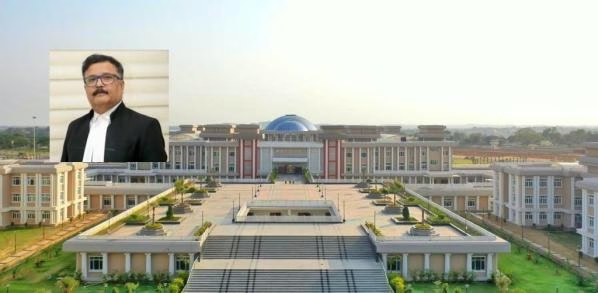
Justice Ananda Sen allowed Sultan Mian’s writ petition and restored the orders passed by the Sub-Divisional Officer in September 1982 appointing him as Pradhan and the Deputy Commissioner’s 1985 order affirming that appointment. The Commissioner’s order dated June 6, 2018, which had removed Sultan Mian from the post after accepting the rival claimant’s plea, was quashed.
The dispute originated after the death of Kadir Mian, the last Pradhan of Mouza Kendua. Sultan Mian, claiming to be his son, was appointed Pradhan by the Sub-Divisional Officer in September 1982 after an inquiry under the Santhal Pargana Tenancy (Supplementary Provisions) Act, 1949.
His appointment was challenged by Islam Mian, the grandson of the deceased Pradhan. However, the Deputy Commissioner dismissed the appeal in 1985, holding that the petitioner’s claim as the son of the last Pradhan had precedence over that of a grandson under the applicable principles of succession.
More than three decades later, in June 2018, the Commissioner allowed the revision petition, holding that Sultan Mian was not the biological son of Kadir Mian and set aside the earlier orders. Aggrieved by this decision, Sultan Mian approached the High Court.
Commissioner Exceeded Revisional Jurisdiction
The High Court ruled that the Commissioner had travelled beyond the limits of revisional jurisdiction by reappreciating evidence and recording fresh findings on disputed questions of fact.
Justice Sen observed that a revisional authority cannot act like an appellate court and is empowered only to examine the legality, propriety and jurisdictional correctness of an order. The Court relied on the Supreme Court’s judgment in Hindustan Petroleum Corporation Ltd. vs Dilbahar Singh (2014) 9 SCC 78 while reiterating the limited scope of revisional powers.
Civil Court Is Proper Forum for Disputed Facts
The High Court also held that the respondent’s allegation that Sultan Mian was not the biological son of the last Pradhan involved disputed questions of fact requiring oral and documentary evidence. Such issues, the Court said, cannot be decided in proceedings under Article 226 of the Constitution.

While restoring Sultan Mian’s appointment, the Court granted liberty to the respondent to approach the appropriate civil court to establish his claim to hereditary succession.
Key Legal Principles
The judgment underscores that revisional authorities cannot substitute concurrent findings of fact recorded by subordinate authorities unless there is a clear jurisdictional or legal error. It further clarifies that disputes relating to lineage, biological parentage, and hereditary succession must be adjudicated by a competent civil court based on evidence and cannot ordinarily be determined in writ proceedings under Article 226.