2008 accident victims get major relief as Jharkhand HC raises compensation to Rs 27.75 lakh
SUMAN K SHRIVASTAVA Ranchi, August 11: Two victims of a 2008 road accident have received major relief from the Jharkhand High Court,…
SUMAN K SHRIVASTAVA
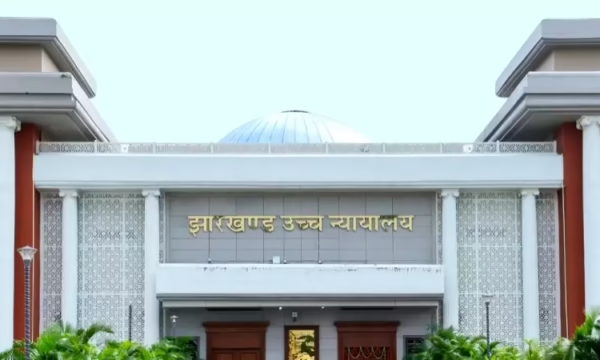
Ranchi, August 11: Two victims of a 2008 road accident have received major relief from the Jharkhand High Court, which has increased their total compensation from about Rs 1.05 lakh to Rs 27.75 lakh after finding that the original award failed to properly account for their permanent disabilities, loss of earning capacity and future medical needs.
The High Court enhanced the compensation of Vikash Kumar Keshri from Rs 67,500 to Rs 16.50 lakh, while the compensation awarded to Yasoda Devi alias Sushila Devi was increased from Rs 37,600 to Rs 11.25 lakh. Both amounts will carry interest at 7.5 per cent per annum from the date their respective claim petitions were filed until payment.
The judgment was delivered by Chief Justice M. S. Sonak on August 11 in two connected appeals—M.A. No. 181 of 2017 and M.A. No. 182 of 2017.
Two victims suffered serious injuries in 2008 accident
The two cases arose from the same accident on October 8, 2008, and were decided together by the Motor Vehicles Accident Claims Tribunal.
Vikash Kumar Keshri and Yasoda Devi had challenged the compensation awarded by the Tribunal, arguing that the amount was far too low and did not reflect the long-term impact of their injuries.
They particularly argued that the Tribunal had failed to consider their loss of future earning capacity, future medical expenses and the actual impact of their permanent disabilities. They also challenged the decision to hold them 50 per cent responsible for the accident merely because three people were travelling on the motorcycle.
Court says disability cannot be judged only by percentage
One of the most important findings of the High Court was that the impact of an injury cannot be assessed simply by looking at the percentage mentioned in a medical disability certificate.
The Court said what matters is how the disability affects a person’s ability to earn a livelihood, taking into account their age, occupation and the nature of work they were doing before the accident.

The High Court found that the Tribunal had dealt with this aspect too casually by focusing largely on the absence of documentary proof of income and failing to properly examine the functional impact of the injuries.
Vikash’s disability affects his ability to work
Vikash had a 60 per cent permanent disability, including an ankylosed right knee, shortening of the right lower limb and visual impairment.
He was involved in buying and selling agricultural produce, work that required him to walk, stand, move around markets and handle and supervise agricultural goods.
The High Court held that his injuries had a substantial impact on his ability to continue doing this work and assessed his functional disability at 70 per cent.
Yasoda’s injuries also have long-term impact
Yasoda Devi had been assessed as having 50 per cent permanent physical disability. Her injuries included fractures involving the pelvis and knee, which resulted in post-traumatic osteoarthritis and continuing weakness.
She was engaged in agricultural work as well as shop-keeping. The Court noted that agricultural work involves standing, walking, bending, squatting, lifting and carrying, activities that were directly affected by her injuries.
Taking her age, occupation and lasting physical limitations into account, the High Court assessed her functional disability at 60 per cent.
Lack of salary or income papers does not wipe out income claim
The Court also gave relief to the claimants on the question of their income.
Vikash had stated that he earned around Rs 6,000 to Rs 7,000 a month from his business, while Yasoda Devi had stated that she earned approximately Rs 6,000 per month through agriculture and shop-keeping.
Although they did not have formal documents proving their earnings, the Court found that their oral evidence regarding their occupations, injuries and treatment remained substantially consistent.
The High Court held that the absence of documentary evidence alone could not justify completely rejecting their income claims. It assessed Vikash’s monthly income at Rs 6,500 and Yasoda Devi’s at Rs 5,500.
Three people on motorcycle does not automatically mean 50% fault
The High Court also overturned the Tribunal’s finding of 50 per cent contributory negligence.
The Tribunal had treated the fact that three people were travelling on the motorcycle as sufficient reason to reduce the compensation. The High Court disagreed.
It held that merely violating a traffic rule does not automatically establish contributory negligence. There must be evidence showing that the violation actually contributed to the accident or made the consequences of the accident worse.
Since the insurance company failed to establish such a connection, the Court set aside the 50 per cent deduction.
Compensation rises sharply after fresh calculation
The High Court recalculated the compensation by taking into account future earning prospects, functional disability, medical expenses, future treatment, pain and suffering and loss of amenities.
For Vikash, the Court calculated Rs 12.99 lakh towards loss of future earnings, while the corresponding amount for Yasoda Devi was Rs 8.31 lakh.
The Court also retained medical expenses of Rs 1,14,836 for Vikash and Rs 55,149 for Yasoda Devi. Each was awarded an additional Rs 30,000 towards special diet, conveyance and miscellaneous expenses and Rs 40,000 towards future medical expenses.
For pain, suffering and trauma, the Court awarded Rs 75,000 to each claimant. It further awarded Rs 50,000 each for loss of amenities of life and Rs 40,000 each towards loss of expectation of life.
Oriental Insurance directed to deposit money within six weeks
With the revised calculation, Vikash Kumar Keshri became entitled to Rs 16.50 lakh, while Yasoda Devi became entitled to Rs 11.25 lakh.
The High Court directed The Oriental Insurance Company Ltd., Hazaribagh, to deposit the enhanced compensation amounts before the Court within six weeks. The money will subsequently be transferred to the claimants’ bank accounts through regular banking channels.
Judgment sends important message on accident compensation
The ruling provides significant relief to the two accident victims after nearly 18 years of litigation and underscores that compensation in motor accident cases must reflect the real-life consequences of permanent injuries.
The High Court made it clear that a victim’s loss cannot be assessed only through a medical disability percentage or the availability of formal income documents. The actual impact of an injury on a person’s livelihood, occupation and quality of life must also be taken into account.
The two appeals were allowed and disposed of, with no order as to costs.