Justice Sujit Narayan calls for justice beyond rescue and prosecution in human trafficking cases
THE JHARKHAND STORY NETWORK Ranchi, August 23: Justice Sujit Narayan Prasad, Judge of the Jharkhand High Court and Executive Chairman of the…
THE JHARKHAND STORY NETWORK
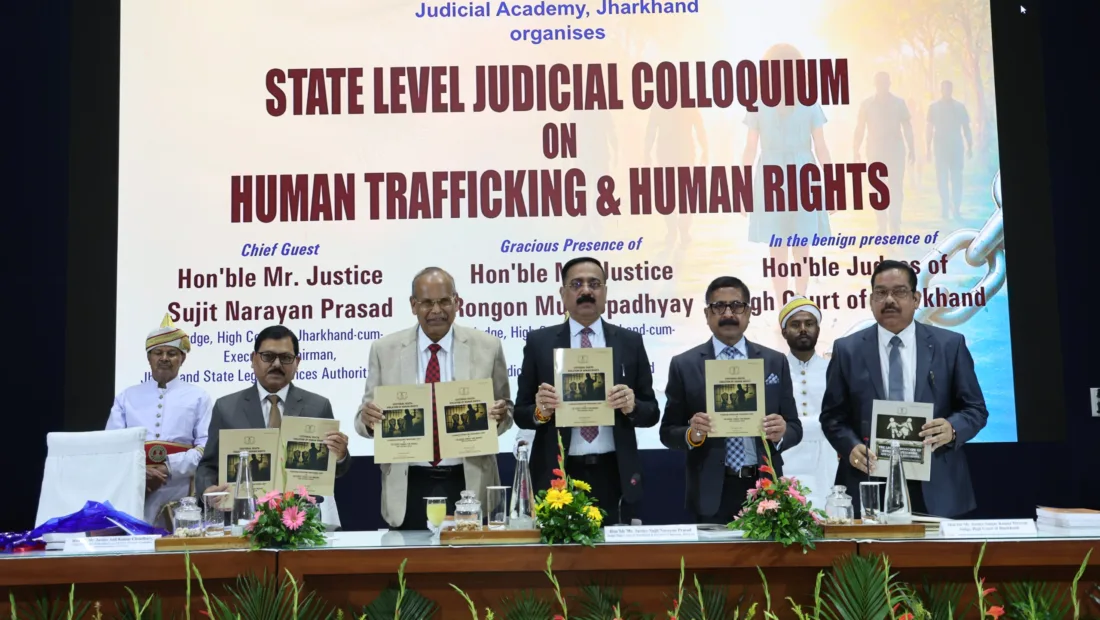
Ranchi, August 23: Justice Sujit Narayan Prasad, Judge of the Jharkhand High Court and Executive Chairman of the Jharkhand State Legal Services Authority (JHALSA), has called for a broader approach to justice in human trafficking cases, stressing that the process must go beyond rescue and prosecution to ensure recovery, rehabilitation, reintegration and prevention of re-trafficking.

Justice Prasad was speaking as the Chief Guest at a state-level conference on “Human Trafficking & Human Rights”, organised by the Judicial Academy, Jharkhand, at the Dr A.P.J. Abdul Kalam Auditorium in Ranchi on Sunday.
The conference brought together judges of the Jharkhand High Court, judicial officers from different cadres, police officers, public prosecutors and other stakeholders to discuss the legal, institutional and human rights challenges associated with human trafficking.
Justice must continue beyond rescue and prosecution
Justice Prasad emphasised that rescuing victims and prosecuting traffickers cannot be the end of the justice process.
He stressed the need to ensure that survivors recover from their trauma, receive adequate rehabilitation and are successfully reintegrated into society. He also underlined the importance of preventing survivors from falling victim to trafficking again.

His emphasis on rehabilitation assumes particular significance as survivors often face social, economic and educational challenges even after being rescued from trafficking.
High Court judges stress victim-sensitive justice
Justice Pradeep Kumar Srivastava, Judge of the Jharkhand High Court, delivered the welcome address and outlined the objectives of the conference. He highlighted the challenges posed by human trafficking and discussed possible solutions to address the problem.

Justice Rongon Mukhopadhyay, Judge of the Jharkhand High Court and Judge-in-Charge of the Judicial Academy, also attended the programme.
Justice Sanjay Kumar Dwivedi and Justice Anil Kumar Choudhary, Judge of the Jharkhand High Court and Member of the Executive Committee of the Judicial Academy, respectively, also addressed the participants.
They emphasised the need for a victim-sensitive, human rights-based justice process, backed by institutional coordination and effective investigation.
The judges highlighted the importance of protection, legal aid, medical care, rehabilitation, compensation, witness protection and livelihood support. They also stressed that survivors should be treated as active rights-holders in the justice process.
Survivors share stories of trafficking
The conference also allowed survivors of human trafficking to share their experiences.
Their accounts brought the lived reality of trafficking to the forefront, highlighting the experiences of exploitation and rescue as well as the challenges survivors continue to face while rebuilding their lives.
During the programme, Justice Rongon Mukhopadhyay and other judges of the Jharkhand High Court felicitated the survivors.
The judges emphasised the importance of their successful reintegration into society, particularly by ensuring access to education and opportunities that can help them rebuild their lives with dignity.
Former NDRF DG highlights emerging trafficking trends
Dr P.M. Nair, former Director General of the National Disaster Response Force and former Nodal Officer, Anti-Human Trafficking, National Human Rights Commission, spoke at length on the dimensions and emerging trends of human trafficking.
He discussed the challenges confronting various stakeholders and highlighted responses and good practices needed to tackle the problem effectively.
Rachna Tyagi and Madhulika Mohta, Advocates of the Supreme Court of India, also addressed the conference on legal challenges involved in the trial of human trafficking cases.
Senior Jharkhand government officers Manoj Kaushik and Kiran Pasi shared their insights on the rehabilitation of victims and survivors.
Two publications released
Two important publications were formally released during the inaugural programme.
These were “The Legal Landscape of Human Trafficking and Landmark Judgements” and “Custodial Deaths: Violation of Human Rights – A Standing Operating Procedure (SOP) and Model Format for Inquiry into Custodial Deaths.”
The publications seek to provide legal and institutional resources relating to human trafficking, landmark judicial decisions and inquiries into custodial deaths.
Judicial Academy stresses coordinated response
The conference highlighted that combating human trafficking requires coordinated action by the judiciary, police, prosecution, government agencies and legal services institutions.
The discussions placed particular emphasis on ensuring that survivors receive support not only during rescue and prosecution but throughout the longer process of rehabilitation and reintegration.
The programme concluded with a vote of thanks proposed by Rajesh Sharan Singh, Director, Judicial Academy, Jharkhand, who expressed gratitude to the dignitaries, speakers, survivors, participants and other stakeholders for their contribution to the programme.