
Jharkhand cadre IAS officer Dr Manish Ranjan’s eight-book AI series: An inheritance for the intelligent age
THE JHARKHAND STORY NETWORK here are books that explain technology, and then there are books that attempt to explain what technology is doing…
THE JHARKHAND STORY NETWORK
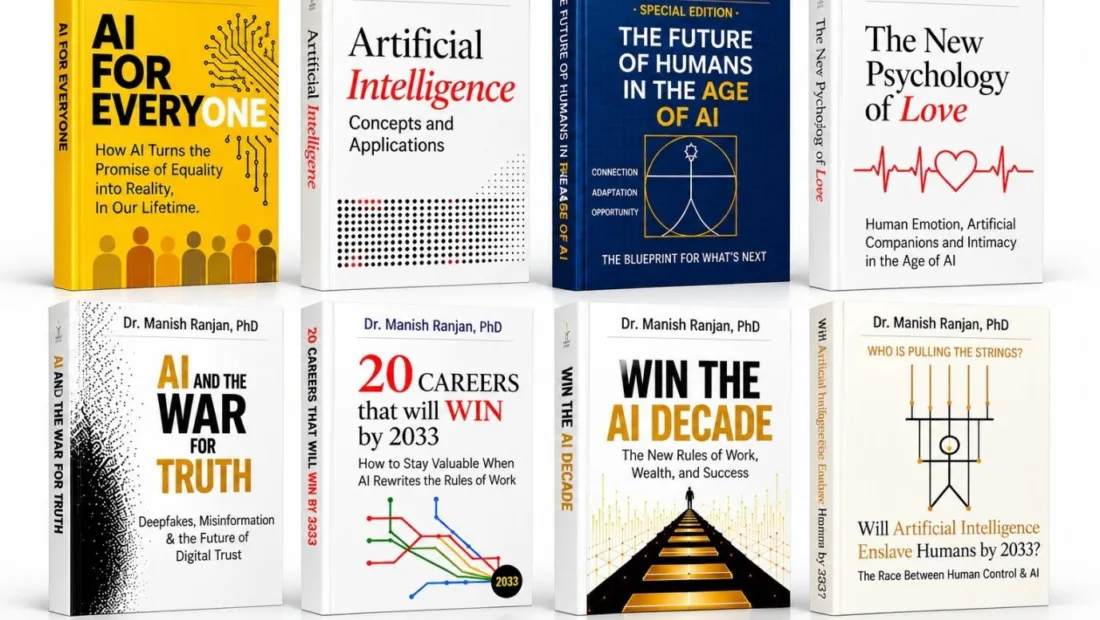
here are books that explain technology, and then there are books that attempt to explain what technology is doing to society. Dr. Manish Ranjan’s eight-volume series, “The AI Series: From AI Basics to the Future,” seeks to do both.
Dr Manish RanjanWhat makes the series particularly distinctive is the perspective from which it has been written. Dr Manish Ranjan is a Jharkhand cadre Indian Administrative Service officer, bringing to the discussion of Artificial Intelligence the perspective of a public administrator who has seen how policy, technology and institutions ultimately affect ordinary citizens.
His academic background includes Berkeley’s Goldman School and Oxford’s Saïd Business School. That combination of public administration, management education and an engagement with emerging technology informs a series that is less concerned with technical jargon and more interested in a larger question: How should human beings prepare themselves for a world increasingly shaped by intelligent machines?
That is a timely question.
Artificial Intelligence has moved rapidly from the specialised vocabulary of computer scientists into the everyday lives of students, professionals, teachers, administrators, businesses and families. Generative AI, automation, deepfakes and machine-assisted decision-making are no longer distant possibilities. They are becoming part of ordinary life.
Ranjan’s eight books attempt to make sense of that transformation from multiple angles—from the fundamentals of AI to employment, equality, governance, human relationships, misinformation and the future of human agency.
Taken together, they read less like eight unrelated books and more like chapters in one extended conversation about the AI age.
Beginning with the Basics
The first volume, “Artificial Intelligence: Concepts and Applications,” provides the foundation.
Its principal strength is accessibility. Rather than assuming that readers have an engineering or computer-science background, the book explains how AI systems learn from data and where they are already being used.

Banking, agriculture, healthcare and education become practical entry points for understanding a technology that can otherwise appear intimidatingly abstract.
This approach is important because AI literacy is unlikely to remain the preserve of technology professionals. Citizens increasingly encounter automated systems as consumers, employees, students and users of public services.
The ability to understand an AI-generated answer—and, equally importantly, to question it—could become one of the defining skills of the coming decades.
AI and the Promise of Equality
The second volume, “AI for Everyone: How AI Turns the Promise of Equality into Reality,” shifts the discussion from technology to social possibility.
Ranjan explores how AI could extend access to expertise in areas where human resources remain limited. The examples are straightforward but potentially transformative: an AI-enabled tutor supporting a child in a remote village, agricultural assistance reaching farmers through mobile technology, or digital tools helping extend medical expertise to underserved communities.
The book’s strength lies in asking readers to consider AI not merely as a productivity tool but as a possible instrument for widening access.
Yet the promise of technology also comes with conditions. AI cannot automatically eliminate inequality. Connectivity, affordability, quality of data, institutional capacity and human oversight will determine whether its benefits actually reach those who need them most.
For India, where technological opportunity exists alongside substantial disparities in access, this question is particularly significant.
Preparing for the Future of Work
The third volume, “20 Careers That Will Win by 2033: How to Stay Valuable When AI Rewrites the Rules of Work,” tackles perhaps the most immediate concern surrounding AI: employment.
Ranjan examines emerging career possibilities across technology, healthcare, education and the creative economy while considering how existing professions could change as AI becomes more deeply embedded in the workplace.
One of the series’ recurring ideas is that the future should not necessarily be viewed as humans versus machines. Instead, people may need to learn how to work effectively alongside increasingly capable systems.
Judgment, empathy, creativity, communication and accountability consequently become important complements to technological capability.
For students and young professionals, the message is straightforward: the value of a qualification may increasingly depend on what a person can actually do with knowledge and technology.
The Rules of the AI Economy
“Win the AI Decade: The New Rules of Work, Wealth and Success” develops the employment argument further.
The book is more practical in orientation, focusing on the habits and approaches that individuals may need as technology changes the workplace.
Its central question is one that many professionals are already confronting: How does one remain valuable when the tools used to perform a job are changing rapidly?
Rather than treating technological change as something that can be resisted indefinitely, Ranjan encourages readers to understand it and adapt to it.
The book therefore works particularly well as a bridge between the larger social questions raised by the series and the practical concerns of individual readers.
The Future of Humans
With “The Future of Humans in the Age of AI,” the series moves beyond jobs and productivity.
The focus shifts to society itself.
If AI changes how people learn, work and communicate, how will it alter human relationships and institutions? What happens when decisions traditionally made by people increasingly involve algorithms? And what qualities will remain essential in a society where machines can perform an expanding range of cognitive tasks?
Ranjan places learning, adaptation, connection and opportunity at the centre of this discussion.
The volume gives the series a broader philosophical dimension, reminding readers that the AI debate is ultimately not only about machines. It is about the kind of society humans want to build around them.
When Machines Enter Human Relationships
Perhaps the most unconventional volume is “The New Psychology of Love: Human Hearts, Machine Minds.”
Here, Ranjan turns from economics and employment to intimacy.
As AI systems become capable of sustained conversations and increasingly personalised responses, some people are beginning to use machines for companionship, advice and emotional interaction.
The book examines the possible implications for loneliness, friendship, family relationships and professional bonds. It also raises questions about how technology may alter people’s understanding of emotional connection itself.
Its underlying distinction is important: a machine can simulate attentiveness, but human relationships involve choice, reciprocity and responsibility.
This volume adds an emotional dimension to a series otherwise dominated by questions of technology, work and public policy.
The Fight for Digital Trust
“AI and the War for Truth: Deepfakes, Misinformation and the Future of Digital Trust” addresses one of the most urgent consequences of increasingly sophisticated AI.
Deepfakes and synthetic media can make fabricated audio, images and videos appear convincing. The implications extend well beyond individual deception.
If people become unable to distinguish authentic material from sophisticated fabrications, trust in genuine information can also begin to weaken.
That makes verification an increasingly important skill in the digital age.
Ranjan’s discussion of deepfakes and misinformation is therefore not simply about identifying false content. It is about the larger infrastructure of trust on which journalism, public institutions, businesses and democratic societies depend.
Will Humans Remain in Control?
The final volume, “Will Artificial Intelligence Enslave Humans by 2033?”, takes up perhaps the most provocative question in the collection.
Can human beings retain meaningful control as machine capabilities continue to expand?
The book explores the tension between technological capability and human oversight. Its concern is less with the imagery of science fiction than with the possibility of gradual dependence.
One of its most memorable propositions is that loss of autonomy need not arrive dramatically. It could occur through a succession of small choices in which convenience increasingly replaces human judgment.
The title is deliberately provocative, but the underlying question is serious: Who ultimately makes the important decisions when machines become capable of making more of them?
A Jharkhand Administrator’s Perspective
The Indian context is one of the series’ most interesting dimensions.
AI is often discussed through the lens of Silicon Valley, technology companies and global laboratories. Ranjan brings a different perspective—that of an Indian civil servant who has worked within the machinery of government.
His position as a Jharkhand cadre IAS officer gives the series particular relevance for readers interested in the intersection of technology and governance.
For states such as Jharkhand, AI is not merely a question of futuristic technology. It has potential implications for the delivery of public services, education, healthcare, agriculture, welfare programmes, resource management and administrative decision-making.
The larger challenge, however, is ensuring that technological advancement does not deepen existing digital divides.
That is why the Indian perspective running through the books is useful. The AI conversation cannot simply be imported from technologically advanced economies; it has to be examined in the context of India’s own social, economic and administrative realities.
Accessible but Broad in Scope
The eight-volume project is ambitious, and its breadth is both its principal strength and an occasional limitation.
Ideas recur across the books, particularly around adaptability, human judgment and the need to work with rather than simply against technology.
Readers with strong technical backgrounds may also find the engineering treatment relatively brief. But this appears consistent with the larger purpose of the series.
These are not specialist textbooks designed primarily for engineers building AI systems. They are books intended to make a rapidly changing technological landscape understandable to a broad readership.
That makes accessibility one of their most important features.
An Inheritance of Knowledge
The most effective way to understand the eight books may be through the idea of inheritance.
Families traditionally prepare for the future by accumulating financial assets. They buy insurance, save money, acquire property and write wills.
But the next generation will inherit something more complicated than material assets. It will inherit a world in which intelligent machines are increasingly embedded in work, education, communication, government and personal life.
The question, then, is not simply what we leave behind, but whether we have prepared the next generation to understand what it is inheriting.
That is the larger contribution of Dr. Manish Ranjan’s series.
The books cannot predict exactly what Artificial Intelligence will look like in 2033—or in the decades that follow. No eight-volume series can. What they can do is encourage readers to understand the forces already reshaping society and to approach them with curiosity rather than either blind enthusiasm or unnecessary fear.
For students, professionals, educators, administrators and general readers trying to make sense of AI, “The AI Series: From AI Basics to the Future” offers a broad and accessible starting point.
In that sense, these eight books are more than a discussion of machines.
They are an argument for preparing people.
And perhaps that is the most useful inheritance in an age when the future is being written, increasingly, by both humans and machines.