From Rule-taker to Rule-shaper: India and BRICS 2026
DR RACHNA K PRASAD The 2026 BRICS Summit in New Delhi marks a definitive pivot in the structural architecture of international relations,…
DR RACHNA K PRASAD

The 2026 BRICS Summit in New Delhi marks a definitive pivot in the structural architecture of international relations, signalling the maturation of a post-Western normative order. Under India’s chairmanship, the forum has transitioned from a consultative body into a primary vehicle for the de-risking of global governance. India has emerged as a power, leveraging its strategy of multi-alignment to hedge against bipolar volatility while serving as the essential interlocutor between the “Old Guard” of the G7 and the “Emerging Engines” of global growth.
The New Delhi summit was designed not as an “anti-West” provocation, but as a “non-West” platform dedicated to restorative justice for the Global South. India’s leadership codified this shift through three strategic pillars:
- Inclusive Governance: Dismantling the gatekeeping mechanisms of legacy institutions to ensure emerging economies possess proportional decision-making equity.
- Reinvigorated Multilateralism: Modernising the global apparatus to reflect the demographic and economic imperatives of the 21st century rather than the 1945 status quo.
- Structural Reform: Creating institutional safeguards against unilateral economic coercion and the weaponization of global financial networks.
India’s “middle path” diplomacy is the cornerstone of this transition. By maintaining strategic autonomy, simultaneously engaging with Israel’s security concerns while hosting Iranian leadership, New Delhi has demonstrated that “Civilizational State Diplomacy” can stabilize regions where Western binary frameworks have failed. This diplomatic dexterity is not merely a philosophical choice; it is a pragmatic response to an irreversible economic rebalancing.
The Great Economic Rebalancing: BRICS vs. G7
The global centre of gravity has fundamentally migrated toward the collective weight of the expanded BRICS+ bloc. The G7’s historical dominance is no longer a reflection of current productivity or demographic reality, but a vestige of a fading era of maritime and financial hegemony.
BRICS 2026: Changing the Global Economic Balance
Economic Weight Comparison (2026)

| Category | G7 Representation | BRICS Representation |
| Global GDP Contribution | 29% | 40% |
| Global Population Representation | 10% | 50% |
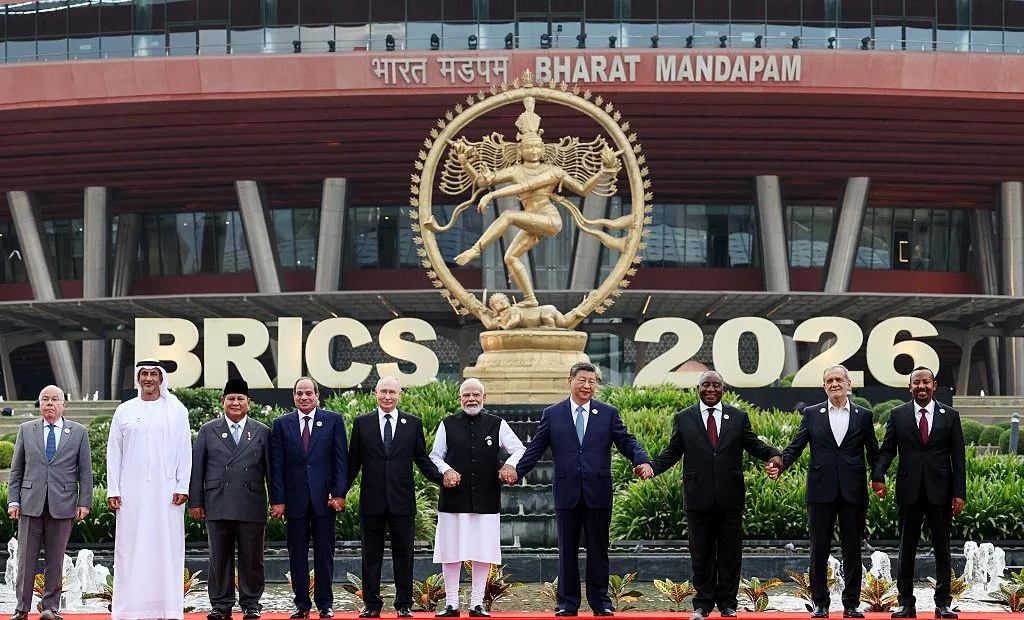
The “Old Leaders,” once the vanguard of growth, have been superseded by what Vladimir Putin characterized as the “New Engines of Growth.” This collective, comprising India, Russia, China, Iran, Saudi Arabia, the UAE, Brazil, and South Africa is supported by a second tier of “Secondary Aspirants” including Malaysia, Vietnam, Ethiopia, and Uzbekistan.
The strategic impact of this shift is profound. While the G7 remains a restrictive “Elite Club” defined by declining relative growth, BRICS has adopted a democratic expansion model that integrates the world’s most vital energy producers and consumption markets. This economic leverage was the necessary prerequisite for the diplomatic breakthroughs achieved in New Delhi, forcing a recalibration of how global consensus is manufactured.

Diplomatic Miracles: The New Delhi Declaration
The New Delhi Declaration was a masterclass in navigating “mini-lateral” friction. The summit’s success stood in stark contrast to the May 2026 Foreign Ministers’ meeting, which collapsed after Iran demanded an explicit condemnation of Israeli/US actions—a move the UAE blocked, leading to a total breakdown in consensus. Between May and September, tensions escalated further as the UAE threatened to suspend trade with Tehran following Iranian ballistic missile attack and maritime blockade.
As the “Host-Mediator,” Prime Minister Modi navigated these “Nervous Uncle” (fufa) dynamics through intensive bilateral engagement. A significant breakthrough was achieved via the Modi-Xi bilateral, facilitated by the presence of Cai Qi, the “No. 2” in the Chinese hierarchy. Cai Qi’s reputation as a pragmatic, pro-India strategist allowed for a softening of the Sino-Indian border narrative, enabling the broader BRICS consensus. Sherpa negotiations, lasting until 4:00 AM, eventually produced a 140-paragraph, 45-page document.
The declaration utilized a sophisticated “Language of Ambiguity” regarding West Asian escalations. By addressing “regional stability” and “restraint” without naming specific parties, India allowed both Iran and the UAE/Saudi Arabia to feel their specific security grievances were validated. This allowed 11 diverse nations to sign a unified text, effectively leveraging their collective voice to demand structural reforms in international security.
Decolonising Global Security and Sovereignty
The New Delhi Declaration asserts that the UN Security Council (UNSC) is a relic of post-1945 victors’ spoils that lacks contemporary legitimacy. A historic milestone was reached with the inclusion of documentary evidence of China and Russia’s stated support for an increased role for India and Brazil in the UNSC. For New Delhi, this provides a vital diplomatic record to hold Beijing accountable in future institutional negotiations.
On the security front, the declaration took a definitive stance on terrorism, reflecting India’s uncompromising regional imperatives:
- The Pahalgam Precedent: The document explicitly condemned the terror attack in Pahalgam, Jammu & Kashmir (April 22, 2025), grounding the summit’s rhetoric in factual tragedy.
- Zero Tolerance: It demanded a rejection of “Double Standards,” dismantling the Western-curated binary of “Good vs. Bad Terrorists.”
Furthermore, the declaration’s support for the “Two-State Solution” based on 1967 borders and the protection of “Peaceful Nuclear Facilities” serves as a direct signal to Washington and Tel Aviv. By codifying these positions, BRICS asserts that international law must be applied uniformly, challenging the unilateralism that has defined West Asian policy for decades.
Institutional Reform: Financial Sovereignty and BRICS Pay
A cornerstone of India’s chairmanship is “Financial Decolonisation”—the creation of alternatives to Western-led systems like SWIFT, which have been weaponized as tools of geopolitical discipline.
Central to this is BRICS Pay, a sophisticated “Payment Gateway” for local currency trade settlement. It is not a single currency, but a system designed to:
- Bypass Secondary Sanctions: Allowing sovereign nations to conduct trade without the oversight of the US Treasury.
- Mitigate Dollar Dependency: Reducing systemic exposure to the volatility of the Greenback.
- Ensure Maritime Security: Facilitating trade across “Uninterrupted Sea Lanes” by decoupling logistics from Western financial hubs.
Complementing this is the New Development Bank (NDB), which acts as a counterweight to the “Bretton Woods Twins” (IMF/World Bank). The summit’s most aggressive proposal, however, was the creation of a BRICS-led maritime insurance and reinsurance entity. This is the final nail in the coffin for Western maritime legal hegemony; by controlling the insurance terms of Global South cargo, BRICS dismantles the West’s ability to use “unilateral sanctions” to freeze global shipping at will.
The Global South Mandate: Africa’s Resource Sovereignty
The expanded BRICS+ framework has pivoted the African narrative from extraction to investment. South African President Cyril Ramaphosa articulated a mandate for “Mineral Sovereignty,” noting that the continent holds $3.5 trillion in reserves, including Platinum, Manganese, and Chromium.
Ramaphosa demanded that foreign powers transition from “extractive colonialism” to “local job creation.” India’s “Make in India” philosophy is now being exported as a template for African nations to develop value-added industrial hubs. By aligning African resource wealth with BRICS financial tools, the bloc is ensuring that the “Old Guard” can no longer dictate the price or the process of resource utilization in the Global South.
The Irreversible Shift to Multipolarity
The 2026 New Delhi Summit was a triumph of strategic autonomy. It proved that the “Voice of the Global South” could manufacture consensus among rivals including the UAE, Iran, China, and India, where Western frameworks only yield fragmentation. The New Delhi Declaration has effectively retired the notion that BRICS is a mere “talk shop.”
India has solidified its role as the architect of a post-Western normative order, bridging the gap between the Russia-China axis and the G7 without surrendering its own strategic imperatives. As the chairmanship moves to China for the 2027 Summit, the New Delhi Declaration provides the “Clear Guidance” for a higher quality of cooperation. The shift to a multipolar world is no longer an aspiration; it is the established reality of the 21st century.
(Dr Rachna K Prasad is Asst Professor Political science Delhi University. She can be contacted at drrachnaprasad24@gmail.com.)