






SUMAN KSHRIVASTAVA
Ranchi, April 5: Jharkhand Chief Minister Hemant Soren has brought renewed attention to the long-pending demand for Scheduled Tribe (ST) status for Assam’s tea garden communities, calling it a “national injustice” in a strongly worded post on ‘X’.
In his message, Soren said: “A truth lies buried on the soil of Assam—a truth that cannot be spoken of enough, nor shared widely enough. The tribal community, which has resided in Assam’s tea gardens for generations, has yet to receive the constitutional status of Scheduled Tribes (ST) to this day. This is no ordinary oversight; it is an injustice of national magnitude—an injustice that history will never forgive.”

He added, “Just imagine: those whom the British forcibly uprooted from their homes and bound to this very soil—those who built Assam’s economy with their own blood and sweat—have, to this day, been denied recognition of their very existence.”
“Even decades after independence, governments changed and leadership shifted, yet the suffering of this community remained unchanged. The most distressing aspect is that even those who made grand promises failed to prioritise this issue.”
“In fact, even the parties currently in power did not deem it worthy of inclusion in their election manifestos.”
Chief Minister Hemant Soren asked, “Shouldn’t the question be raised as to why an entire community has been systematically deprived of its constitutional rights?”
“As long as justice remains incomplete, democracy, too, remains incomplete.” “I wish to state this unequivocally: this issue transcends the realm of politics. It is a matter of justice, dignity, and identity. The tribal community of Assam can no longer be made to wait.”
“They must receive their rights—their full rights, their constitutional rights—and they must receive them with dignity. The time has come for the nation to acknowledge this injustice and rectify it.”
“For as long as justice remains incomplete, democracy, too, remains incomplete.”
Campaign Backdrop and Political Ripples
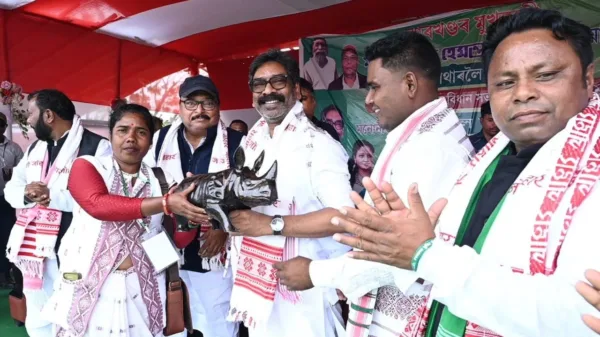
Soren’s remarks come as he has been camping in Assam for several days, actively campaigning for the upcoming Assembly elections. The Jharkhand Mukti Morcha (JMM) has fielded 18 candidates, mainly in Upper Assam constituencies with a significant presence of tea garden tribal workers.
ALSO READ: The “Safety Net” Shift: How India’s new VB-GRAM G Act reimagines rural employment
While the statement focuses on justice and identity, it also aligns with the JMM’s broader outreach to tea tribes, positioning the party as a voice for their long-standing demands.
However, the move has created unease within the Congress, the JMM’s ally in Jharkhand. Congress leaders, including three ministers from the state, are also campaigning in Assam. Privately, some leaders argue that JMM’s entry could split tribal votes and indirectly benefit the BJP.
A senior Congress leader, speaking off the record, said Soren should clarify whether the JMM would align with the Congress or the BJP if it wins seats in Assam.
Alliance Strains Surface
The tension has led to sharp exchanges between the two parties. JMM general secretary Supriyo Bhattacharya recently described the Congress as a “poisonous snake,” prompting a strong response.
Congress in-charge K. Raju, addressing a press conference, targeted the JMM-led government in Jharkhand, alleging that “mining mafias are ruling the roost” in the state.
Adding to the political buzz, JD(U) MLA Saryu Roy suggested that the JMM, which has 34 MLAs in Jharkhand, could consider forming a government without the Congress’ support. He later clarified that his comment was casual and not part of any political strategy.
A Larger Political Context
Soren’s intervention has placed the issue of ST status for Assam’s tea garden communities at the centre of political discourse. At the same time, his party’s electoral push in the state has introduced new complexities within opposition politics.
As campaigning intensifies, the intersection of social justice messaging and electoral strategy is likely to remain a key theme in Assam’s political landscape.