After 25 years, Bihar-Jharkhand reach deal on Son River water sharing
THE JHARKHAND STORY NETWORK New Delhi, August 31: After nearly 25 years of differences, Bihar and Jharkhand have reached an agreement on…
THE JHARKHAND STORY NETWORK
New Delhi, August 31: After nearly 25 years of differences, Bihar and Jharkhand have reached an agreement on sharing the waters of the Son River, paving the way for improved irrigation and drinking water availability in several districts of both states.

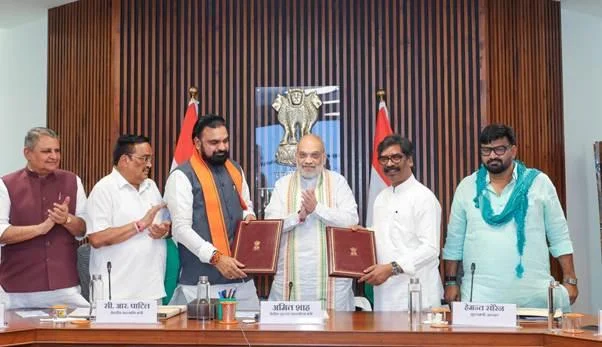
A Memorandum of Understanding (MoU) was signed in New Delhi on Monday in the presence of Union Home and Cooperation Minister Amit Shah, with Jharkhand Chief Minister Hemant Soren and Bihar Chief Minister Samrat Choudhary attending the ceremony.
Under the agreement, Bihar will receive 5.75 million acre-feet (MAF) of Son River water, while Jharkhand will be allocated 2.00 MAF.
For Jharkhand, the agreement is particularly significant for Palamu and Garhwa districts and adjoining areas, where improved availability of Son River water is expected to strengthen irrigation and drinking water resources.
The agreement is also expected to provide greater water security to large rural populations dependent on agriculture and groundwater sources.

For Bihar, the arrangement is expected to benefit districts including Bhojpur, Buxar, Rohtas, Kaimur, Aurangabad, Arwal, Gaya and Patna.
The agreement brings to an end a long-pending issue between the two neighbouring states and is being viewed as an example of cooperative federalism and inter-state dialogue.
ALSO READ: Delimitation Rally: Congress challenges JMM’s tribal stronghold, puts BJP on alert

Amit Shah hails cooperative federalism
Amit Shah said long-standing inter-state issues could be resolved when states approach them with a spirit of dialogue, cooperation and mutual understanding.
He described the Son River agreement as an example of Prime Minister Narendra Modi’s vision of ‘Team India’, saying cooperation between states was essential for ensuring development and better utilisation of natural resources.
The Union Home Minister said the agreement would help provide irrigation water to lakhs of farmers in Bihar and Jharkhand while also strengthening drinking water availability for a large population.
Soren thanks Centre
Hemant Soren expressed his gratitude to Prime Minister Narendra Modi and Amit Shah for helping resolve the long-pending Son River water-sharing issue.
The Jharkhand Chief Minister said the agreement would strengthen water resources in the state’s drought-prone Palamu and Garhwa regions and give fresh momentum to development activities.
Bihar Chief Minister Samrat Choudhary also thanked the Prime Minister and the Union Home Minister for facilitating the agreement.
The signing ceremony was attended by Union Jal Shakti Minister C.R. Patil, Bihar’s Deputy Chief Ministers, Jharkhand Water Resources Minister Hafizul Hasan, Jharkhand Chief Secretary Avinash Kumar, Water Resources Department Secretary Prashant Kumar, Resident Commissioner of Jharkhand Bhawan Arva Rajkamal and senior officials from the Centre and both states.
Series of inter-state water agreements
The Centre said the Son River agreement is part of a broader effort to resolve water and other inter-state issues through dialogue and institutional mechanisms.
Several significant agreements concerning water-related disputes have been reached between states this year through the Inter-State Council.
These include a consensus among Himachal Pradesh, Uttarakhand, Delhi, Uttar Pradesh, Haryana and Rajasthan on the Kishau Multipurpose Dam Project on June 16; an agreement between Rajasthan and Haryana on the Yamuna Water Project on June 29; and an agreement among Madhya Pradesh, Gujarat, Rajasthan and Maharashtra on July 7 to resolve payment-related disputes concerning the Narmada Project.
The Son River agreement is particularly important for Bihar and Jharkhand because the two states have shared the river system since Jharkhand was carved out of Bihar in 2000.
The resolution of the dispute after nearly 25 years is expected to provide greater clarity over water utilisation and enable both states to plan irrigation and drinking water projects more effectively.