






SUMAN K SHRIVASTAVA
Ranchi, January 17: As Chief Minister Hemant Soren leads a state delegation to Davos for the World Economic Forum (WEF) Annual Meeting, Jharkhand is positioning itself on the global stage as a nature–culture tourism destination, where development is shaped by coexistence between landscapes, indigenous communities and living traditions.
Marking 25 years of statehood, the state is reimagining its development trajectory—from one historically linked to extraction to a future increasingly defined by sustainable tourism, responsible investment and community-led growth. At Davos, tourism is being projected as a strategic pillar of Jharkhand’s next phase of development.
From Extraction to Attraction: A New Tourism Narrative
Jharkhand’s evolving tourism vision reflects a conscious shift toward attraction-led development, aligned with global conversations on sustainability. Under the leadership of Chief Minister Hemant Soren, tourism is being positioned as a driver of livelihoods, cultural preservation and ecological balance, offering long-term opportunities for local communities.

Geography as the Foundation of Tourism
Situated largely on the Chotanagpur Plateau, Jharkhand’s terrain of forested uplands, rocky river systems and mineral-rich hills defines its tourism identity. Iconic waterfalls such as Hundru, Dassam, Jonha and Lodh are integral to everyday life, influencing agriculture, movement and belief systems, rather than existing as isolated attractions.
Ranchi: Gateway to Nature and Connectivity
The state capital, Ranchi, often referred to as the City of Waterfalls, serves as the primary gateway for visitors. With expanding road, rail and air connectivity, Ranchi combines administrative significance with immediate access to forests, hills and lakes, offering a practical base for nature tourism circuits.
Indigenous Culture at the Core
Nearly two-fifths of Jharkhand’s population belongs to indigenous communities whose languages, festivals, rituals and art forms continue as living traditions. Festivals such as Sarhul, Karam, Sohrai and Tusu, and art forms including Sohrai and Kohbar painting, Paitkar art, Dokra metalwork and Chhau masks, position Jharkhand as a destination for authentic cultural tourism rooted in continuity.
Spiritual, Historic and Megalithic Landscapes
Jharkhand’s tourism map is further enriched by spiritual and heritage sites such as Baidyanath Dham (Deoghar), Rajrappa, Deori Mandir and Pahadi Mandir, alongside Maluti temples, Palamu Fort and ancient megalithic landscapes, where history and nature coexist seamlessly.
McCluskieganj: A Distinctive Heritage Retreat
Adding a unique layer to the state’s tourism profile is McCluskieganj, an Anglo-Indian settlement known for its colonial-era architecture, forested surroundings and tranquil atmosphere, emerging as a niche heritage and leisure destination.
Adventure and Experiential Tourism Gains Momentum
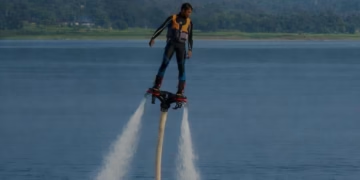
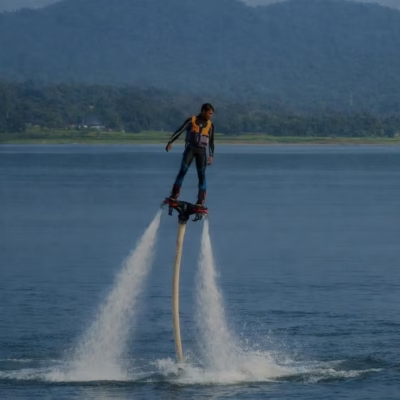
Jharkhand’s diverse terrain supports a growing portfolio of adventure tourism, including trekking, trail cycling, rock climbing, waterfall rappelling, paragliding and river-based activities. The state’s strong sporting culture in hockey and archery, along with endurance and aviation sports, is increasingly supported by community-led initiatives.
Investment Opportunities at Davos
At the World Economic Forum, Jharkhand is inviting responsible global investment in eco-tourism, heritage conservation, adventure infrastructure, hospitality and community-based tourism. The emphasis remains on sustainability, cultural sensitivity and long-term value creation.
As Jharkhand steps onto the global stage at Davos, tourism emerges as a powerful bridge between its past and future—transforming landscapes of legacy into landscapes of opportunity through continuity and coexistence.
