
Beyond the Ballot: How the 2026 Bengal election could redefine India’s most fragile frontier
There are game-changing shifts that followed the election, weaving together security, diplomacy, infrastructure, and governance. It is not a neat story of…
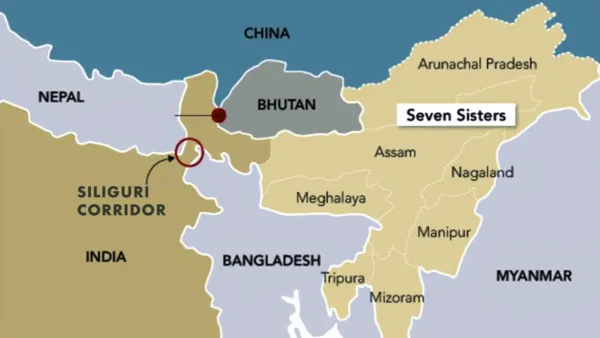
Siliguri corridor

There are game-changing shifts that followed the election, weaving together security, diplomacy, infrastructure, and governance. It is not a neat story of triumph but a layered narrative of how politics and geography collide.
There are places on a map that look ordinary until history suddenly remembers them.
The Siliguri Corridor is one of those places.
At first glance, it appears to be just another narrow strip of land in North Bengal. But zoom out, and the picture changes dramatically. This tiny corridor—barely 20 to 22 kilometres wide at its narrowest point—is the only land connection between mainland India and the eight northeastern states. Everything passes through it: military convoys, fuel tankers, railway lines, telecom cables, medicines, food supplies, and millions of ordinary journeys.
For decades, policymakers referred to it with an uneasy nickname: the “Chicken’s Neck.” The phrase itself carried anxiety. A neck can nourish the body, but it can also be choked.
What changed after the 2026 West Bengal Assembly election is not merely the political party governing Kolkata. What changed is the strategic imagination surrounding the corridor itself. The Bharatiya Janata Party’s victory and the end of prolonged confrontation between the state government and the Centre have created something India rarely experiences in sensitive border regions—policy alignment.
Whether one supports or opposes the politics behind this transition is a separate debate. Yet it is difficult to deny that the election has triggered a series of shifts that could reshape India’s eastern frontier for decades.

The implications go far beyond Bengal.
They touch national security, federalism, diplomacy with Bangladesh, China’s growing regional footprint, infrastructure planning, and even the economic future of the Northeast. In a way, the 2026 election may eventually be remembered less as a state election and more as a geopolitical turning point.
The Geography India Could Never Ignore
To understand why this election matters so deeply, one has to first appreciate the strange vulnerability of the Siliguri Corridor.

India’s Northeast is home to more than 45 million people and shares international borders with China, Myanmar, Bangladesh, Bhutan, and Nepal. Yet the region is connected to the Indian mainland through a strip so narrow that in some stretches a disruption lasting even a few days could create enormous logistical complications.
Military strategists have worried about this for years. Natural disasters make the anxiety worse. North Bengal and adjoining areas are flood-prone, landslide-prone, and seismically active. Rail tracks are vulnerable. Roads get choked. River systems shift unpredictably.
And then there is the geopolitical reality.
To the west lies Nepal. To the south, Bangladesh. Bhutan sits to the east. China looms to the north through the Himalayan frontier. Few places in the world compress so many strategic variables into such a tiny space.
For years, India treated the corridor primarily as a vulnerability to be defended. What appears to be emerging now is a very different doctrine: transform the corridor from a weak point into a hardened strategic hub.
That shift in thinking changes everything.
The End of the “Bengal Gap”
One of the least discussed but most consequential problems in eastern India has been the incomplete fencing along sections of the India–Bangladesh border in West Bengal.
The issue was never simply about barbed wire. It reflected a larger breakdown in coordination between the state government and the Centre. Land acquisition delays, administrative resistance, political disagreements, and local tensions meant that several stretches remained porous long after other sectors had been secured.
This created what security officials informally called the “Bengal Gap.”
The consequences were tangible. Smuggling networks adapted quickly. Counterfeit currency routes exploited weak zones. Criminal groups used the border fluidly. Illegal cattle trade flourished in certain pockets. Security agencies repeatedly argued that gains made elsewhere were undermined because the Bengal sector remained inconsistent.
Assam Chief Minister Himanta Biswa Sarma’s remarks after the election were unusually direct. He essentially argued that even if Assam strengthened enforcement, loopholes in Bengal weakened the broader regional security architecture.
Critics may dismiss such statements as political rhetoric. Yet there is a structural truth beneath them: borders cannot function effectively when adjacent states operate under competing strategic priorities.
The 2026 result appears to have altered that equation overnight.
Suddenly, the language changed from confrontation to synchronization. The Centre, Assam, and Bengal began speaking in the vocabulary of “joint security management.” A 45-day target for resolving pending land allocation issues was announced with surprising urgency.
Whether that timeline proves realistic is another matter. India’s bureaucracy has a habit of stretching ambitious deadlines into long procedural marathons. Still, the intent itself matters. For the first time in years, the Bangladesh border in eastern India is being treated as one integrated national security frontier rather than fragmented state-level jurisdictions.
That alone is a significant departure.
India Is Going Underground
Some infrastructure projects reveal more about a country’s anxieties than its speeches do.
The proposed underground railway systems in the Siliguri Corridor fall into that category.
At first, the idea sounds excessive. Why would India spend enormous sums building underground transport links through North Bengal when surface infrastructure already exists?
But the logic becomes clearer once one understands the corridor’s fragility.
Surface infrastructure is exposed. A landslide can cut rail movement. Floods can paralyze highways. In wartime scenarios, visible transport routes become vulnerable targets. Even peacetime congestion creates strategic risk because nearly all northeastern connectivity depends on the same overstretched channels.
An underground system changes the equation.
It creates redundancy. And in strategic planning, redundancy is survival.
The idea of an underground railway network is, therefore, radical but necessary.
Three rationales drive this project. First, disaster resilience: underground transit remains operational even when surface routes are paralysed. Second, security: hardened tracks beneath the earth are far less susceptible to attack. Third, decongestion: bypassing surface traffic ensures smoother movement of goods and personnel.
The proposed network aligns with broader projects already underway: the Sevoke–Rangpo railway link connecting Sikkim to the national rail grid, the Bagdogra airport expansion, and multi-track railway corridors through Uttar Dinajpur, Darjeeling, and Kishanganj.
Taken separately, these may look like infrastructure upgrades. Together, they resemble the early architecture of a hardened logistical spine.
There is another subtle but important shift here. India traditionally built frontier infrastructure slowly, often fearing that better roads might aid an invading force. That thinking dominated for decades along Chinese border regions.
Now the philosophy is almost the opposite: underdevelopment itself is seen as a security risk.
Fast mobility, uninterrupted logistics, and resilient transport networks are increasingly treated as deterrence tools. The Siliguri Corridor is becoming a testing ground for that doctrine.
The Decline of the Kolkata-Centric Model
North Bengal has long carried a quiet grievance.
The region generated wealth through tea, timber, tourism, and trade, yet many residents believed political and economic power remained concentrated around Kolkata. Development, they argued, flowed southward while the frontier districts remained strategically important but economically secondary.
That resentment was not always loud, but it was persistent.
The 2026 political transition appears to have opened the door for a different regional framework—one that positions North Bengal not as a peripheral extension of Kolkata but as a frontier growth zone in its own right.
The proposed institutional ecosystem reflects this shift.
AIIMS Siliguri is expected to serve not just North Bengal but neighbouring states and cross-border populations. Technical institutions like IITs and NITs are being discussed as anchors for a knowledge economy that could slow youth migration. Plans for a National Law University specialising in transboundary issues suggest an attempt to intellectualise frontier governance itself.
Some of these announcements may remain partially aspirational. Indian politics often overproduces institutional promises. Yet even the direction of planning matters.
There is a psychological difference between governing a frontier as a burden and governing it as an opportunity.
The old model viewed the corridor as a narrow passage to be managed. The emerging model views it as a gateway to Southeast Asia.
That distinction aligns closely with India’s Act East Policy.
Darjeeling and the Search for Stability
Every conversation about North Bengal eventually reaches Darjeeling.
The hills are breathtakingly beautiful, but politically, they have rarely been calm for long. Demands for Gorkhaland, periodic unrest, shutdowns, identity politics, and tensions over autonomy have shaped the region for decades.
What makes Darjeeling uniquely sensitive is its geography. Few constituencies in the world sit so close to three international borders simultaneously—Nepal, Bhutan, and Bangladesh—while also remaining within strategic proximity to China.
Instability here is not merely a local law-and-order issue. It has national implications.
That is why the repeated references to a Permanent Political Solution (PPS) matter so much.
The phrase itself has been used before, often without resolution. Scepticism is understandable. The hills have witnessed multiple agreements that temporarily reduced tensions without fully addressing structural demands.
Still, the political environment may now be more conducive than before.
A stable arrangement in Darjeeling would dramatically improve the long-term viability of infrastructure expansion, investment inflows, tourism growth, and military logistics in the corridor. Investors avoid uncertainty. So do governments plan multi-decade projects?
Without internal stability, the broader vision for North Bengal simply cannot work.
This is perhaps the most delicate challenge facing the new political order. Security can be strengthened through fencing and railways. Political trust is much harder to engineer.
The Teesta Equation and the China Factor
Sometimes diplomacy stalls not because nations disagree, but because federal politics intervenes.
The Teesta water-sharing agreement between India and Bangladesh became a classic example of that phenomenon. Despite years of negotiations, the treaty remained frozen largely because the West Bengal government opposed terms it believed would hurt farmers in North Bengal.
The change in government has suddenly reopened the conversation.
For Bangladesh, the Teesta issue is emotionally and economically significant. Water access affects agriculture, livelihoods, and regional stability downstream. Dhaka has repeatedly framed the matter as urgent.
For India, however, the issue now carries an additional geopolitical layer: China.
Beijing has steadily expanded its footprint across South Asia through infrastructure financing, strategic investments, and water diplomacy. If India appears unwilling or unable to resolve long-pending regional concerns, neighbouring countries naturally look elsewhere for leverage and partnerships.
That is the real strategic warning embedded in current discussions.
A Teesta agreement would not merely settle a bilateral dispute. It would strengthen India’s credibility as a regional partner capable of balancing domestic politics with international commitments.
At the same time, the matter remains complicated inside Bengal itself. Water politics are never emotionally neutral. Farmers fear reduced irrigation access. Local ecological concerns are genuine.
Any final agreement will therefore require political finesse, not just diplomatic urgency.
Breaking the “Syndicate Economy”
There is another side to the Siliguri story that rarely enters strategic discussions: the everyday economy of intimidation and informal control.
For years, businesses in parts of Bengal complained about what locals loosely called the “syndicate system.” Construction supplies, labour contracts, local permissions, transport access, and government tenders often passed through politically connected intermediaries.
Not every accusation was true. Some were exaggerated for political effect. Yet enough patterns emerged over time to create a reputation problem.
And reputation matters enormously for investment.
The new administration has framed economic reform in the corridor almost like a cleanup operation. Syndicates, extortion-linked “club culture,” and middleman networks are now being publicly identified as barriers to modernization.
Again, implementation will determine credibility.
Dismantling entrenched informal economies is extraordinarily difficult because they often sustain local patronage systems and employment structures. Crackdowns can create resistance. Sometimes they merely replace one network with another.
Still, the emphasis on transparent e-tendering, logistics modernisation, and industrial ease-of-doing-business reflects a larger ambition: turning Siliguri into a genuine commercial gateway connecting mainland India to Nepal, Bhutan, Bangladesh, and eventually Southeast Asia.
If that transformation succeeds, the corridor could evolve into something closer to a regional trade hub than a defensive bottleneck.
The Bigger Transformation Nobody Is Fully Talking About
What makes the 2026 Bengal election historically significant is not any single policy announcement. It is the convergence of multiple shifts happening simultaneously.
Border management is being centralised more coherently.
Infrastructure planning is becoming militarily informed.
North Bengal is being economically repositioned.
Diplomacy with Bangladesh is being recalibrated.
Internal political stabilisation is being prioritised.
And perhaps most importantly, India is beginning to think of the Siliguri Corridor not merely as territory to defend, but as geography to strategically leverage.
That is a profound conceptual change.
For decades, India’s frontier regions were often viewed through the lens of vulnerability. The Northeast was distant. Borderlands were reactive spaces. Development lagged behind security concerns.
Now the thinking appears more ambitious.
The corridor is increasingly imagined as the physical anchor of India’s eastern century—a bridge connecting South Asia to Southeast Asia under the broader framework of the Act East Policy.
Whether this vision materialises is still uncertain. Grand geopolitical narratives frequently collide with administrative inertia, local politics, environmental constraints, and financial realities.
The terrain itself is unforgiving. Floods will not disappear because governments change. Ethnic tensions cannot be resolved through slogans. Infrastructure projects in ecologically fragile zones carry enormous environmental consequences. And opposition voices will continue questioning whether security rhetoric sometimes masks political centralisation.
Those concerns deserve serious attention.
Yet even after acknowledging all the caveats, one conclusion remains difficult to escape: the 2026 Bengal election has altered the trajectory of India’s eastern frontier in ways that extend far beyond state politics.
The 2026 election did not change the map, but it changed how the map is managed.
Security and infrastructure are being integrated. Diplomacy is being recalibrated. Economic reforms are being enforced. The challenge now is to ensure that these shifts are sustained, that development reaches the frontier, and that the corridor evolves from a “Chicken’s Neck” into a corridor of prosperity. India is trying—perhaps for the first time at this scale—to turn it into a strategic advantage.
And if that experiment succeeds, the consequences will reach far beyond North Bengal. They may redefine how India imagines its borders, its federal structure, and its role in the wider Indo-Pacific region.
(Dr Rachna K Prasad is Assistant Professor of Political Science at Delhi University. She can be contacted at drrachnaprasad24@gmail.com.)