






SUMAN K SHRIVASTAVA

 Ranchi, December 21: In a strong and far-reaching judgment exposing systemic failures in land administration, the Jharkhand High Court has ordered a criminal investigation by the Anti-Corruption Bureau (ACB) against erring government, municipal, and regulatory officials for facilitating illegal constructions on land acquired for the Rajendra Institute of Medical Sciences (RIMS), Ranchi, more than five decades ago.
While acknowledging that the scale and nature of irregularities could justify a CBI probe, the Court consciously refrained from handing the investigation to the Central Bureau of Investigation, opting instead to direct the State Police and Anti-Corruption Bureau to register FIRs and conduct a detailed probe at this stage.

Land Acquired in 1964–65, Yet Illegal Constructions Allowed
The Division Bench of Chief Justice Tarlok Singh Chauhan and Justice Sujit Narayan Prasad traced the controversy to land acquisition proceedings conducted in 1964–65 for the establishment of RIMS, including hospital buildings and hostels. The acquisition was completed under the Land Acquisition Act, 1894, compensation was paid to the landowners, and the land vested absolutely in the State.
Despite this, the Court found that over the years, illegal registrations, mutations, rent receipts, non-encumbrance certificates, building plan sanctions, and even RERA approvals were granted in favour of private individuals and builders, leading to large-scale construction within the RIMS campus.
Encroachments Detected After PIL, Evictions Upheld
The issue came to light during a Public Interest Litigation pending since 2018. Acting on directions of the High Court, the Member Secretary of JHALSA, Kumari Ranjana Asthana, conducted an inquiry and reported encroachments over approximately seven acres of land within the RIMS precincts.
The High Court noted that large-scale unauthorised structures had come up within the acquired RIMS campus, including temples, shops, multi-storey residential buildings, apartments, huts, parks and commercial establishments. These constructions were found on land acquired in 1964–65 for public purposes and vested in the State. The Court observed that such encroachments obstructed hospital services, compromised hygiene and security, and posed serious safety concerns, particularly near the girls’ hostel, where incidents of theft and harassment were reported.
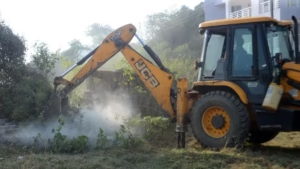
Based on this report, the Court ordered the removal of encroachments on December 3, granting 72 hours to vacate and authorising the District Administration and police to carry out evictions. The Court reiterated that no private ownership can exist within land lawfully acquired for RIMS, a statutory medical institution.
Claims of Title Rejected, Compensation Already Paid
Multiple applicants filed interlocutory applications claiming ownership over Plot Nos. 11 and 1693, relying on 1932 khatiyan records, rent receipts issued as late as 2019, sale deeds, map sanctions, and CNT Act permissions.
After examining original land acquisition records produced by the Deputy Commissioner, Ranchi, the Court held that:
- The land was fully acquired in 1964–65
- Compensation was paid to all predecessors-in-interest
- The plots claimed by applicants fell within the acquired land
The Court ruled that no subsequent revenue or municipal document can revive or create title once land vests in the State.
Section 24(2) Plea Rejected, Supreme Court Law Applied
Applicants invoked Section 24(2) of the 2013 Land Acquisition Act, claiming lapse of acquisition due to alleged possession.
Rejecting the argument, the Court relied on the Constitution Bench judgment in Indore Development Authority v. Manoharlal (2020), holding that Section 24(2) applies only when both possession has not been taken and compensation has not been paid. Since compensation had been paid, the provision was held inapplicable.
The Court further observed that invoking Section 24(2) amounts to an admission of acquisition, contradicting claims that the land was never acquired.
Suppression of Facts, Clean Hands Doctrine Applied
The Bench found that applicants had suppressed material facts by not disclosing acquisition proceedings and receipt of compensation by their predecessors. Citing settled Supreme Court jurisprudence, the Court held that writ jurisdiction being equitable, relief cannot be granted to parties who approach the Court without clean hands.
Anti-Corruption Probe Ordered, CBI Probe Deferred
Taking serious note of the role of officials, the Court directed:
- Registration of FIRs
- Investigation by the Anti-Corruption Bureau against erring revenue officials, Circle Officers, municipal authorities, RERA authorities, and others
- Departmental proceedings against officials involved in illegal registrations, mutations, issuance of rent receipts and non-encumbrance certificates, and sanction of building plans
The Court noted that although it has previously ordered CBI investigations in similar cases involving illegal map sanctions, it is refraining at this stage from handing over the present case to the CBI, reserving that option depending on the outcome of the State-level probe.
Compensation to Affected Residents, But Not at Public Cost
While recognising the hardship faced by residents whose buildings are being demolished, the Court held that the State exchequer cannot be burdened for losses caused by official misconduct.
The Bench directed that:
- Affected residents are entitled to compensation
- Compensation must be recovered from erring officials and builders, not from public funds
Banks, RIMS Authorities Also Under Scanner
The Court expressed shock at the conduct of:
- Banks that sanctioned loans on acquired government land without due diligence
- RIMS authorities, who failed to act despite encroachments within campus precincts
- Municipal and planning authorities, who sanctioned maps and multi-storey constructions
Banks were directed to conduct internal inquiries against responsible officials.
Supreme Court Declined Interference
Special Leave Petitions challenging the High Court’s orders were dismissed by the Supreme Court on December 17, 2025, which declined to interfere while granting liberty to raise appropriate pleas before the High Court.
Next Hearing on January 6, 2026
The matter has been posted for further hearing on January 6, 2026, with the original records ordered to be returned to the authorities.