
Chhattisgarh High Court backs hoardings banning Christian pastors in tribal villages
Ranchi, Nov 7: In a significant ruling touching the intersection of faith, law, and tribal identity, the Chhattisgarh High Court has upheld…
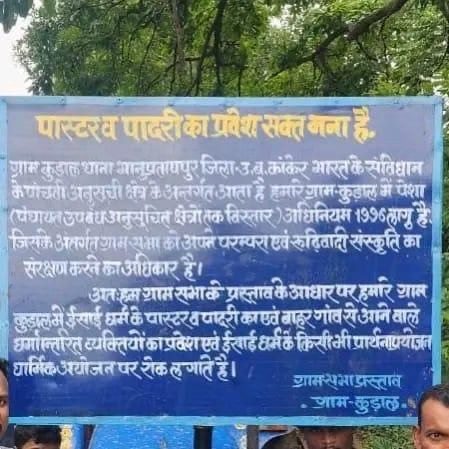
Ranchi, Nov 7: In a significant ruling touching the intersection of faith, law, and tribal identity, the Chhattisgarh High Court has upheld the legality of hoardings installed in several tribal villages of Kanker district that bar the entry of Christian pastors and “converted Christians.” The court, in a recent judgement, said the hoardings were not unconstitutional, emphasising that they were meant to preserve tribal identity, not to promote religious discrimination.
Petitions challenged hoardings as unconstitutional
The order came while disposing of two public interest litigations, which stated that the hoardings violated fundamental rights guaranteed under Articles 19(1)(d) and 25 of the Constitution, which protect the right to free movement and freedom of religion.
The petitioners alleged that the hoardings had been erected at the behest of government authorities, following an August 14, 2025, circular from the Director of Panchayati Raj. That circular instructed officials in districts covered under the Panchayat (Extension to Scheduled Areas) Act (PESA) to circulate an oath encouraging villagers to protect Jal, Jangal, Jameen (water, forest, and land) along with their cultural traditions, folk songs, and faith.
They claimed the directive was being misused by local political groups to instigate hostility against Christians and that no proper Gram Sabha meetings were held before erecting the boards. Villagers in Havechur, one of the affected villages, reportedly told the petitioner that they were unaware of any such resolution being passed.

State defends circular as cultural safeguard
Opposing the petitions, Additional Advocate General Y.S. Thakur argued that the claims were speculative and lacked evidence. He said the government’s circular never instructed officials to install hoardings or spread religious hatred but only sought to safeguard tribal culture and identity in Scheduled Areas.
“The circular emphasizes protecting traditional customs, maintaining ecological balance, and honoring tribal heroes. It aims to strengthen community harmony, not divide it,” the State submitted.
Court cites sensitive nature of religious conversions
A division bench comprising Chief Justice Ramesh Sinha and Justice Bibhu Datta Guru, referring to earlier Supreme Court observations, remarked that religious conversion remains a sensitive and complex issue in India’s social landscape. It noted that while the Constitution guarantees the right to profess and propagate religion, “conversion through coercion, inducement, or deception” disturbs social harmony and erodes the cultural identity of indigenous tribes.

The bench highlighted past instances of violence in Bastar and Narayanpur districts linked to alleged forced conversions, observing that such activities have historically led to law and order challenges in tribal regions.
Hoardings justified under PESA Rules
The court concluded that the hoardings were installed by Gram Sabhas as precautionary measures “to prevent forcible conversions and to protect tribal culture.” It ruled that this action fell within the Gram Sabha’s powers under the Chhattisgarh PESA Rules, 2022, which authorise local bodies to maintain peace and uphold community traditions.
The bench also noted that the petitioners had not exhausted their alternative statutory remedy under Rule 14 of the PESA Rules, which allows grievances to be raised before the Gram Sabha and, if necessary, appealed to the Sub-Divisional Officer (Revenue).
Petitions disposed of
Dismissing the PILs, the court granted liberty to the petitioners to seek remedies under the PESA framework and directed that if they face any threat or restriction on movement, they may seek protection from the jurisdictional police.
“The installation of hoardings to protect tribal culture and prevent fraudulent conversions cannot be termed unconstitutional,” the court observed, closing the matter.