






THE JHARKHAND STORY NETWORK
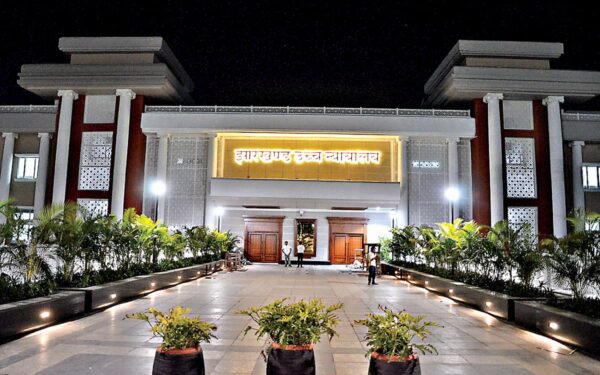
Ranchi, Sept 23: An exchange of words unfolded in the Jharkhand High Court on Monday after the State Government designated Pooja Singhal, Secretary of the Information Technology Department (IT), as the Adjudicating Officer (A.O.) under the Information Technology Act, 2000.
The petitioner’s lawyer, Utkarsh Singh, however, dismissed the appointment as mere lip service, saying the step fails to meet statutory requirements. The Court has issued a formal notice to the State, ordering a hearing in this matter on November 11.

Background: Two Decades of Inaction
The legal dispute originated from a Public Interest Litigation filed by Manoj Kumar Singh, which challenged the absence of any functional A.O. office in Jharkhand despite clear statutory mandates.
For roughly 21 years, Jharkhand did not comply in any meaningful way, leaving cyber fraud victims and complainants with no civil forum under the IT Act to seek redress.
ALSO READ: ED raids 9 locations across Ranchi, Delhi, in land scam linked to Kamlesh Singh
Recent Developments & Petitioner’s Critique
Earlier in August 2025, the High Court directed the State to appoint an adjudicating officer within four weeks and report back. The State government responded with notifications on September 2, 2025, claiming that the IT Secretary had been appointed, and a supplementary counter-affidavit suggested that mechanisms were being put in place.
But Utkarsh Singh argued these actions are superficial. He highlighted that no case has yet been filed before the newly appointed A.O., and that the notification lacks essential details: timelines, procedure, digital interface, and online accessibility. In his view, compliance has been symbolic rather than functional.
High Court Steps In: Notice & Next Hearing
Respondents, including the State Government and the Union of India, have been served notices. The State has sought time to file counter-affidavits clarifying how and when the A.O.’s office will actually operate—digitally, paperlessly, with remote hearing facilities, status tracking, etc. The Court has scheduled the next hearing for November 11 to examine the State’s reply and assess whether the appointment meets the legal standard.
Why This Matters
The A.O. under the IT Act is endowed with powers akin to a civil court: to summon witnesses, require document production, examine issues, award compensation and more. Without a working A.O. office, victims of cyber fraud, data breach, or other IT-related civil wrongs are left with traditional criminal courts or police mechanisms, which the petitioner argued are ill-suited for timely redress.
Also central is Rule 4(k) of the IT (Qualification & Experience of Adjudicating Officers and Manner of Holding Inquiry) Rules, 2003, which states: “as far as possible, every application shall be heard and decided in four months and the whole matter in six months.” Achieving this requires infrastructure—online filing systems, document management, remote participation—not just titular appointments.
What to Watch
- Whether the State provides a clear operational plan with infrastructure, timelines, and digital facilities.
- If the Court accepts that the appointment of Pooja Singhal addresses the statutory requirements, or whether more specific orders will be directed.
- How accessible the A.O. office is to affected persons: in terms of filing complaints, tracking, receiving documents and orders, and remote participation.
