






DR RACHNA K PRASAD

For decades, the Gulf monarchies—Saudi Arabia, the United Arab Emirates, and Qatar—marketed themselves as the “Island of Stability.” It was a neat bargain: the Middle East supplied energy and capital, while the United States guaranteed an absolute, high-tech security umbrella. That contract defined the petrodollar era. It reassured investors, stabilised oil markets, and allowed futuristic visions like Dubai’s tourism empire and Saudi Arabia’s Neom project to flourish.
But that contract has now been liquidated. The images of smoke rising from Saudi Aramco refineries and drones buzzing past the U.S. Embassy in Riyadh are not just battlefield snapshots; they are symbols of a collapsing order. When the State Department tells American citizens to flee immediately, it signals more than a logistical withdrawal. It is a crisis of trust. Washington’s priorities—defending Israel and preserving its own strategic ego—have left its Gulf allies, who bankrolled U.S. presence for generations, exposed and burning.

The Fatal Math of Asymmetric Warfare
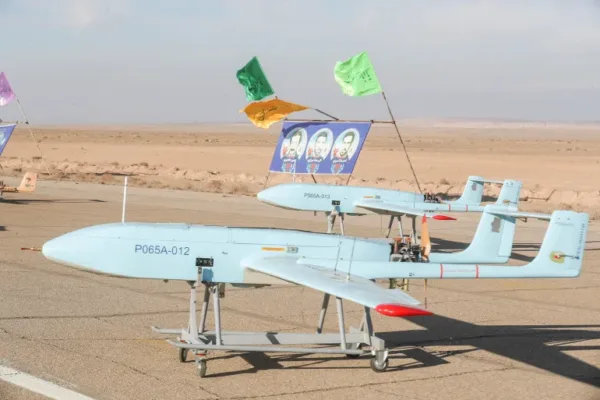
The conflict has revealed a brutal arithmetic. Million-dollar Patriot and THAAD interceptors are being fired at Iranian drones that cost barely $30,000. This isn’t just a cost imbalance—it’s a logistical trap.
Global production of interceptors is capped at around 2,000 units per year. Iran, by contrast, can churn out drones almost endlessly. The burn rate for Gulf allies is catastrophic: the UAE has fewer than 1,000 interceptors, Kuwait fewer than 500, Bahrain fewer than 100. And stopping a single ballistic missile often requires two or three interceptors. At this pace, entire nations could be defenceless within 48 hours.
Faced with this reality, Gulf leaders are making impossible choices. Do they let cheap drones strike billion-dollar energy facilities, saving their interceptors for existential threats? Iran has found a way to bleed the U.S. security apparatus dry without ever engaging in a conventional dogfight.
This is the essence of asymmetric warfare: the weak exploit the cost structures of the strong. It is not about matching firepower; it is about bankrupting myths.
To plug the haemorrhage, Washington has resorted to what analysts call “strategic cannibalism.” Air defence assets are being stripped from other flashpoints to cover the Gulf.
In South Korea, fear is palpable. Of the eight Patriot batteries guarding Seoul, three have already been redeployed. The THAAD battery in Seongju may be next. For Pacific allies, the message is clear: their security can be sacrificed when Washington’s priorities shift. It reinforces a troubling perception—that U.S. allies are not partners, but customers, repositioned whenever the hegemon’s interests demand.
This is not new. The Carter Doctrine of 1980 declared that the U.S. would use military force to protect Gulf oil supplies. But what was once a promise of protection has become a mechanism of redistribution. Assets are stripped from one region to cover another, leaving allies exposed. The “Great Ditching” is simply the latest iteration of a pattern where U.S. commitments are conditional, transactional, and ultimately expendable.
The Death of the Stability Myth
The Gulf’s ambitious “post-oil” visions—Neom’s futuristic cityscape, Dubai’s tourism empire, Doha’s data hubs—depend on the perception of absolute safety. That perception has been shattered.
Flights are rerouted or cancelled, transit hubs are choking, and Saudi Aramco—the world’s most valuable oil firm—is taking direct hits. Meanwhile, Israel’s Haifa refinery remains secure under U.S. carrier protection. The optics are devastating: Gulf allies see themselves abandoned while Israel enjoys the full shield.
The wealthy are already voting with their feet. Reports suggest high-net-worth individuals are fleeing the UAE on $350,000 chartered jets, some driving hours just to find an operational airfield. The “ego fight” between Washington and Tehran is being fought on Gulf soil, and it is the region’s transport and tourism sectors that are paying the price.
IRGC Unlike Iran’s regular military, the Revolutionary Guard answered directly to the Supreme Leader. These units now operate autonomously, following pre-set retaliatory scripts: “Attack the enemy wherever you see them.”
This is a strategic nightmare. A decentralised force cannot be negotiated with, does not follow the rules of statecraft, and ignores cooling-off periods. It is revenge on autopilot.
History offers parallels. When al-Qaeda lost central leadership, its affiliates became more unpredictable, more violent, and harder to contain. The IRGC represents a similar evolution: a force that is both empowered and unrestrained.
Adding another layer of intrigue are reports of Mossad agents arrested in Qatar and Saudi Arabia. The allegation: Israel is staging false-flag operations to frame Iran, forcing reluctant Gulf monarchies into a war they desperately want to avoid.
Regional analysts call this “Netanyahu’s Revenge,” a settling of old scores after a botched Israeli operation in Doha years ago. If true, it means the Gulf is not just caught between Washington and Tehran—it is being manipulated by Tel Aviv as well.
This is the danger of multipolarity: when alliances fracture, opportunistic actors exploit the vacuum.
And there is a darker interpretation of Washington’s strategy. By allowing the Middle East to be torn down, the U.S. may be creating a “level playing field.” A ruined region requires two things: reconstruction and new weapons.
Once the “Stability Myth” is fully destroyed, the U.S. defence industry stands to gain trillions in orders for F-35s and advanced systems from terrified allies. It is the commodification of ruin—a reset where war becomes the most profitable business of all.
This is not unprecedented. After World War II, the Marshall Plan rebuilt Europe, but it also entrenched U.S. economic dominance. After the Gulf War, arms sales surged. The cycle is familiar: destruction followed by reconstruction, both monetised.
To understand the present, we must revisit the past. The Carter Doctrine of 1980 declared that the U.S. would use military force to protect Gulf oil supplies. It was a promise of absolute protection.
The Gulf War of 1991 reinforced that promise. U.S. forces expelled Iraq from Kuwait, demonstrating the effectiveness of the American security umbrella. The Iraq War of 2003, however, began to erode trust. The “weapons of mass destruction” narrative was exposed as false, and allies realised that U.S. priorities could be driven by ego as much as necessity.
The current crisis represents the culmination of that erosion. The U.S. is digitally sophisticated but strategically alone. Allies no longer see American directives as security necessities; they see them as destabilising manoeuvres.
The End of the American Century?
What does this all mean? It means the old security contract is gone. The Gulf monarchies can no longer buy stability with petrodollars. America’s high-tech umbrella has holes, and Iran has found a way to exploit them with drones that cost less than a luxury car.
It also means allies everywhere—from Seoul to Riyadh—are realising that U.S. protection is conditional, transactional, and ultimately expendable. The myth of stability has died, and in its place is a level playing field of destruction.
The question now is not whether the Gulf can rebuild, but whether trust can ever be restored. When the sky starts falling, who can a partner truly rely on?
Perhaps this is the end of the American Century. Or perhaps it is simply the friction of a world rebalancing. Either way, the cracks in the West are no longer cosmetic—they are structural.
(Dr Rachna K Prasad is Asst Professor of Political Science at the University of Delhi. She can be contacted at drrachnaprasad24@gmail.com)
