
ISRO successfully launches meteorological satellite INSAT-3DS
THE JHARKHAND STORY DESK Sriharikota, Feb 17: The Indian Space Research Organisation (ISRO) achieved a successful launch of its meteorological satellite…
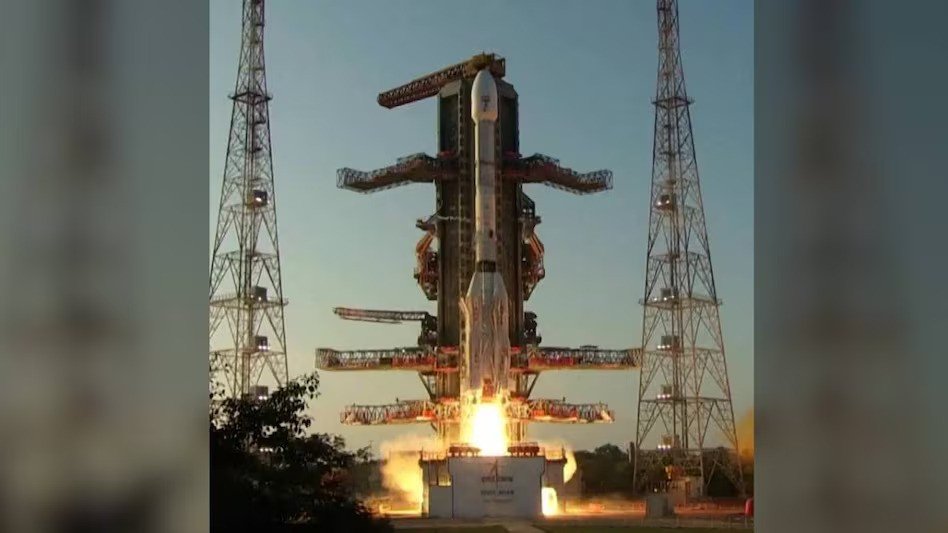
Image: India Today NE
THE JHARKHAND STORY DESK
Sriharikota, Feb 17: The Indian Space Research Organisation (ISRO) achieved a successful launch of its meteorological satellite INSAT-3DS using the GSLV F14 spacecraft, which took off from the Sriharikota spaceport at 5:35 pm on Saturday.
The satellite will research natural catastrophe alerts and weather forecasts.
The meteorological satellite INSAT-3DS was launched into the Geosynchronous Transfer Orbit (GTO) by the GSLV on its 16th mission. Further orbit-raising operations will guarantee that the satellite is in a geostationary orbit.
The INSAT-3DS satellite represents a subsequent mission in the third generation of meteorological satellites operating from a geostationary orbit.

The Ministry of Earth Sciences (MoES) is providing all funding for the mission.
Also Read- Indian women’s team enter final of Badminton Asia Championships for first time after defeating Japan
INSAT-3DS satellite aimed to enhances meteorological observations and disaster warning capabilities
The satellite is intended to provide improved meteorological observations and monitor both land and ocean surfaces for enhanced weather forecasting and disaster warning capabilities. It will supplement the existing meteorological services alongside the currently active INSAT-3D and INSAT-3DR satellites. Indian industries have played a substantial role in the development of the satellite.
The mission’s main goals are to observe the Earth’s surface, the ocean, and its environment in a variety of spectral channels that are important to meteorology and to provide the vertical profile of several atmospheric meteorological parameters.

It will, among other things, offer Satellite Aided Search and Rescue services as well as Data Collection and Data Dissemination capabilities from the Data Collection Platforms (DCPs).
The INSAT-3DS Satellite data will be used by several departments of the Ministry of Earth Sciences (MoES) to provide better weather forecasts and meteorological services, including the India Meteorology Department (IMD), National Centre for Medium-Range Weather Forecasting (NCMRWF), Indian Institute of Tropical Meteorology (IITM), National Institute of Ocean Technology (NIOT), Indian National Center for Ocean Information Services (INCOIS), and numerous other agencies and institutes.