
Jharkhand Bandh: BJP shuts roads, backs student stir as JPSC-JSSC row turns into major political battle
SUMAN K SHRIVASTAVA Ranchi, August 11: The BJP-sponsored Jharkhand Bandh on Tuesday brought parts of the state to a standstill as the…
SUMAN K SHRIVASTAVA
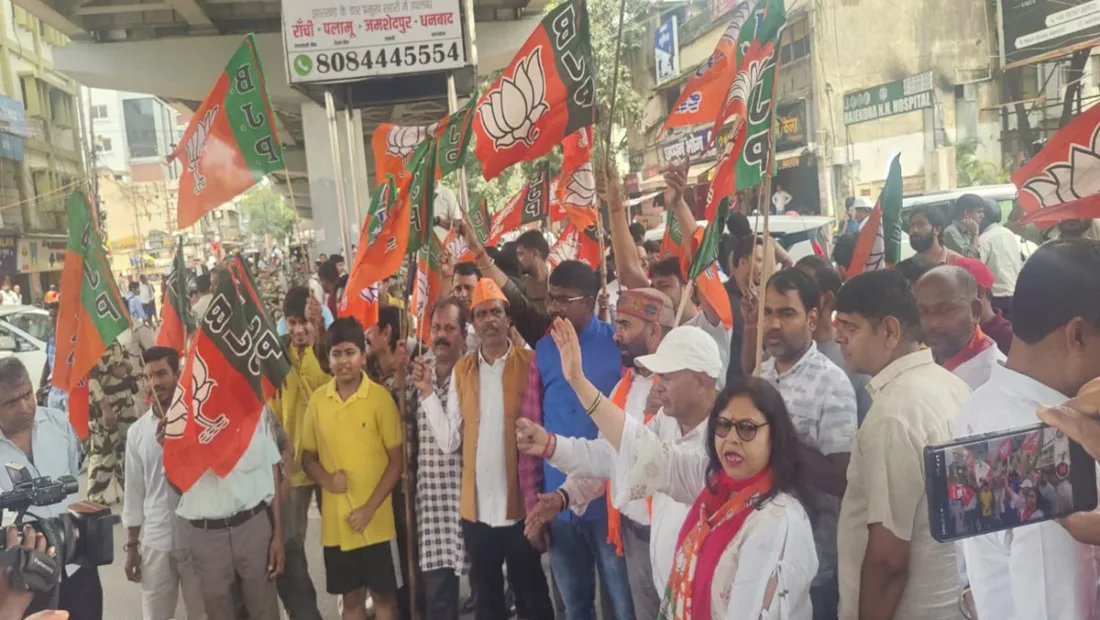
Ranchi, August 11: The BJP-sponsored Jharkhand Bandh on Tuesday brought parts of the state to a standstill as the Opposition party took its protest against the police lathi-charge on JPSC-JSSC aspirants from the streets to a statewide political campaign against the Hemant Soren government.
The bandh, called in response to the police action during Monday’s attempted Assembly march by protesting job aspirants, witnessed road blockades, tyre burning and slogan-shouting in several parts of Ranchi and other districts. Schools and many business establishments remained closed in several areas, while vehicular movement was significantly lower than usual. Essential services were kept outside the scope of the shutdown, according to BJP state president Aditya Sahu.
The developments have pushed the long-running recruitment examination controversy into the centre of Jharkhand’s political discourse, with the BJP seeking to turn the student agitation into a broader campaign against the JMM-led government.

BJP takes student issue to streets across Jharkhand
The BJP called the shutdown to protest what it described as “atrocities” against students and demanded accountability for the police action during Monday’s Assembly march.

In Ranchi, BJP workers blocked roads at several locations, including Kishoreganj, Argora, Kanke Road and areas around the CMPDI gate. Tyres and wooden logs were burnt at places including Harmu Chowk, Kishoreganj Chowk and near Nucleus Mall, disrupting traffic.
The bandh’s impact was not confined to the state capital. Protests and road blockades were reported from Giridih and Ramgarh, with BJP workers in Ramgarh blocking the Ranchi-Patna highway near Subhash Chowk. The highway blockade continued for around three hours before police intervened and cleared the road.
The response, however, was uneven across the state, with the intensity of disruption varying from one district to another.

Ranchi becomes epicentre of BJP-ABVP mobilisation
Ranchi remained the main centre of the day’s political mobilisation.
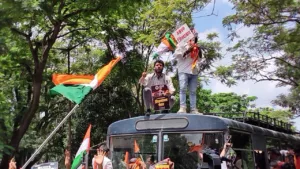
Alongside the bandh, the Akhil Bharatiya Vidyarthi Parishad organised a march from the old Assembly premises towards the new Assembly building to protest against the police action and press its demands over recruitment examinations.
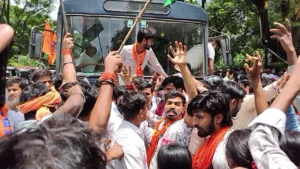
Police detained the protesters before they could proceed towards the Assembly. The detention itself led to another confrontation, with several activists sitting or lying on the road to prevent police buses from moving. Some protesters climbed on top of the vehicles and continued raising slogans, while police personnel attempted to clear the route.
The standoff continued for several hours before the detained protesters were taken away in buses through different routes.
The administration had deployed additional security personnel at sensitive locations and around the Assembly premises in anticipation of the protests.
What triggered the BJP bandh?
The immediate trigger for Tuesday’s bandh was Monday’s confrontation between police and students marching towards the Jharkhand Assembly.
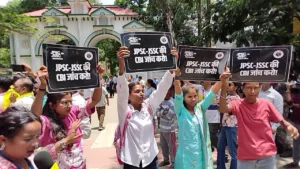
Thousands of JPSC-JSSC aspirants have been protesting since July 25 over alleged irregularities and paper leaks in recruitment examinations. Their demands include greater transparency in the examination process, reforms in the functioning of the Jharkhand Public Service Commission and Jharkhand Staff Selection Commission, cancellation of certain examinations and an independent investigation by the CBI.
On Monday, protesters advanced towards the Assembly and crossed multiple barricades. Police used water cannons, tear gas and lathi-charge to stop them. Several protesters claimed they were injured, while Ranchi Police said 14 personnel were injured during the clashes.
The action provided the BJP with a fresh political opening to intensify its attack on the state government.
BJP seeks to turn recruitment row into anti-government campaign
For the BJP, the bandh is about more than the immediate police action. The party has been backing the students’ demand for an independent probe into alleged irregularities in JPSC and JSSC examinations and is now seeking to make recruitment, paper leaks and the treatment of protesting aspirants a major political issue in Jharkhand.
BJP leaders have accused the Hemant Soren government of using force against students instead of addressing their grievances. The party has also demanded accountability for those responsible for the alleged examination irregularities.
The political strategy is significant because the recruitment controversy directly touches one of the most politically sensitive constituencies in Jharkhand—young people preparing for government jobs.
For the Opposition, the issue provides an opportunity to portray the government as insensitive to the concerns of job aspirants. For the ruling alliance, however, the challenge is to demonstrate that its decisions on examination reforms and investigations are producing credible results while preventing the student movement from becoming a prolonged political confrontation.
Students maintain distance from political parties
Despite the BJP’s decision to back the agitation and call a statewide bandh, the protesting students have maintained that their movement is not affiliated with any political party.
Student leaders have said they would welcome support from anyone backing their demands but would not formally associate the movement with any political organisation. Their stated focus remains transparency in recruitment examinations and action against those responsible for alleged irregularities.
That distinction could become increasingly important as political parties attempt to shape the narrative around the agitation.
Government says major demands already addressed
The Jharkhand government, meanwhile, has maintained that it has already accepted a substantial portion of the students’ demands.
According to Higher and Technical Education Minister Sudivya Kumar, the government has agreed to cancel the 14th JPSC examination as well as certain backlog examinations from 2023 and 2025. The government has also agreed to an Enforcement Directorate probe after evidence of financial irregularities emerged, while proposing a committee headed by a retired High Court judge to oversee the CID investigation.
The government has, however, maintained that it cannot order cancellation of the JSSC-CGL examination because it was conducted under court monitoring.
Officials have also proposed reforms in the standard operating procedures of JPSC and JSSC, with inputs from institutions including IIT-ISM Dhanbad, IIM Ranchi and XLRI Jamshedpur.
The students have rejected the government’s claim that most of their demands have been met and continue to press for an independent probe and other changes.
Hemant Soren accuses BJP of politicising student agitation
The political confrontation has spilled into the Assembly as well.
Chief Minister Hemant Soren has accused the BJP of attempting to exploit the student movement for political gains and urged the protesting aspirants to resolve their grievances through dialogue and trust.
On Tuesday, as the Assembly witnessed uproar over the police action, Soren defended the government’s handling of the examination issue and said investigations and reforms were already underway.
The BJP, however, has intensified its attack, arguing that students would not have been forced onto the streets had the government adequately addressed their concerns in the first place.
Assembly session ends amid political uproar
The bandh coincided with another major political development in Ranchi. The Jharkhand Assembly was adjourned sine die on Tuesday, a day ahead of schedule, following repeated disruptions by ruling and Opposition members over the student protests and alleged lathi-charge.
The simultaneous street protests and Assembly confrontation underlined how rapidly the recruitment examination controversy has evolved from a student issue into a major political contest between the BJP and the JMM-led ruling alliance.
A test of BJP’s political strategy
The BJP-sponsored bandh gives the Opposition a platform to consolidate its attack on the Hemant Soren government around issues of youth employment, examination transparency and law and order.
For the government, the immediate challenge is to prevent the issue from escalating further while convincing students and job aspirants that its proposed investigations and reforms will produce credible outcomes.
The student movement itself remains the crucial variable. If the protesters maintain their political independence while continuing the agitation, both the BJP and the ruling alliance will have to compete for the narrative without being able to fully claim ownership of the movement.
For now, the JPSC-JSSC controversy has become one of the most significant political flashpoints in Jharkhand, bringing students, the Opposition, the government and the administration into an increasingly tense confrontation.