Jharkhand launches Samaveshi Ajeevika Yojana to help 16,000 ultra-poor households escape poverty
THE JHARKHAND STORY NETWORK Daltonganj, November 22: Jharkhand has launched the Samaveshi Ajeevika Yojana (SAY), a poverty-alleviation initiative aimed at helping ultra-poor…
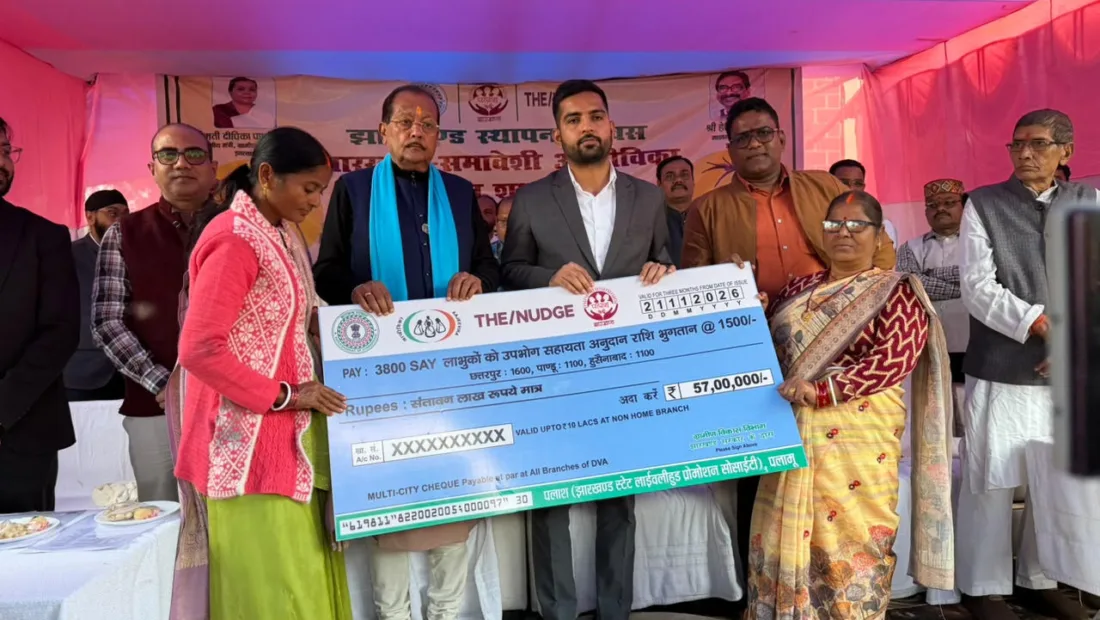
A prototype bank cheque for ₹57 lakh, representing Consumption Support Grant assistance of ₹1,500 each for 3,800 ultra-poor households, was handed over to two beneficiaries at Chhatarpur on Saturday during the launch of SAY.
THE JHARKHAND STORY NETWORK
Daltonganj, November 22: Jharkhand has launched the Samaveshi Ajeevika Yojana (SAY), a poverty-alleviation initiative aimed at helping ultra-poor households move towards financial independence through sustained livelihood support.
The scheme, launched by the district administration in Palamu on Saturday, is part of a first-phase rollout covering six districts across Jharkhand. It targets 16,000 critically poor households, with the objective of helping them overcome extreme poverty and reduce their dependence on external support.
The initiative is linked to the Centre’s concept of an Ultra Poor Change Maker (UP CM) and is being implemented under the Ministry of Rural Development’s Deendayal Antyodaya Yojana (DAY) and National Rural Livelihood Mission (NRLM). Administrative sources said the Centre and state governments would share the funding in a 60:40 ratio.
Palamu identifies 3,800 ultra-poor households
Finance Minister Radha Krishna Kishore and Palamu Deputy Commissioner Dilip Pratap Singh Shekhawat jointly inaugurated the scheme at Chhatarpur on Saturday, according to Anita C Kerketta, District Programme Manager of the Jharkhand State Livelihood Promotion Society (JSLPS).
The Palamu unit of JSLPS organised the launch programme. Convergence Coordinator Ashish K Shukla said 3,800 ultra-poor households had been shortlisted in the district.

The scheme is being implemented in three Palamu blocks: Chhatarpur, Pandu and Hussainabad. Of the identified households, 1,600 are from Chhatarpur, while Pandu and Hussainabad account for 1,100 each.
Administrative sources said the programme aims to help these households emerge from extreme poverty within 36 months through sustained income-generating activities.
₹57 lakh distributed as consumption support
At the launch, the administration handed over a prototype bank cheque for a cumulative ₹57 lakh under the Consumption Support Grant for the 3,800 identified households. The support works out to ₹1,500 per household.

The scheme also provides a Livelihood Support Grant, intended to help beneficiaries establish sustainable sources of income.
Administrative officials described the initiative as following a “Graduation Approach” to help ultra-poor families move beyond survival-level existence and become economically self-reliant.
“It’s a Graduation Approach to uplift the ultra poor from the stark and jejune poverty. These stark poor are to be change makers of themselves,” officials said.
Another official described the programme as a transition from dependence on government assistance to self-reliance, saying, “Survival on a pittance for the ultra poor is an economic curse. SAY is a journey or transition from living in government charity to self reliance”.
Identification of beneficiaries remains a challenge
Officials, however, acknowledged that identifying genuinely poor households could prove difficult. They cautioned that the scheme might face problems similar to those encountered under the Antyodaya Yojana, particularly the inclusion of relatively well-off families while deserving households are left out.
An official, speaking on condition of anonymity, questioned whether field-level officers had a clear understanding of how to identify an ultra-poor household.
The official said extreme poverty often forces families to prioritise finding their next meal over education and healthcare.
The programme is intended to reach households facing such chronic deprivation and help them build stable livelihoods over the next three years.