Jharkhand HC says Lokayukta cannot direct CBI probe, dismisses plea against Amreshwar Sahay
Ranchi, June 9: The Jharkhand High Court has ruled that the Lokayukta does not have the authority to direct central agencies such…
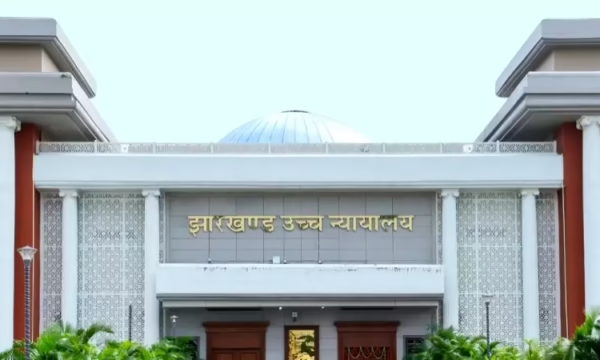
Ranchi, June 9: The Jharkhand High Court has ruled that the Lokayukta does not have the authority to direct central agencies such as the Central Bureau of Investigation (CBI) or the Accountant General to conduct investigations, while dismissing a petition challenging an order passed by former Jharkhand Lokayukta Justice (Retd.) Amreshwar Sahay.
Justice Sanjay Kumar Dwivedi dismissed a writ petition filed by Satyadeo Roy, who had questioned the legality of a 2012 order in which the then Lokayukta declined to order a probe by the CBI or the Accountant General into alleged irregularities connected to a Ranchi University fund embezzlement case.
Lokayukta Has No Jurisdiction Over Central Agencies
The petitioner had argued that the Lokayukta possessed powers under the Jharkhand Lokayukta Act, 2001, to order an investigation by central agencies. However, the High Court disagreed, holding that the Act permits the Lokayukta to seek assistance only from officers or investigating agencies of the State Government and not from central agencies like the CBI.
The court noted that when the complaint was filed before the Lokayukta, an FIR had already been registered and the matter was under police investigation. Under the provisions of the Jharkhand Lokayukta Act, issues relating to an ongoing criminal investigation fall outside the Lokayukta’s jurisdiction.
“The Lokayukta can only direct State Government agencies to investigate,” the court observed while upholding the 2012 order.
Challenge Against Former Lokayukta Rejected
Apart from seeking quashing of the order, the petitioner had also alleged that Justice (Retd.) Amreshwar Sahay should not have dealt with the complaint because one of the persons referred to in the matter, Jyoti Kumar, was his brother. The petitioner contended that the former Lokayukta ought to have delegated the matter to another officer.

The High Court rejected this argument, holding that the Lokayukta is a single-member statutory institution and that its core adjudicatory functions cannot be delegated under Section 19 of the Act.
Doctrine of Necessity Applies
The court invoked the legal principle of the doctrine of necessity, which allows an authority to decide a matter when no alternative decision-maker is available.
Justice Dwivedi observed that, unlike multi-member bodies or courts where matters can be assigned to another bench, the Lokayukta functions as a single-member institution. Therefore, Justice Sahay was required to decide the complaint and could not transfer the final decision-making authority to another person.

The court further noted that the impugned order did not grant any benefit to the Lokayukta’s brother and was based solely on the statutory limitations contained in the law. As a result, allegations of bias were not established.
Investigation and Trial Already Completed
The High Court also took note of submissions that the police investigation in the Ranchi University case had been completed and that the criminal trial arising out of the FIR had concluded in October 2024. The court observed that the petitioner had earlier pursued a public interest litigation regarding the same matter and that the investigation process had already run its course.
Petition Dismissed
Concluding that there was no illegality in the order passed by former Lokayukta Amreshwar Sahay and that allegations of bias were unsubstantiated, the High Court dismissed the writ petition and declined to grant any declaratory relief sought by the petitioner. All pending applications were also disposed of.