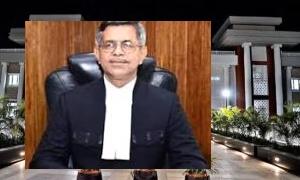







SUMAN K SHRIVASTAVA
 In the years 2014 and 2015, the iron hills of Jharkhand fell strangely quiet.
From Noamundi to Kiriburu, from Gua to Meghahatuburu, conveyor belts stopped mid-motion, dumpers stood rusting under forest canopies, and downstream furnaces began to starve. What had once been a rhythmic industrial hum dissolved into an uneasy stillness.
The State Government ordered the closure of twelve major iron ore mines, declaring that their mining leases had expired. Among those affected were not only smaller leaseholders, but also the backbone of India’s steel economy—Tata Steel, Steel Authority of India Limited (SAIL), and Orissa Manganese and Minerals Pvt. Ltd.

The impact was immediate and devastating.
Jharkhand—then India’s third-largest producer of iron ore—lost nearly 19 million tonnes of annual production overnight. Steel plants panicked. Blast furnaces faced raw material shortages. Imports rose sharply, pushing up costs across the steel sector. Analysts spoke of losses running into thousands of crores, not merely in mining revenue, but across construction, infrastructure, and manufacturing chains that depended on domestic steel.
But beyond balance sheets, the human cost cut deeper.
In West Singhbhum, tribal households slipped into distress. Workers were laid off. Generations that had built their lives around the mines watched livelihoods evaporate. The State exchequer, too, bled—royalty revenues collapsed just when Jharkhand could least afford it.
ALSO READ: Jharkhand HC@25: How the high court drew the line on reservation in promotion
The closures were not born of indifference. They followed Supreme Court directions and the findings of the Justice M.B. Shah Commission on illegal mining. Across Goa, Karnataka, and Odisha, courts had drawn a hard line: the environment could no longer be sacrificed at the altar of extraction.
Yet in Jharkhand, the crisis exposed a quieter failure.
Many leaseholders—large and small—had applied for renewal well within time. Their applications lay pending for years, sometimes decades. Files moved slowly, if at all. Decisions never came.
When the hammer finally fell, it fell not only on violators, but also on lawful operators—on workers, communities, and the State itself.
This tension—between legality and livelihood, environment and economy—set the stage for one of the most consequential mining judgments in Jharkhand’s history.
A new law, a new promise
The paralysis was not unique to Jharkhand. Across India, mining had slowed to a crawl under the weight of uncertainty.
Sensing the damage, Parliament intervened.
On January 12 2015, the Mines and Minerals (Development and Regulation) Amendment Act, 2015 came into force, marking a decisive break from the past.
Renewals were abolished. Auctions became the future. Discretion was curbed. Transparency was promised.
For minerals like iron ore, Parliament declared that existing leases would stand “deemed to be extended”—either up to 50 years from the original grant, or up to March 31 2020 or 2030, depending on whether the mine was captive or merchant.
The intention was unmistakable:
to end administrative limbo, revive mining, protect jobs, stabilise steel production, and channel future allocations through competitive bidding.
But buried within the new framework were the words “subject to compliance”—words that would soon become the seed of fresh conflict.
When miners turned to the High Court
Despite the amendment, Jharkhand rejected renewal applications even after renewal itself had ceased to exist in law.
Among those affected were not just corporate giants, but miners like Padam Kumar Jain and M/s Shah Brothers—names that rarely dominated headlines, yet represented the real, lived face of Jharkhand’s mining economy. Their operations had been lawful. Their renewal applications had been filed years earlier. Still, their mines were shut.
For them, this was not a regulatory setback—it was the extinction of livelihood without fault.
Left with no alternative, they knocked on the doors of the Jharkhand High Court, alongside larger entities whose closures were now threatening India’s steel supply chain itself.
At the heart of the dispute lay a deceptively simple question:
When Parliament says a mining lease “shall be deemed to be extended”, can the State still refuse it?
The answer would decide not only the fate of individual mines, but whether Jharkhand’s mineral economy would be governed by law—or by administrative silence.
Justice Aparesh Kumar Singh and the voice of clarity
The judgment, delivered on October 6 2016, by Justice Aparesh Kumar Singh, stands today as a defining moment in Indian mining jurisprudence.
Drawing deeply from Supreme Court precedent—especially Common Cause v. Union of India (2016)—the Court told the story of mining law as it had evolved:
from discretion to discipline,
from uncertainty to certainty.
Justice Singh explained that a “deemed extension” is not a legal fiction meant to deceive, but a legislative command meant to operate fully. When Parliament speaks in mandatory terms, the State cannot undo that command by indirect means.
ALSO READ: Jharkhand HC@25: From stigma to statute, a verdict that reframed mental health rights
Three truths emerged with clarity
First, renewal and extension are not the same. Renewal requires discretion; extension is continuation by force of law. After 2015, the State’s power to grant or refuse renewal for iron ore simply no longer existed.
Second, a mining lease does not lapse automatically. Lapse requires an express order. Silence cannot be weaponised.
Third—and critically—the Court did not dilute environmental safeguards. Mining could resume only after forest clearance, environmental approval, pollution consent, and compliance with mining plans. Violations could be punished strictly—but punishment could not take the form of denying a statutory extension Parliament itself had mandated.
What the law granted directly, the State could not take away indirectly.
Restoring balance — and reviving steel
The judgment struck a balance only a constitutional court rooted in ground realities could strike.
It quashed the State’s rejection orders as non-speaking and violative of natural justice. It restored deemed extensions while empowering regulators to halt operations where clearances were missing.
And in doing so, it unlocked something larger.
Mines reopened lawfully.
Steel plants stabilised.
Imports reduced.
Workers returned.
Royalty once again flowed into the State treasury—running into hundreds of crores in the years that followed.
What had begun as a legal dispute ended as an economic revival, reconnecting Jharkhand’s iron ore with India’s steel heartbeat.
A judgment that travelled beyond Jharkhand
The clarity of Justice Singh’s reasoning did not remain confined to Ranchi. Other High Courts, faced with similar post-2015 disputes, drew guidance from this interpretation of deemed extension and State power.
The judgment became a national reference point.
Why this case belongs in the Silver Jubilee story
As the Jharkhand High Court completes twenty-five years, this case deserves remembrance not merely for legal correctness, but for human consequence.
It told the story of miners big and small.
Of steel plants gasping for ore.
Of laws misunderstood—and then clarified.
Above all, it reaffirmed a simple truth:
Law must not become an accident of delay.
Nor should justice be held hostage to silence.
When the mines of Jharkhand spoke again, they did so lawfully, responsibly, and with dignity.
That is why this judgment stands tall—in the story of the Jharkhand High Court, at twenty-five, and beyond.
