







SUMAN K SHRIVASTAVA
 On a winter morning in January 2000, when the map of India still carried no state called Jharkhand, the Patna High Court delivered a judgment that read less like a routine answer to a legal reference and more like a reckoning with history. The case was Mora Ho v. State of Bihar. Yet the real protagonist was neither Mora Ho nor the State. It was a set of rules drafted in 1833 by a British officer—never formally approved, never properly published—yet followed for over a century and a half in a corner of eastern India called Kolhan.
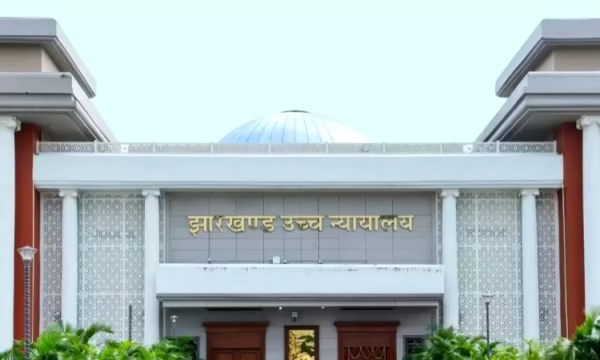
The judgment stood at a crossroads of time: one foot in the colonial past, the other stepping toward a constitutional future that Jharkhand—still unborn—would soon inherit. Twenty-five years later, as the Jharkhand High Court marks its silver jubilee, Mora Ho reads like a foundational text: a story about law’s endurance, its blind spots, and its uneasy relationship with legitimacy.
Kolhan: Where the Code Stopped
By the late twentieth century, the Code of Civil Procedure, 1908, had become the grammar of civil justice across India. From Srinagar to Kanyakumari, it provided a common language of pleadings, decrees and execution.

Yet in Kolhan—now part of West Singhbhum district—the Code halted as if at an invisible border. Civil justice here continued under Wilkinson’s Rules, an improvised colonial code framed when the Ho people were described in official records as “ignorant” and “uncivilised.”
A decree under Wilkinson’s Rules could not travel beyond Kolhan. It could not be executed in Ranchi, much less in Delhi. In a nation that prided itself on legal unity, Kolhan remained an exception—an administrative island shaped by conquest.
Captain Wilkinson and the Anxiety of Empire
After the East India Company acquired the Diwani of Bengal, Bihar and Orissa in 1765, the forests and hills of Chotanagpur resisted control. The Ho, Munda and Oraon communities governed themselves through the Manki–Munda system, rooted in custom rather than statute. Attempts to impose revenue systems led to repeated uprisings, culminating in the Kol insurrection of 1831–33.
In response, the British created the South-West Frontier Agency in 1834, appointing Captain Thomas Wilkinson as its first Agent. He was a soldier-administrator, not a legislator. Tasked with restoring order, he drafted what later came to be called Wilkinson’s Rules—a “simple code” for civil disputes among tribal communities. The Rules discouraged lawyers, favoured arbitration by village panchayats, and concentrated discretion in the hands of the Agent.
But they lacked legal sanction.
Regulation XIII of 1833 made clear that only the Governor-General in Council could frame rules for such territories. Wilkinson had no legislative authority. A letter dated February 17, 1834, from the Judicial Department instructed that the proposed civil rules be suspended pending a formal regulation—one that never materialised.
Rules Without a Seal
Despite the absence of approval, the Rules were applied in practice for decades. In 1958, two Division Benches of the Patna High Court upheld their validity in Dulichand Khirwal v. State of Bihar and Mahendra Singh v. Commissioner, Chotanagpur Division.
Unable to produce a formal notification or approval, the court invoked the maxim omnia praesumuntur rite et solenniter esse acta donec probetur in contrarium—all things are presumed lawful until proven otherwise.
Practice became proof.
By the time Mora Ho reached the High Court, that presumption itself stood questioned.
The Reference and the Full Bench
The dispute concerned land—Plot No. 2075 of the village Konkoa. After moving through Kolhan’s peculiar hierarchy—from Panches to the Deputy Commissioner and then to the Commissioner—the matter reached the High Court.
The petitioner challenged not merely the decision but the authority of Wilkinson’s Rules themselves.
A Full Bench was constituted to answer whether the Rules were ever validly framed, whether later legislation saved them, and whether they survived constitutional change.
Three judges heard the matter: Justice S.J. Mukhopadhaya, Justice R.A. Sharma and Justice M.Y. Eqbal.
Justice Mukhopadhaya: Legitimacy Demands Proof

Justice Mukhopadhaya examined colonial records and settlement reports. His conclusion was unequivocal: there was no evidence that Wilkinson’s Rules were ever approved by the Governor-General in Council.
The Final Report on the Survey and Settlement Operations in Ranchi (1902–1910) admitted the Rules “did not receive the sanction of Government.” The Resettlement Report of the Kolhan Government Estate (1913–1918) echoed this.
The Rules, he held, were draft rules followed in practice but never clothed with statutory authority. Delegated power could not be further delegated—delegatus non potest delegare. An Agent could not become a legislator through habit.
Wilkinson’s Rules lacked statutory force.
Justice Sharma: Doctrine and Consequence
Justice R.A. Sharma agreed but recognised the practical implications. For over 150 years, civil justice in Kolhan had functioned under these Rules. Titles had changed hands; decrees had been executed.
To invalidate them abruptly would create a vacuum.
He declared the Rules non-statutory but allowed them to continue temporarily until the government framed proper regulations, directing the State to act within three months.
Justice Eqbal’s Dissent: The Argument for Continuity
Justice M.Y. Eqbal dissented. For him, legitimacy also flowed from recognition and continuity. The Kolhan Civil Justice (Regulating and Validating) Acts of 1966 and 1978 had explicitly validated actions taken under the Rules. Subsequent constitutional adaptations, he argued, preserved existing laws.
To unsettle the system now would destabilise a region that relied upon it.
His dissent was less a defence of colonial origins and more a plea for stability in a historically sensitive area.
A Judgment Before Jharkhand
The majority view prevailed. Wilkinson’s Rules were declared non-statutory. In principle, the Civil Procedure Code held the field in Kolhan.
Less than a year later, Jharkhand became a state. Two judges from the Bench—Mukhopadhaya and Eqbal—would help shape the new High Court’s early jurisprudence. Their disagreement foreshadowed Jharkhand’s continuing tension between tribal distinctiveness and constitutional uniformity.
Twenty-Five Years Later: Continuity Persists
History, however, moves unevenly.
A quarter-century after Mora Ho, Kolhan continues to function under Wilkinson’s framework. Draft regulations prepared decades ago never took effect. Only recently has the Jharkhand government begun framing new Kolhan Civil Rules.
The reason lies partly in institutional continuity.
West Singhbhum, overlapping with the old Kolhan estate, still operates within the Manki–Munda system, formally recognised under Wilkinson’s framework. Mankis oversee clusters of villages (pirs); Mundas act as village heads. In 1857, the British created the post of Kolhan Superintendent to mediate between tribal institutions and the state. That office has survived the Raj, Independence, the Constitution, and statehood.
Today, 91 Mankis and nearly 1,250 Mundas continue to function, receiving honorariums from the state. Many disputes still find their first resolution within this traditional system before reaching formal courts.
This embedded structure explains why the judicial declaration in Mora Ho did not immediately transform administration. The court exposed the legal fragility of Wilkinson’s Rules, but could not dismantle a lived system overnight.
The Larger Meaning
Kolhan remains a legal island—no longer unquestioned, yet not fully transformed. When new rules eventually replace Wilkinson’s colonial draft with a constitutionally grounded framework, it will mark not just procedural reform but the closing of a historical loop that began with rebellion and passed through accommodation.
In commemorating twenty-five years of the Jharkhand High Court, Mora Ho stands not merely as a precedent but as a narrative of transition.
It reminds us:
- Law may endure without legitimacy, but legitimacy ultimately demands law.
- Tradition may guide justice, but it cannot permanently replace constitutional authority.
- History, once confronted, asks to be consciously rewritten.
Wilkinson’s Rules were born of empire. Mora Ho was born of constitutional conscience. Between them lies the unfinished journey of Kolhan—and of Jharkhand itself.
