Jharkhand SIR: Palamu family produces WWII records to establish parental mapping
THE JHARKHAND STORY NETWORK Daltonganj, August 28: A family originally from Amritsar has brought out a prized piece of its history—a Second…
THE JHARKHAND STORY NETWORK
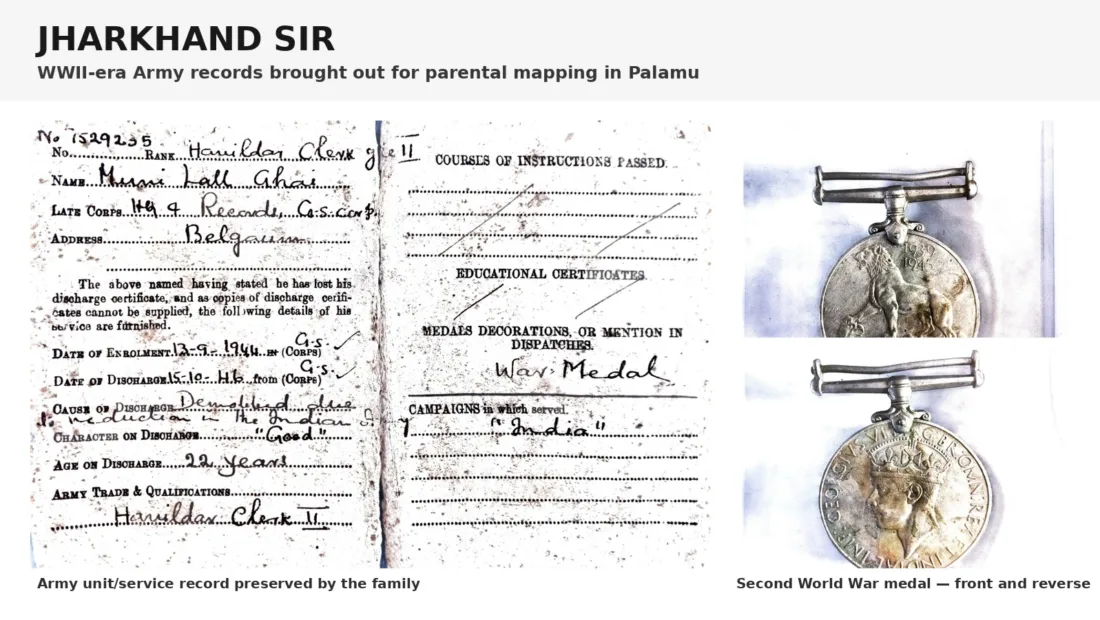
Daltonganj, August 28: A family originally from Amritsar has brought out a prized piece of its history—a Second World War medal and an Indian Army unit record dating back to 1953—to establish its family lineage during the ongoing Special Intensive Revision (SIR) of electoral rolls in Jharkhand’s Palamu district.
The family, which has been settled in Palamu for nearly five decades and is well known in the area, produced the documents at an SIR camp at Palamu Club as part of the process of establishing its parental linkage, or progeny mapping.
For the family, the decades-old military records are more than historical memorabilia. They are a record of their father’s service in the Indian Army and a part of the family’s Indian roots.
Ashwini Ghai, 67, a journalist, said his brother Narender Kumar Ghai visited the Palamu Club SIR camp carrying the Second World War medal awarded to their father, Munni Lall Ghai, along with his Army unit record dated May 10, 1953.
“Our father was a Havildar Clerk and had served in the Indian Army. We originally came from Amritsar and later resettled in Palamu,” Ghai told this correspondent.
Munni Lall Ghai, who served in the Indian Army during the Second World War, died in 1999 in what was then undivided Bihar.
Ghai said the family’s decision to produce the old military records was prompted by the notice received in connection with the SIR exercise.
ALSO READ: Resentment grows among Jharkhand IFS officers over delay in transfer, posting

‘Wonder, admiration and respect’ at SIR camp
Recalling the reaction at the Palamu Club camp, Ghai said the officials appeared surprised and impressed when the medal and military record were shown to them.
“It was a mix of wonder, admiration and respect. The team appeared proud of our father, Munni Lall Ghai, who had served as an Indian soldier,” he said.
The family, however, said the SIR camp team did not retain photocopies of either the Amritsar unit record or the War Medal.
“My brother handed over a copy of the passport as a document,” Ghai said.
The family remains hopeful that its progeny mapping will be completed promptly on the basis of the documents submitted.
Progeny mapping a challenge for many electors
Assistant Electoral Registration Officer Amardeep Walhotra at the Palamu Club SIR camp said establishing parental linkage can be particularly challenging among electors from the labour class, many of whom do not have documentary records readily available.
“Progeny mapping of labour-class electors is highly challenging as they often do not have any papers or documents with them,” Walhotra said.
He added that in some cases, electors refer to parents who had received pensions. Officials then ask them to submit relevant documents, such as pension records, to establish the required linkage.
Sources said the Palamu Club SIR camp has been witnessing a relatively brisk pace of disposal compared with some other camps, where confusion and crowding have been reported.
Women have also been turning up at the camps on behalf of male family members who are away for employment or work.
Quick assistance at Palamu Club camp
During a visit to the Palamu Club SIR camp on Thursday, August 27, this correspondent saw a woman elector who received a death-related message on her phone and requested that her case be dealt with quickly.
Walhotra intervened and allowed her to move ahead in the queue, enabling her to complete the process within minutes.
72,760 electors in five constituencies under ‘no mapping’ category
The Ghai family is not currently listed under the “no mapping” category, and Ashwini Ghai said the family expects its parental mapping to be completed soon.
He said the family was providing relevant documents to establish its lineage and its roots in India.
According to figures available for Palamu, the district’s five Assembly constituencies have a combined 72,760 electors under the “no mapping” category.
Daltonganj Assembly constituency accounts for the highest number, with 21,090 such electors.
Officials are working to bring electors in the “no mapping” category into the mapped category by establishing the required family linkages and verifying supporting documents.
Footfall at the SIR camps has been increasing, although turnout has reportedly slowed somewhat around the recent festivals of Eid Milad-un-Nabi and Raksha Bandhan, which fell within a short interval of each other.
For the Ghai family, however, the SIR exercise has brought an unexpected moment of reconnection with a chapter of its history—one preserved for more than seven decades in an Army record and a Second World War medal belonging to a father who served India.