







SAMEER AHMAD
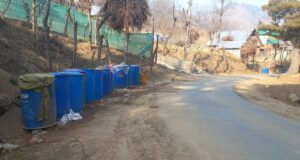
Anantnag, Jammu and Kashmir: Blue plastic drums lined up on the roadside are the lifelines of people of Cherhard in Kokernag of Anantnag district. The village lies on a hillock, about 30 km from Anantnag and about 10 km from Kokernag Botanical Garden.

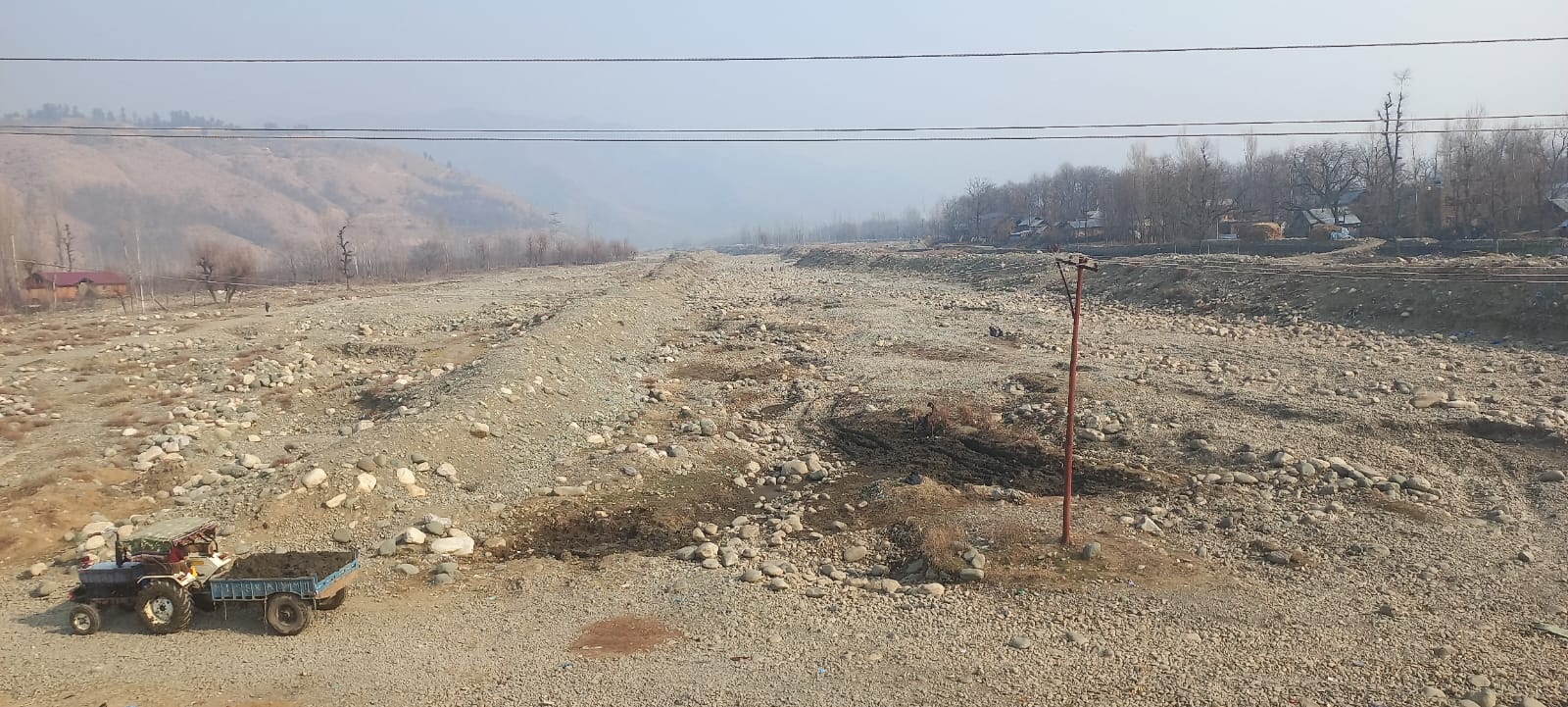
The village women used to walk over a km down the hilly terrain daily to fetch potable water from Brengi nullah, but with the weather being exceptionally dry since mid-November, the nullah also dried up. So now, the households have become fully dependent on the water that the Public Health Engineering (PHE) Department fills up in the two plastic drums that each family has placed on the roadside.
“Our drums used to be filled twice a week for free. But with the dry spell continuing, our quota has been reduced to just once in a week,” complained Manzoor Ahmad Khatana (49). Water from one drum was for household use for the entire week, while the other was to meet livestock needs. He said the villagers here lived below the poverty line and relied on daily wages.

In 2021, the PHE Department started work on a water supply scheme to this Gujjar hamlet under the Jal Jeevan Mission. “We dug up a borewell, but could not find water. After inspecting the place along with consultants, we have proposed to lift water from Kokernag. The scheme will be completed by March end,” Faroze Ahmad, Assistant Executive Engineer, PHE Department, Kokernag, told 101Reporters.
While people suffer due to lack of water, farmers are worried about irrigation. Businesses running on tourist inflow are already hit by snowless December and January.
Also Read- India to be self-sufficient in tur-urad pulses by 2027: Agriculture Minister Arjun Munda
Western disturbances originate in the Mediterranean Sea or Caspian Sea, and bring non-monsoonal rainfall and winter rain to the northwestern parts of the Indian subcontinent. They also cause snow and fog. The temperature along the Mediterranean has increased by 1.4 degree Celsius since one-and-a-half centuries, severely impacting the fragile ecology of Jammu and Kashmir.
United Nations Secretary-General Antonio Guterres, during his visit to Nepal on October 29 last year, acknowledged the change and said that Nepal has lost nearly a third of its ice volume in the last three decades with glaciers melting 65% faster in the last decade than before.
According to the Meteorological Department, this January was one of the driest and warmest January in the last 43 years in Jammu and Kashmir, except in the plains of Jammu (Jammu, Samba and Kathua). Faizan Arif, an independent weather forecaster, said day temperatures are likely to stay several degrees above normal in the coming days.
“Jammu and Kashmir’s combined rain and snowfall situation has become critical with December 2023 and January 2024 recording deficits of 79% and 91%, respectively. When we talk about the previous winter, it was 78% deficit in December 2022, followed by a surplus rain/snowfall of 42% in January 2023,” he said.
Both escalating rainfall deficit and dry spells contribute to declining water levels in rivers and depleting groundwater resources. Sustainable water management practices and exploring alternative water sources are crucial to mitigate the potential long-term damage.
The persistent dry season has raised the Kashmir Valley’s day temperature above normal. Chillai kalan, the 40-day severe winter period in Kashmir, was supposed to begin on December 21 last year and last till January 31 this year. However, the dry spell has so far prevented snow accumulation in the upper reaches, which normally helps recharge glacial ice. At the same time, in a shift in weather pattern, Kashmir Valley and Ladakh witnessed record-breaking cold on February 1 and 2.
In his book Water Polity and Kashmir, Rao Farman Ali said that Jammu and Kashmir has 3,642 glaciers, and almost all of them are melting very fast [due to high temperatures]. One or two glaciers have already disappeared. This phenomenon can be observed across the Himalayan belt and the Pamir mountain range.
Agriculture hit
Lack of snow and rains points to the tough days awaiting the farming community. In his book, Ali said that the food grain requirement in Jammu and Kashmir was 23 lakh metric tonne (MT) of which four lakh MT was produced locally. It is quite clear that producing even that meager quantity of food grain would become an insurmountable challenge if the dry spell continued.
While snowfall eluded December and January, the first week of February has brought optimal snowfall to the region. However, in view of the likely less satisfactory snow accumulation in the mountains, paddy cultivators could be more affected than other farmers. The water-intensive crop needs irrigation from late April to mid August. The erratic seasons have made it a challenging task for all farmers to decide when to sow their crops.
Almost all power projects in Jammu and Kashmir are hydroelectric in nature. The dry spell has reduced 70% of their efficiency. This trend might continue in the mid and late summer season and force common man to bear with an erratic power supply with huge power curtailments.
“Snowless winters can have a substantial impact on glacier accumulation and recession. Without snow, glaciers may have less ice accumulation and the heat will accelerate the recession or melting process resulting in low river water discharge in future. This can have a negative impact on agriculture as farmers rely on river water for irrigation. The current dry spell and extreme heat have reduced river flow, hampering dam refilling and negatively affecting hydropower output,” Dr Masoon Ahmad Beig, an expert in environmental geography and lecturer at Government Degree College, Kulgam, told 101Reporters.
Winter droughts may cause water stress, increased fire risk, soil erosion and increased disease and pest susceptibility in forests and agriculture. Both dry weather and heat will disrupt natural cycles, plant-pollinator interactions, and affect crop growth and productivity. An overall decline in biodiversity, social and economic strain, and displacement among communities could be noticed.
Also Read- Jharkhand Weather: IMD forecasts clear weather and drop in min. temp. from tomorrow
Anantnag district relies on glacial melts for water sources. “Changes in precipitation patterns could result in water scarcity, affecting irrigation practices in south Kashmir. Irregular rainfall and increased evaporation rates may lead to drought conditions, impacting crop yields and overall farm productivity,” Aijaz Ahmad, Chief Agriculture Officer, Anantnag, told 101Reporters.
South Kashmir is known for apples and other fruits. Changes in temperature and precipitation patterns may affect the quality and quantity of fruit yields, impacting horticultural farmers. Aijaz said concerted efforts to mitigate climate change, develop resilient agricultural practices, and empower farmers to adapt to the changing environment were the need of the hour.
Kokernag Sub-divisional Magistrate Suhail Ahmad told 101Reporters that sustainable practices to ensure judicious use of resources should be followed to tide over the crisis. A few administrative orders have been issued in this regard recently.
Action plan of local bodies
After the 2018 election, panchayat administration work has not been easy. “Restrictions following the abrogation of Article 370 affected panchayat operations in late 2019. The next two years were snatched away by COVID-19,” said Advocate Farooq Ahmad Ganie, former sarpanch, Sadiwara.
The panchayats have completed their full term on January 9, and are directly operated by Rural Development Department officials now.
“Panchayats play an important role in resolving disputes within the farmer community, especially water disputes… Since the powers rest with the administrators until the next panchayat elections, the administration must draft and share the plans and proposals with gram sabha before the expiry of plans and proposals,” he added.
“There is a set mechanism to take care of plan formation by way of organising gram sabhas with or without the existence of Panchayati Raj Institutions. A special campaign was organised after October 2 for the formation of Gram Panchayat Development Plan,” Reyaz Ahmad, Assistant Commissioner Development, Anantnag, told 101Reporters.
In view of the dry spell, Rural Development and Panchayati Raj Department has given special focus to rain harvesting and water conservation efforts in Anantnag district. “Consequently, works related to water harvesting tanks, check dams, renovation of ponds, springs, irrigation channels and other traditional water bodies have been incorporated in the panchayat level plans. Also, field functionaries have been advised to identify unused wells, so that groundwater recharge works can be taken up to augment the groundwater table,” he said.
Also Read- Supreme Court invalidates Electoral Bond scheme deeming it unconstitutional
However, Ganie felt all proposed plans should be whetted keeping in mind the upcoming 30 years, to ensure sustainable development and safeguarding of water bodies for a better tomorrow.
(Sameer Ahmad is a Kashmir-based freelance journalist and a member of 101Reporters, a pan-India network of grassroots reporters.)

