Palamu Nilgai attack victim’s family gets first ₹1 lakh compensation instalment
THE JHARKHAND STORY NETWORK DALTONGANJ, November 28: The family of Manoj Tiwary, who was killed in a collision with a Nilgai on…
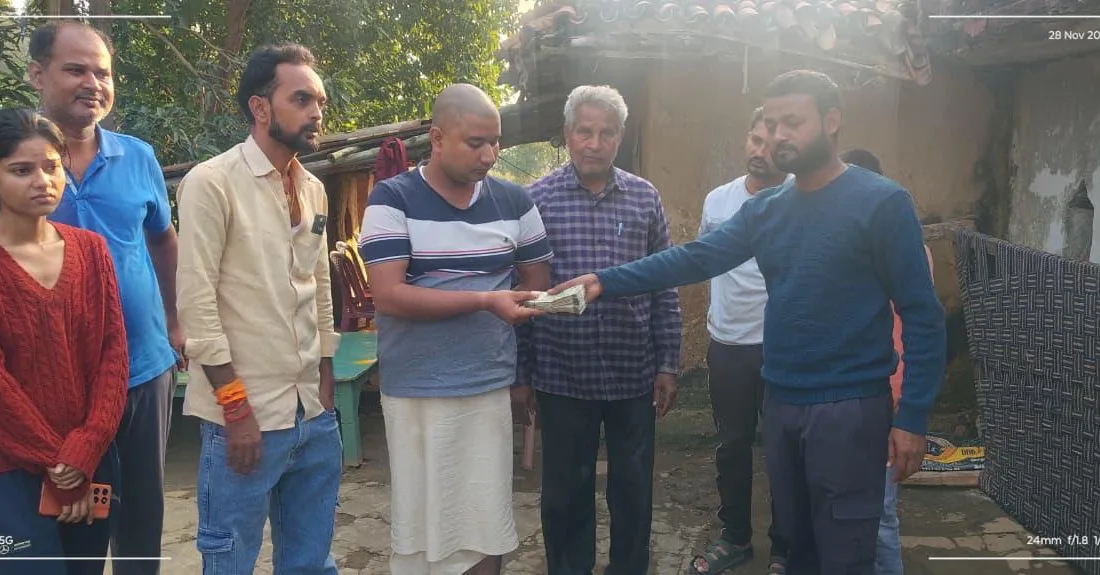
Son of the deceased Manoj Tiwary receives ₹1 lakh in compensation from Bishrampur beat forest officer-in-charge Gaurav Nirala on Saturday.
THE JHARKHAND STORY NETWORK
DALTONGANJ, November 28: The family of Manoj Tiwary, who was killed in a collision with a Nilgai on NH-39 in Palamu, received the first instalment of compensation amounting to ₹1 lakh on Saturday, less than 24 hours after the incident.

Acting on the instructions of Medininagar Divisional Forest Officer (DFO) Satyam Kumar, Bishrampur beat forester-in-charge Gaurav Nirala handed over the amount in cash to the deceased’s son, Amrit Nutan Tiwary, at their residence in Tolra village under Rehla police station limits.
Manoj Tiwary, 55, was killed on Friday night when a Nilgai collided with his motorcycle while he was returning home on NH-39.
Forest department sources said the remaining ₹4 lakh of the immediate cash component would be released after the division receives the post-mortem report, death certificate and police statement relating to the incident.
The Jharkhand government has increased the ex gratia assistance for human deaths caused by wildlife from ₹4 lakh to ₹10 lakh in 2026. Under the revised arrangement, ₹5 lakh is payable in cash, while the remaining ₹5 lakh is to be placed in a bank term deposit in the name of a family member, with a minimum lock-in period of five years.

The first instalment was handed over to Amrit Nutan Tiwary, who is above 18 years of age. The deceased is survived by his wife, son and a minor daughter.
Forest department plans Nilgai-prone zone mapping
Speaking to this correspondent, DFO Satyam Kumar said the forest division would prepare a vulnerability map identifying areas prone to Nilgai-related road accidents.
The map will be shared with the Sadak Suraksha Samiti to facilitate caution notices and preventive measures.

“There will be caution/ warning sign boards across the road/NH declaring the zone as Nilgai-prone to alert motorists, whether of two-wheelers or four-wheelers, to be on guard against sudden and abrupt appearance or charging of the Nilgai,” the DFO said.
The division is also considering underpasses to improve the safety of both Nilgai and road users.
Kumar said stretches of roads and highways close to agricultural fields would be kept under watch by forest personnel.
Forest officials distinguish collision from human-wildlife conflict
The DFO said the incidents reported so far involved individual Nilgai rather than herds. He suggested that sudden encounters with a lone animal could leave motorists with little time to react.
“It’s no human-Nilgai conflict at all. It’s a case of mishap. It’s just a fatal collision between Nilgai and human. Chance and place matter most in such a collision,” Kumar said.
He added that a collision could occur before either the animal or the motorist had enough time to anticipate its consequences.
According to sources, Nilgai may become unsettled by sharp lights and vehicle horns and can collide with motorists. Their sudden appearance on roads, particularly near agricultural areas, poses a risk to road users.
Residents call for greater public awareness
Civilian Anil Gupta said people in Palamu were more accustomed to being cautious about elephants, while Nilgai had emerged as a relatively new source of concern.
He observed that residents would need time to understand the animal’s behaviour and develop ways to avoid sudden encounters.
Palamu Tiger Reserve has already identified elephant zones within its territory and issued alerts to people. The Medininagar forest division is now working towards a similar identification of Nilgai-prone stretches along roads and highways.
The developments have also drawn attention to the need for the Sadak Suraksha Samiti to consider wildlife-related road fatalities as part of its broader assessment of accidents on highways.