








SUMAN K SHRIVASTAVA
 Ranchi, Dec. 26: Chief Minister Hemant Soren’s interaction with tribal organisations over the approval of the PESA Rules on Friday underlines a renewed political emphasis on tribal self-governance and village-centric administration in Jharkhand. The meeting with representatives of the Central Sarna Committee, Raji Padha Sarna Prayer Assembly, and other tribal bodies takes place at a time when the ruling dispensation is seeking to reinforce its ideological and electoral base among the Scheduled Tribes, who form the political backbone of the state.
The delegation’s symbolic welcome, accompanied by traditional drumbeats, reinforced the cultural and political messaging surrounding the decision, projecting the PESA Act implementation in Jharkhand as both a governance reform and a reaffirmation of tribal identity.

PESA Act: Governance Reform with Political Weight
The Panchayats (Extension to Scheduled Areas) Act, long demanded by tribal groups, is expected to significantly alter the power dynamics at the grassroots level by strengthening Gram Sabhas in Scheduled Areas. By granting decision-making authority over local resources, land use, and development priorities, the law aligns closely with Jharkhand’s historical resistance to centralised control over tribal regions.
Politically, the Cabinet approval allows the Hemant Soren-led government to position itself as a defender of jal, jangal aur zameen, a phrase deeply embedded in Jharkhand’s political discourse. The Chief Minister’s repeated references to ancestral struggles and sacrifices were aimed at reinforcing this narrative.
Reclaiming the Statehood Narrative
In his remarks, CM Soren invoked the long struggle for a separate Jharkhand state, reminding audiences that statehood in 2000 was the outcome of sustained tribal movements. This framing places the current PESA decision within a broader historical continuum, allowing the government to argue that it is correcting post-statehood governance gaps that diluted tribal autonomy.
Since Jharkhand’s formation, frequent political instability and policy reversals have often weakened institutional trust among tribal communities. By foregrounding PESA, the current government is 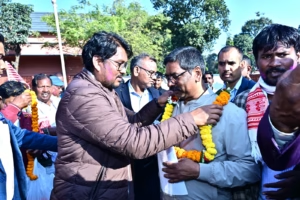 attempting to re-anchor governance in the original ideological promise of the Jharkhand movement.
Countering Misinformation and Consolidating Rural Support
The Chief Minister’s emphasis on public awareness of the PESA Rules reflects an acknowledgement of competing political narratives in rural and tribal areas. Allegations of misinformation and misinterpretation of laws often shape village-level political mobilisation. By urging community leaders to educate villagers, the government appears keen to control the narrative surrounding PESA’s implementation and pre-empt political opposition.
His remarks on protecting “innocent rural people” from exploitation also signal a broader political message: positioning the state government as an intermediary between tribal communities and market or bureaucratic forces.
Jobs, Youth, and Governance Credibility
The reference to the appointment of nearly 10,000 youths to government posts serves as an attempt to link identity-based politics with governance performance. In a state where unemployment remains a politically sensitive issue, the government is projecting administrative action alongside cultural symbolism to strengthen its credibility.
This dual messaging—tribal rights combined with employment generation—suggests a calibrated political strategy aimed at both traditional supporters and aspirational youth.
Village-Centric Politics as Electoral Strategy
The repeated assertion that “strong villages make a strong state” reinforces the Hemant Soren government’s emphasis on decentralised governance. In political terms, this approach resonates strongly in Scheduled Areas, where distrust of top-down policy-making remains high.
As Jharkhand navigates future electoral and governance challenges, the PESA Rules approval may emerge as a defining political marker. Its success, however, will depend less on symbolic endorsement and more on effective implementation, capacity-building at the Gram Sabha level, and the state’s ability to withstand legal and administrative challenges.
For now, the move positions the Hemant Soren-led government firmly within the ideological framework of Jharkhand’s tribal politics, seeking to reclaim both historical legitimacy and contemporary political momentum.
