







THE JHARKHAND STORY NETWORK
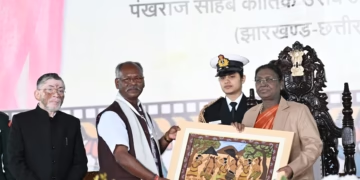
Gumla/Ranchi, Dec. 30: President Droupadi Murmu on Tuesday emphasised the need to preserve tribal identity while moving on the path of development, as she addressed the Antarrajyiy Jansanskritik Samagam Samaroh – Kartik Jatra in Gumla, Jharkhand. The inter-state cultural gathering brought together people from Jharkhand, Odisha, and Chhattisgarh.
The President stated that the rivers, mountains, and forests of the Gumla region are a testament to India’s ancient civilisation and rich tribal traditions. She described the event as a confluence of tribal and non-tribal communities.

“My Family Is 140 Crore Indians”
Addressing the gathering, President Murmu said, “My family consists of 140 crore countrymen. I am a daughter of the tribal community in this vast family.” She said the time has not yet come for her to be called the Mother of the Nation, adding that she would prefer to remain a sister or mother to the people.
She said she felt a strong sense of belonging among the people of Gumla and the surrounding regions.
Youth Must Stay Connected to Tribal Traditions
The President stressed that it is crucial to connect the youth and future generations with the traditions of tribal communities. She advised young people to move forward on the path of development while preserving their tribal culture, heritage, and identity, saying progress should not come at the cost of tradition.
Jharkhand Tenure and Birsa Munda’s Legacy
Recalling her six-year tenure as Governor of Jharkhand, President Murmu said she closely understood the lives and challenges of the people. Visiting the birthplace and workplace of Dharti Aba Birsa Munda, she said, felt like a pilgrimage.
She urged citizens to follow Birsa Munda’s ideals and work collectively for social and national development.
Kartik Oraon and Tribal Empowerment
Paying tribute to Kartik Oraon, the President said he played a significant role in strengthening tribal consciousness, identity, and self-respect by following the ideals of Birsa Munda. Kartik Oraon worked to protect tribal land, forests, and rights across Jharkhand, Chhattisgarh, and Odisha.
She said his contribution extended beyond the tribal community, as he held important constitutional positions and strongly promoted education as a means of empowerment. His legacy continues to inspire tribal communities to protect their rights while embracing modern development.
Education Is the Key to Development
President Murmu said education is the foundation of progress for individuals, families, and society. She noted that Jharkhand, Odisha, and Chhattisgarh are blessed states, and the Chief Ministers of all three belong to tribal communities.
She stated that no department can truly progress unless education advances and expressed her intention to help establish a university in the Gumla region. With public cooperation, she said, the proposal would succeed.
Antyodaya and Welfare Schemes
The President said the government believes in Antyodaya, ensuring that development reaches the poorest and the last person in society. She highlighted the establishment of Eklavya Model Residential Schools and various welfare schemes launched in the name of Birsa Munda, whose birth anniversary is now celebrated across the country.
“Tribal Community Still the Most Backward”
Despite ongoing efforts, President Murmu said the tribal community remains the most backward. Many still lack land, housing, and food security and continue to live in forests.
She said that during her tenure as Governor, 75 tribal communities in Jharkhand were found without land or houses. She also recalled that the land of the Tana Bhagats, earlier unregistered, was registered for one rupee during her tenure. The government, she said, is working in mission mode for their upliftment.
Gumla: Land of Heroes
Calling Gumla a land of heroes, the President remembered Param Vir Chakra awardee Albert Ekka, noting that a postage stamp has been issued in his name and his portrait and biography are now permanently displayed at the Param Vir Chakra Gallery at Rashtrapati Bhavan.
She also highlighted the role of sports, tribal art forms, and youth participation, saying both men and women must come forward for economic and social empowerment.
Naxalism Weakening in Chhattisgarh
Addressing the event, Chhattisgarh Chief Minister Vishnu Deo Sai said the state had long suffered due to Naxalism. With a double-engine government, peace is returning to the Bastar region. Roads, electricity, drinking water, ration cards, health centres, and schools are reaching remote areas, and Naxalism is taking its last breath, he said.
