






THE JHARKHAND STORY NETWORK
Ranchi, March 14: A three-day Agrotech Farmers’ Fair began on Saturday at Birsa Agricultural University (BAU), with Union Minister of State for Defence Sanjay Seth urging scientists and farmers to work together to develop Ranchi as the Millets Capital of India.
Call to promote millets and nutritious grains
Inaugurating the fair, Seth said that people in India had gradually moved away from millets over the last three decades. However, due to the efforts and inspiration of Prime Minister Narendra Modi, both production and consumption of millets have increased significantly in the past five years.
He noted that millet-based dishes are now becoming popular even in hotels and social gatherings.

The minister also said that the defence ministry is willing to sign an agreement with BAU so that ragi (madua) biscuits and other millet products developed by the university can be supplied to military canteens across the country.
He urged scientists to also develop nutritious food formulas for soldiers who guard the nation’s borders, even in extreme temperatures of minus 40 degrees Celsius.
Emphasis on organic farming in Jharkhand
Seth highlighted the potential of organic agricultural produce in Jharkhand, saying that the taste of Ranchi’s tomatoes, papaya, jackfruit, peas, and capsicum is unmatched by produce from other states. Even while living in Delhi, he said, he prefers vegetables brought from Ranchi.
He also mentioned that under the Pradhan Mantri Kisan Samman Nidhi scheme, about 9.32 crore farmers in the country receive ₹6,000 annually, including 2.15 crore women farmers.
Farmers above 60 years of age receive a monthly pension of ₹3,000, including 2.53 lakh farmers from Jharkhand. He added that 82 crore people in the country have been receiving 5 kg of free ration every month for the past five years.
Jharkhand government promoting ‘Madua Kranti’
As the Guest of Honour, Jharkhand Agriculture, Animal Husbandry and Cooperative Minister Shilpi Neha Tirkey said the state government has launched the Madua Kranti Yojana, under which farmers cultivating madua (finger millet) receive an incentive of ₹3,000 per acre.
She pointed out that Telangana increased the area under madua cultivation from 20,000 hectares to 1 lakh hectares within two years, and Jharkhand should aim to achieve similar progress.
Tirkey said that in the era of climate change and uncertain rainfall, farmers must combine traditional agricultural knowledge with modern technology.
Training and support for farmers stressed
Kanke MLA Suresh Kumar Baitha emphasised strengthening advisory services and training programmes for farmers and rural communities. He also urged the government to formulate a policy for permanent employment of daily-wage workers at BAU.
Agriculture Secretary Abubakar Siddiqui was also present at the event.
The programme began with a welcome address by BAU Vice-Chancellor Dr. S. C. Dubey, while the vote of thanks was delivered by Director of Extension Education Dr. Rekha Sinha. The event was conducted by Shashi Singh.
Progressive farmers honoured
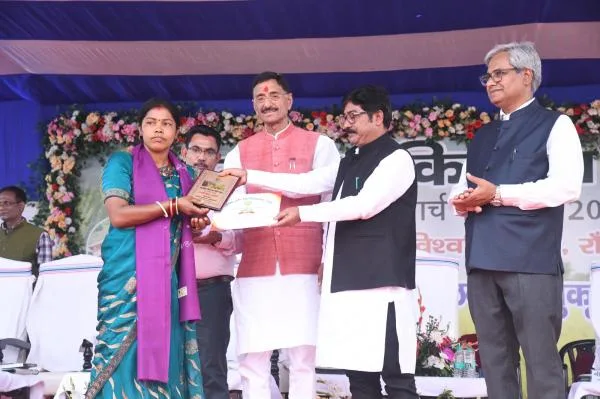
On the occasion, 14 progressive farmers were honoured for their contributions to innovative farming and animal husbandry. They included:
- Rupa Sinha and Dootilal Bedia (Angara, Ranchi)
- Rajesh Kumar Munda and Sangeeta Devi (Peterwar, Bokaro)
- Narmada Pathak and Kishore Kumar Manjhi (Dumka)
- Ayodhya Bind and Upendra Singh (Garhwa)
- Arun Oraon and Kewal Oraon (Latehar)
- Madhu Marandi and Dharamraj Mandal (Sahebganj)
- Shakti Kumar and Bigan Kharwar (Lohardaga)
135 stalls showcase farm technologies
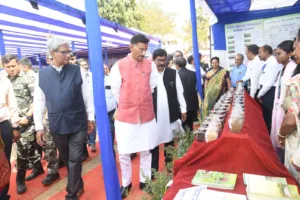
A total of 135 stalls have been set up at the fair. These include stalls from BAU departments, colleges, regional research stations, Krishi Vigyan Kendras, ICAR institutes, agricultural departments, seed and machinery companies, banks, financial institutions and NGOs.
At the food processing stalls, more than 25 millet-based products made from madua, sorghum and pearl millet are being displayed, including cookies, biscuits, cakes, laddus, mathri, pasta, vermicelli, chowmein and macaroni.
A battery-operated machine for madua transplantation is also being demonstrated.
The Veterinary Faculty stall showcases models related to animal health and productivity in the context of climate change, and also demonstrates the harmful effects of cattle consuming single-use plastic along with fodder.
In the horticulture exhibition, which includes fruits, flowers, vegetables, spices, ornamental, medicinal and aromatic plants as well as processed fruit products, 1,115 entries have been received from farmers, homemakers and entrepreneurs.
