Sitaram Maroo: The Man behind Jharkhand’s first RSS shakha
SUMAN K SHRIVASTAVA Ranchi, Sept. 29: As the Rashtriya Swayamsevak Sangh (RSS) marks its centenary year, Ranchi is preparing to celebrate the…
SUMAN K SHRIVASTAVA
Ranchi, Sept. 29: As the Rashtriya Swayamsevak Sangh (RSS) marks its centenary year, Ranchi is preparing to celebrate the 100th birth anniversary of Sitaram Maroo, the man who organised the first RSS shakha in what is now Jharkhand. Back in the 1940s, when the Sangh was just beginning to expand beyond Maharashtra, Maroo laid the foundation of its presence in the Chotanagpur region, then part of undivided Bihar. His pioneering effort would go on to shape Jharkhand into a bastion of nationalist politics and later a stronghold of the Bharatiya Janata Party (BJP).
The First Shakha
In 1946, Sitaram Maroo opened the first RSS shakha in Ranchi, introducing the organisation’s discipline and ideology to the tribal heartland. This beginning laid the groundwork for the Sangh’s steady rise in the region, which was later to become a key theatre for nationalist politics.
Though Jharkhand was carved out of Bihar in 2000, the Sangh’s roots in the area go back to this period. Ranchi and Jamshedpur became early centres of activity for the RSS, attracting local youth and sowing the seeds of a movement that would consolidate over decades through social work, education, and political mobilisation.
Stay informed. Get Jharkhand's top stories in your inbox.
Free. No spam. Unsubscribe anytime.
Sitaram Maroo: Life of Discipline and Service
Born on October 11, 1925, in Ranchi, Sitaram Maroo was the son of Chauthmal Maroo, who had migrated from Rajasthan. From a young age, Maroo was drawn to the Sangh, balancing business with service and activism. In 1948, when RSS chief M.S. Golwalkar was arrested after the assassination of Mahatma Gandhi, Maroo led protests in Ranchi. He and 16 others were jailed for six months, cementing his reputation as a committed swayamsevak.
Maroo also contributed to society in multiple ways—establishing charitable institutions like Nagarmal Modi Seva Sadan hospital in 1958, starting the Ranchi Express newspaper in 1963 (later one of the most widely read dailies of South Bihar), and founding Sanskriti Vihar in 1986, which continues to run schools and medical camps in rural Jharkhand. Yet, his identity remained firmly tied to the RSS, which shaped both his ideology and his lifelong mission.


📌 Timeline: RSS in Jharkhand (erstwhile South Bihar)
1943 – Kushabhau Thakre establishes an RSS shakha in Pachtaurgarh, inspiring the young Sitaram Maroo.
1946 – First RSS shakha in Ranchi organised by Sitaram Maroo. Simultaneously, Babuaji starts a shakha in Jamshedpur.

1948 – After RSS chief M.S. Golwalkar’s arrest, protests led by Maroo in Ranchi. He and 16 swayamsevaks jailed for six months.
1950s–60s – Sangh expands in Ranchi, Jamshedpur, Hazaribagh, Dhanbad. Associated organizations like ABVP, Vanvasi Kalyan Kendra, and Bharatiya Mazdoor Sangh take root.
1963 – Maroo launches Ranchi Express, which becomes the ideological voice of the region.
1970s – RSS cadre base strengthened during the Emergency and Ram Janmabhoomi movement.
2000 – Jharkhand carved out of Bihar; BJP, with RSS support, forms the first government under Babulal Marandi.
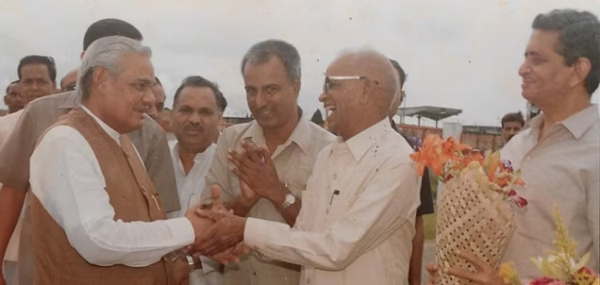
2003 – Sitaram Maroo passes away after celebrating 40 years of Ranchi Express in a function attended by Vice President Bhairon Singh Shekhawat.
Building the Sangh in South Bihar
The rise of RSS in the region was not the work of one man alone. Alongside Maroo, figures such as Kushabhau Thakre, Sundar Singh Bhandari, Nanaji Deshmukh, and Kailashpati Mishra played crucial roles in consolidating the organisation’s presence in South Bihar. Their efforts extended beyond shakhas—they promoted cultural nationalism, organised social service initiatives, and built institutions that connected the Sangh with local communities.

By the 1960s and 70s, RSS had become a significant force in Ranchi, Jamshedpur, Hazaribagh, and Dhanbad. The Sangh’s reach grew further through affiliated organisations such as the Akhil Bharatiya Vidyarthi Parishad (ABVP), Vanvasi Kalyan Kendra, Vikas Bharti and Bharatiya Mazdoor Sangh, which connected students, tribal communities, and industrial workers with the broader ideological framework of the Sangh Parivar.
From Sangh to Politics: The BJP’s Bastion
The organisational work of the RSS gradually translated into political capital for the Bharatiya Jana Sangh and later the Bharatiya Janata Party. South Bihar, especially Ranchi and Jamshedpur, became a BJP stronghold from the late 1980s. The Ram Janmabhoomi movement further energised the cadre base in Jharkhand, strengthening the BJP’s dominance.
When Jharkhand was carved out of Bihar in 2000, the BJP naturally emerged as the ruling party, with Babulal Marandi as the state’s first Chief Minister. The foundation for this rise, however, was laid decades earlier by swayamsevaks like Sitaram Maroo, whose quiet but determined work built the Sangh network in the region.
Centenary Celebration in Ranchi
On October 11, Ranchi will commemorate Sitaram Maroo’s birth centenary. The event comes at a symbolic moment, coinciding with the centenary of the RSS itself. Leaders and organisations associated with the Sangh are expected to participate, highlighting the intertwined legacy of Maroo’s personal journey with the larger trajectory of the Sangh in Jharkhand.
While the BJP’s political fortunes in Jharkhand have seen ups and downs in recent years, the ideological and organisational base created by the RSS remains intact. The story of Sitaram Maroo and the first shakha in Ranchi stands as a reminder of how the Sangh spread its roots in distant corners of India, often through the dedication of individuals who combined personal sacrifice with a larger sense of mission.
A Lasting Legacy
Sitaram Maroo passed away in December 2003, just weeks after celebrating the 40th anniversary of Ranchi Express with Vice President Bhairon Singh Shekhawat as the chief guest. His youngest son, Ajay Maroo, later served as a Rajya Sabha MP from Jharkhand for the BJP.
As the Sangh looks back on a hundred years, the memory of pioneers like Maroo—and the shakhas they planted in places like Ranchi and Jamshedpur—offers both inspiration and perspective. It shows how the seeds of an idea, sown in a small town, can grow into a movement that reshapes the political and cultural life of a state.