Sona Devi University hosts seminar on Indian knowledge system and contemporary global challenges
THE JHARKHAND STORY NETWORK Jamshedpur, October 30: Sona Devi University, Ghatshila, organised a two-day national seminar on “Contemporary Global Scenario and Indian…
THE JHARKHAND STORY NETWORK
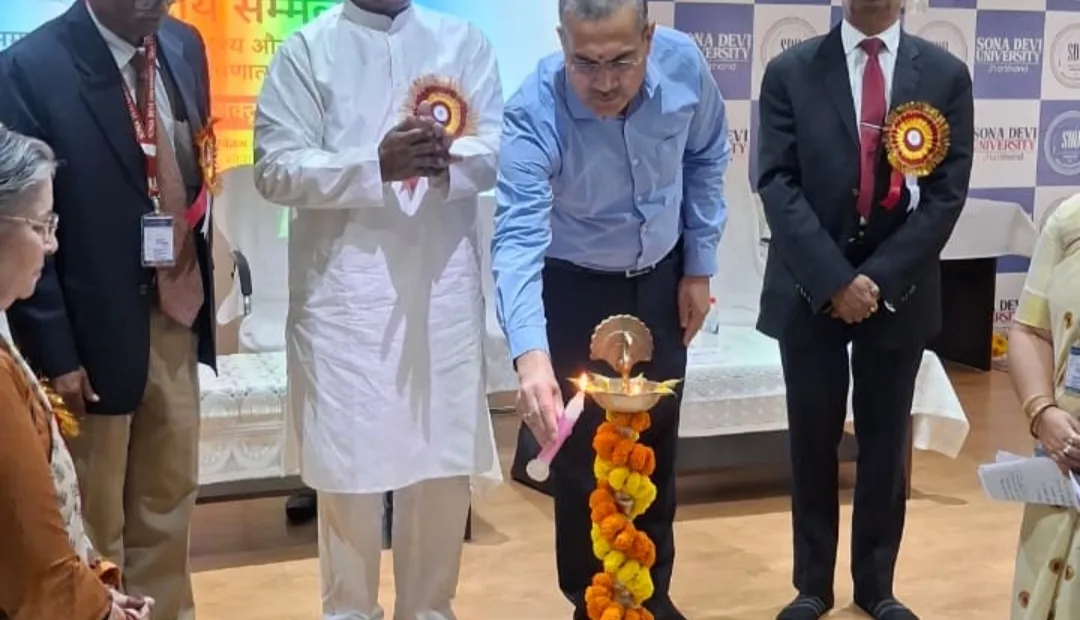
Jamshedpur, October 30: Sona Devi University, Ghatshila, organised a two-day national seminar on “Contemporary Global Scenario and Indian Knowledge System: An Analytical Discourse”, bringing together eminent academicians, researchers and policymakers to deliberate on the relevance of India’s rich intellectual and cultural heritage in addressing contemporary global challenges.
Held at the university’s Swami Vivekananda Auditorium, the seminar focused on integrating traditional Indian knowledge with modern education, science, technology, research and social development.
Eminent Academicians and Policymakers Attend Inaugural Session
The inaugural session was attended by university Chancellor Prabhakar Singh, Vice-Chancellor Prof. Braj Mohan Pat Pingua, Registrar and Dean of Science Nit Nayana, NIT Jamshedpur Director Prof. Gautam Sutradhar, and Jamshedpur West MLA and chairman of the Jharkhand Assembly’s Committee on Delegated Legislation Saryu Roy, among others.
Addressing the gathering, Vice-Chancellor Prof. Pingua stressed the need to promote Indian knowledge traditions amid emerging global challenges such as climate change, technological advancement and innovation.
He urged research scholars to pursue original and innovative research, observing that today’s research would lay the foundation for a progressive India.
NIT Director Highlights Link Between Traditional Knowledge and Modern Science
NIT Jamshedpur Director Prof. Sutradhar highlighted the connections between traditional Indian knowledge and contemporary science and technology.
He encouraged researchers to explore areas such as robotics, greenhouse technology and emerging scientific applications through the lens of Indian knowledge systems.
Chancellor Prabhakar Singh welcomed the initiative to incorporate Indian knowledge systems into higher education.
Referring to India’s ancient intellectual and cultural heritage and the impact of colonial rule on traditional education, he emphasised the need to restore indigenous knowledge traditions to academic discourse. He expressed confidence that these traditions would contribute significantly to the vision of Viksit Bharat by 2047.
Saryu Roy Emphasises Application of Traditional Wisdom
MLA Saryu Roy elaborated on the philosophical foundations of Indian knowledge systems, explaining the distinction between synthesis and analysis.
Referring to Adi Shankaracharya, the concept of zero, Swami Vivekananda, and the Ramayana and Mahabharata, he emphasised the importance of preserving traditional wisdom and applying it to contemporary problems.
He also stressed that knowledge should serve social welfare rather than merely commercial interests.
Speakers Highlight Relevance of Indian Philosophy
Former head of the Sanskrit Department at Kolhan University, Ragini Bhushan, underlined the relevance of the Vedas and Upanishads in understanding present-day societal challenges.
DBMS College of Education Principal Monica Uppal highlighted the contribution of Indian philosophy to modern science, management and leadership.
The programme also featured presentations on the university’s academic initiatives, emerging areas such as artificial intelligence and institutional collaborations.
The inaugural session concluded with a vote of thanks by Kanchan Sinha, Dean of Humanities and Social Sciences, followed by the national song and national anthem.