





THE JHARHAND STORY NETWORK
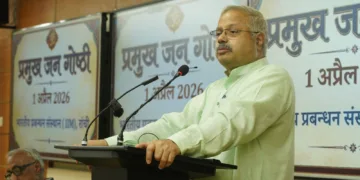
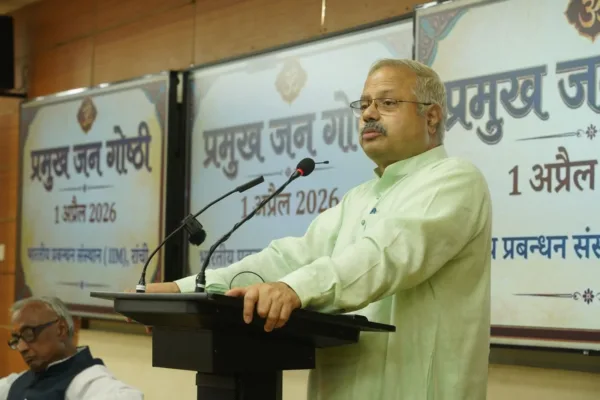
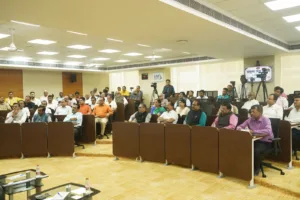
Ranchi, April 1: RSS Akhil Bharatiya Prachar Pramukh Sunil Ambekar on Wednesday addressed a Pramukh Jan Goshti at IIM Ranchi, where a large number of distinguished personalities from education, administration, healthcare, media, and social sectors gathered to discuss the organisation’s 100-year journey, its ideology, and the ‘Panch Parivartan’ roadmap for social transformation.
RSS@100: Journey, Ideology and Growing Outreach
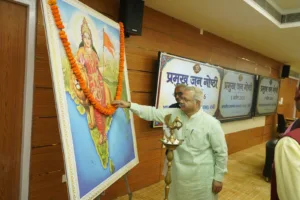
The programme began with the traditional lamp lighting, followed by a welcome address by Rajiv Kamal Bittu, Prant Sampark Pramukh, who emphasised the importance of dialogue and participation in nation-building during the RSS centenary year.
In his keynote address, Sunil Ambekar elaborated on the 100-year journey of the Rashtriya Swayamsevak Sangh (RSS), noting that the organisation, founded on Vijayadashami in 1925, has evolved into a major socio-cultural force. He observed that awareness about the RSS ideology is growing across India, with people from diverse backgrounds showing curiosity and actively engaging in discussions about its work and role in society.
Describing the RSS as more than just an organisation, Ambekar said it is an “experience” that can be best understood through practice, reflecting the views of the current Sarsanghchalak.
Dr Hedgewar’s Vision and Focus on Unity
Ambekar spoke about RSS founder Dr. Keshav Baliram Hedgewar, highlighting his early patriotism and his understanding of the challenges posed by social disunity during British rule. He said Dr. Hedgewar identified the lack of unity across caste, creed, language, and region as a major reason for national weakness, and founded the RSS to build a strong, organised society.
He emphasised that character building and individual development remain central to the RSS model, with daily shakhas promoting discipline, values, and patriotism across thousands of locations in the country.
Panch Parivartan: Roadmap for Social Transformation
A key focus of the address was the concept of Panch Parivartan (Five Transformations), introduced in the RSS centenary year. Ambekar detailed its five pillars—Kutumb Prabodhan, Samajik Samrasta, Paryavaran Sanrakshan, Swabodh, and Nagrik Kartavya Bodh—linking them to broader goals of social harmony, environmental protection, cultural awareness, and civic responsibility.
He stressed that strengthening family values, ensuring social equality, adopting sustainable practices, and encouraging awareness of cultural roots are essential for long-term nation-building.
ALSO READ: NTPC Mining hits 44.16 MMT, becomes dedicated mining arm
Collective Participation and Long-Term Vision
Ambekar reiterated that meaningful societal change depends on the participation of ordinary citizens rather than a select few. He said the RSS works with a long-term vision to build a strong, self-reliant, and organised society through continuous efforts across generations.
Dignitaries and Interactive Session
The event was also graced by Gopal Sharma, Prant Pracharak. Among those present were Deepak Srivastava (Director, IIM), Prof. S. P. Agarwal (Vice Chancellor, Sai Nath University), Dr. Gopal Pathak, Ganesh Reddy (Citizen’s Foundation), Sunil Badal (Editor, Rashtriya Naveen Mail), Suman Shrivastava (Editor, The Jharkhand Story), Sanjay Kumar, Dr. Ajit Sinha, Dr. Rashmi, Dr. Jigyasa Ojha, Pinky Khoya, Rajiv Kamal Bittu, Dr. Triveni Nath Sahu, Dr. Sahdeo Ram, Dr. D. K. Singh (Vice Chancellor, JUT), Mantu Kumar (Vibhag Pracharak), Vishaal Kumar (Mahanagar Pracharak), Deepak Pandey (Mahanagar Karyavah), Vijay Kumar (Prant Sah Prachar Pramukh), Snigdh Kumar Ranjan (Mahanagar Prachar Pramukh), Ravindra (Mahanagar Sampark Pramukh), Santosh Kumar, Ravi Bhushan, Dr. Jyoti Prakash, and several other distinguished citizens.
The programme concluded with an interactive question-and-answer session, where participants raised questions and shared suggestions. Sunil Ambekar responded in a simple yet insightful manner, making the session engaging and meaningful.