






THE JHARKHAND STORY NETWORK
Ranchi, March 17: The Rashtriya Swayamsevak Sangh (RSS) has underlined its growing organisational footprint in Jharkhand while laying out a broader national roadmap ahead of its centenary year. This emerged at the three-day All India Representatives’ Meeting (Akhil Bharatiya Pratinidhi Sabha) held from March 13 to 15 in Samalkha, Haryana.
Wide Participation and Key Deliberations
The meeting brought together 1,438 representatives from 46 provinces across the country, including 31 delegates from Jharkhand. Deliberations centred on organisational expansion, strengthening social harmony, and mobilising what the Sangh described as virtuous and patriotic forces in the national interest.

Strong Organisational Growth in Jharkhand
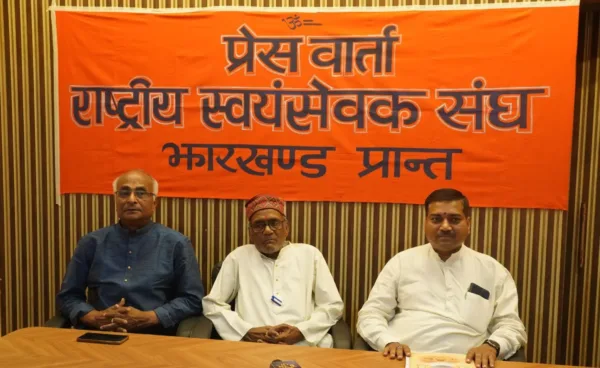
Sharing details of Jharkhand, Prant Karyawah Sanjay Kumar said the organisation has steadily expanded its presence across the state. RSS activities are now being conducted at more than 1,050 locations, with over 1,500 shakhas, milan and mandalis. The network spans urban centres as well as rural areas, reflecting what leaders described as a deepening grassroots reach.
ALSO READ: West Bengal Polls: Why Eastern India needs a resurgent Bengal for Jharkhand to thrive
Expansion Reaches Remote Regions Nationwide
At the national level, the Sangh reported that its activities have grown to over 1.34 lakh units across more than 55,000 locations, including remote and border regions such as the Andaman and Nicobar Islands, Arunachal Pradesh and Ladakh. This expansion, the leadership said, is aimed at strengthening cultural cohesion and national unity.
Focus on ‘Panch Parivartan’ and Social Harmony
The meeting also placed emphasis on qualitative transformation through the concept of “Panch Parivartan,” which focuses on social harmony, family awareness, environmental protection, a swadeshi lifestyle, and civic responsibility.
In this context, a message from Sarkaryavah Dattatreya Hosabale marking the 650th birth anniversary of Sant Ravidas called for reinforcing unity and social goodwill at a time of rising divisions.
Centenary Year Plans and Outreach Initiatives
Looking ahead to its centenary year, the RSS outlined plans for wider public outreach and mass engagement. Recent initiatives were cited to highlight the scale of mobilisation, including large participation in Vijayadashami events and extensive contact programmes reaching lakhs of families across villages.
Jharkhand has also figured prominently in these outreach efforts. Earlier this year, senior RSS leaders visited the state and participated in social harmony meetings attended by thousands of representatives from different communities.
Focus on Tribal Outreach in Jharkhand
A separate Janajati Samvad programme brought together tribal leaders and community representatives to discuss issues related to culture, faith and social challenges, reflecting the organisation’s increasing focus on tribal engagement in the state.
Training and Organisational Strengthening
Training and organisational strengthening remain a key focus area. The Sangh noted that multiple training camps have already been conducted across the country, with more planned in the coming months.
In Jharkhand, a Sangh Shiksha Varg is scheduled to be held in Jamshedpur from May 26, 2026, along with a special camp for participants from the North-East.
Broader Ideological Focus
Beyond organisational matters, the meeting also engaged with broader ideological themes, including the need to strengthen the Bharatiya worldview, move beyond colonial mindsets, and reinforce cultural values in public life.
A Milestone Ahead of Centenary Year
The Samalkha meeting, leaders indicated, was not just a routine organisational review but a milestone in shaping the direction of the Sangh’s future activities. With expansion, outreach and ideological consolidation forming its core agenda, the RSS appears to be positioning itself for a more active role in the run-up to its centenary year.