UNICEF child journalists meet CM Hemant Soren, discuss child rights and education
THE JHARKHAND STORY NETWORK Ranchi, November 20: Ten child journalists associated with UNICEF met Chief Minister Hemant Soren at his residential office…
THE JHARKHAND STORY NETWORK
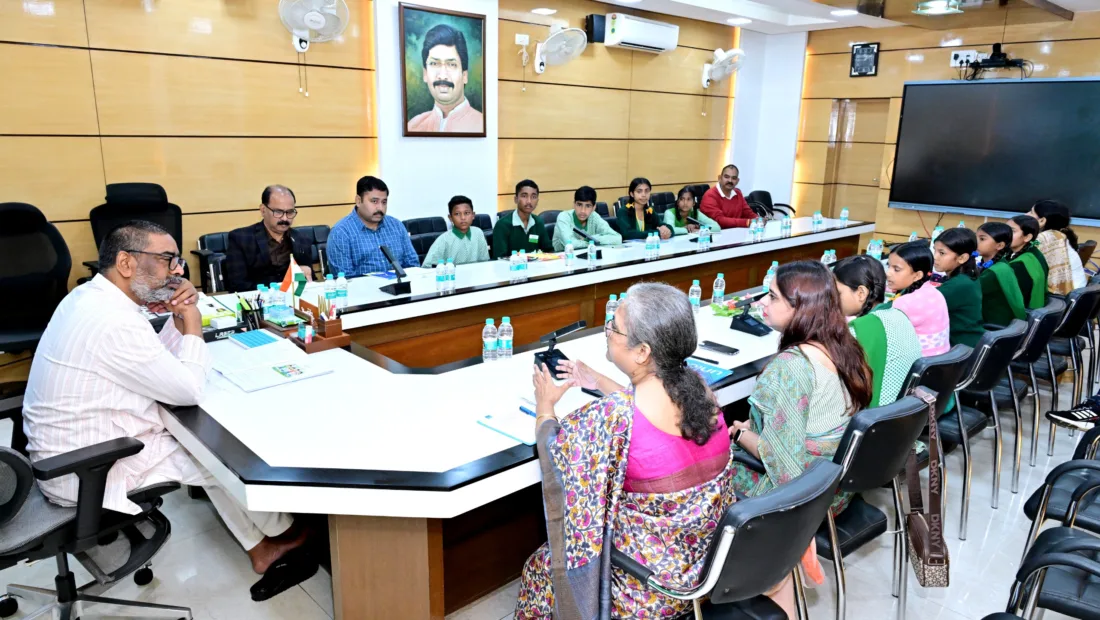
Ranchi, November 20: Ten child journalists associated with UNICEF met Chief Minister Hemant Soren at his residential office on Kanke Road in Ranchi on Thursday, on the occasion of World Children’s Day, and held an interaction on child rights, education, health, social issues and their aspirations for the future.
During the meeting, the children shared their experiences of bringing positive changes to their schools and communities. They told the Chief Minister about their efforts to prevent social problems such as child marriage and child labour and to help children who had dropped out of school return to the education system.
The young journalists also spoke about awareness campaigns on menstrual hygiene management, prevention of non-communicable diseases among children, healthy eating habits and climate change.
Government working to improve school education
Responding to the children’s questions, Soren said the state government was working continuously to improve the quality of school education. He said the government would review the issue of teachers being assigned non-academic duties and explore ways to address it.
The Chief Minister said the government had decided to provide sports equipment to students with a particular interest in sports and develop playgrounds at the panchayat level so that children could nurture their sporting talents alongside their studies.

He also said the Chief Minister’s Excellent Schools initiative was bringing improvements in the academic standards of students.
District-level libraries planned
Soren said libraries were being developed at the district level, emphasising that education was essential for helping children distinguish between right and wrong.
Referring to child marriage, he said the practice was a legal offence and also went against nature. He stressed that marriages should take place only when boys and girls reach the legally prescribed age.

The Chief Minister said state government officials had been directed to spend a day in schools in their respective areas and interact with students. He also highlighted the menstrual hygiene awareness campaigns being conducted in schools and the provision of sanitary pads to girls and women.
Children’s confidence and awareness impress Chief Minister
Addressing the UNICEF officials and child journalists, Soren said their awareness and confidence had consistently impressed him.
“When these children speak about their rights with such clarity and confidence today, I feel proud imagining the kind of leaders they will become when they grow up,” he said, stressing the need for collective efforts to realise their potential and ensure that every child’s voice is heard.
He described children as the most important link in Jharkhand’s future and said their questions, concerns and suggestions should be taken seriously.
According to the Chief Minister, the state government was committed to creating a child-friendly environment in which every child could learn, express themselves, remain safe and get equal opportunities to fulfil their aspirations.
He expressed hope that the experiences of the child journalists would encourage other children to become aware of their rights and speak up for themselves and their communities.
UNICEF’s efforts appreciated
Soren said the issues raised by the children reflected both the state’s development priorities and the challenges they faced in their everyday lives. Listening to children, he added, helped the government understand how effectively its schemes and initiatives were reaching them and whether these programmes were meeting their needs.
Appreciating UNICEF’s efforts, he said such initiatives were important because they made the impact of children’s participation visible and encouraged society to work towards protecting their interests.
UNICEF Jharkhand Chief Dr Kaninika Mitra said the organisation’s 80 years of work with children had reinforced its belief that children should not be viewed merely as beneficiaries of schemes and policies. Their participation should also be ensured in decisions that affect their lives.
She said UNICEF believed in the power of children’s voices and described child journalists as a living example of that potential. It was the responsibility of adults to listen to children, encourage their abilities and provide them with opportunities to move forward, she said.
Mitra added that the child journalist programme had demonstrated that providing children with accurate information, confidence and a platform for leadership could bring about wider social change.
UNICEF Jharkhand Communication, Advocacy and Partnership Specialist Astha Alang said children’s progress and development depended significantly on decisions taken by adults.
She pointed out that geographical barriers, poverty and gender inequality continued to obstruct the development of many children. Prioritising every child was therefore more important than ever, she said, adding that investment in children today would lay the foundation for a better future for society as a whole.
Child journalists participate in interaction
The child journalists who attended the meeting were Sonu Oraon of Government High School, Kanke; Khushboo Kumari of Paramveer Albert Ekka GMS, Sadar; Tanu Kumari of GUMS, Palu, Ormanjhi; Sofia Nuzhat of GUMS, Hurhuri, Ratu; Priyanshi Bardiyar of GMS, Harmu Housing; Suraj Pratap Singh of GHS, Boria, Kanke; Pallavi Kumari of Government School, Dahu, Ormanjhi; Sakshi Kumari of GMS, Tigra Nawa Toli, Ratu; Pankaj Kumar of Government School, Harmu; and Priyanshi Kumari of Government School, Dahu.
Sushmita Bhattacharya and Vivek Kumar of NBJK were also present.