







THE JHARKHAND STORY NETWORK
Daltonganj, January 23: The Wildlife Crime Control Bureau (WCCB) has unearthed a large-scale pangolin scale smuggling network operating across Jharkhand and Bihar, triggering serious concerns over whether forest divisions and the Palamu Tiger Reserve (PTR) failed to detect the illegal trade.

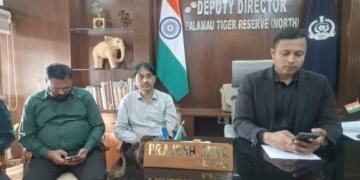
Deputy Director (North Division) of PTR, P. K. Jena, said that wildlife trafficking cannot be stopped unless demand for wildlife trophies and articles is curbed at the source.
WCCB–SAWEN Coordination Against Wildlife Trade
India, a member of the South Asia Wildlife Enforcement Network (SAWEN), is coordinating with seven other countries—Sri Lanka, Bhutan, Bangladesh, Pakistan, Nepal, Afghanistan, and the Maldives—to counter transnational wildlife crime.

In Jharkhand, the WCCB exposed what officials described as a “sleeping” but highly organised smuggling network dealing in pangolin scales—far larger than anticipated.
Pangolin Scale Seizures Since November 2025
The crackdown began in the third week of November 2025, starting from Aurangabad in Bihar and extending to Palamu district. In Palamu, Medininagar Forest Division Chief Satyam Kumar and his team assisted the WCCB in recovering pangolin scales.
Seizures and arrests are continuing, raising questions over whether detection of such crimes should rely solely on the WCCB.
Why Did Forest Officials Miss the Smuggling?
Sources questioned how forest divisions and PTR officials failed to notice pangolin hunting and scale trade, despite routine enforcement actions.
While PTR teams have seized deer meat and rescued peafowl chicks from villages, no pangolin scales were ever recovered locally, prompting demands for an explanation.
“Capturing a pangolin is a silent operation. Bush meat consumption and belief in traditional medicinal value drive its killing,” said Jena.
Pangolins are boiled to remove their scales. There is a widespread misconception that the scales are bulletproof, although the animal’s body is naturally difficult to puncture.
White-Collar Buyers Behind Illegal Trade
On those involved in the trade, Jena said,
“There are white-collared people from the higher echelons of society involved in buying and stocking pangolin scales. Their actions are unlawful, and they should be ostracised.”
Sources revealed that a pastor, an imam, and a retired government teacher are among those arrested in connection with the illegal trade.
Poaching and wildlife smuggling are more prevalent in Jharkhand, Chhattisgarh, Odisha, and Madhya Pradesh.
“It is traditional, ritualistic, and seasonal. During festivals, wildlife faces greater risk. ‘Shikar karna’ remains embedded in the subconscious,” Jena explained.
The affluent create demand for wildlife trophies, while the poor manage the trade for minimal gains—creating a vicious cycle.
Suggested Measures to Curb Wildlife Smuggling
Based on a covert investigation, the following steps are suggested:
- Deploy local informers to gather intelligence on wildlife trafficking
- Announce rewards for information leading to the recovery of wildlife trophies
- Form women-led teams to verify suspicious boiling or cooking activities in villages
- Conduct routine checks for wildlife trophies, similar to liquor and timber inspections
- Intercept wildlife contraband on state and national highways
- Act proactively rather than after offences occur
- Expand enforcement focus beyond tigers and elephants to species like pangolins and otters
