2025 Nobel Prize in Physics awarded to Clarke, Devoret and Martinis
THE JHARKHAND STORY DESK Advertisement New Delhi, Oct 7: The 2025 Nobel Prize in Physics has been jointly awarded to John…
THE JHARKHAND STORY DESK

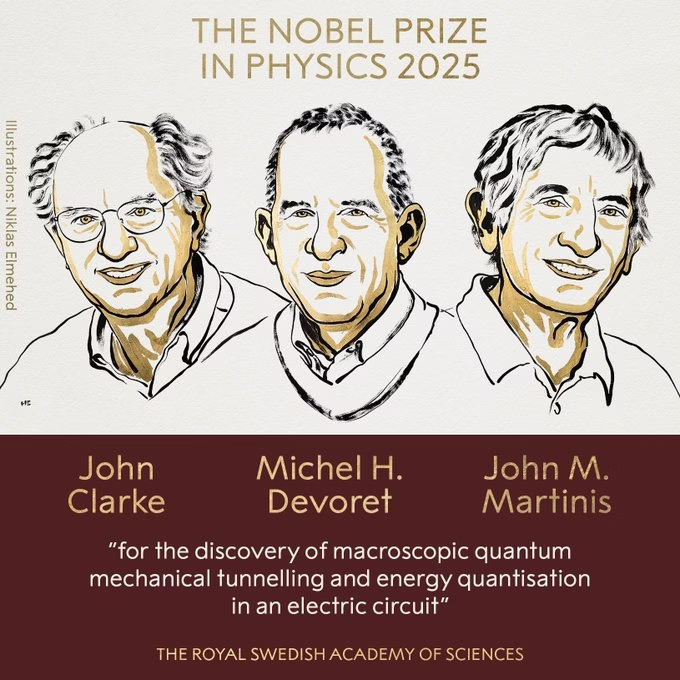
New Delhi, Oct 7: The 2025 Nobel Prize in Physics has been jointly awarded to John Clarke, Michel H. Devoret, and John M. Martinis “for the discovery of macroscopic quantum mechanical tunnelling and energy quantisation in an electric circuit.”
According to the Royal Swedish Academy of Sciences, the laureates conducted a series of experiments that showed the strange phenomena of the quantum world can be observed in a tangible system, large enough to be held in the hand.
“Their superconducting electrical system could tunnel from one state to another, as if it were passing straight through a wall. They also showed that the system absorbed and emitted energy in doses of specific sizes, just as predicted by quantum mechanics,” the release said.
Also Read- Five Jharkhand medical colleges’ delegation to meet Health Minister on stipend revision
Nobel laureates are selected by different institutions based on the category of the award: the Royal Swedish Academy of Sciences handles chemistry and physics, the Swedish Academy oversees literature, Karolinska Institute in Sweden awards the prize for physiology and medicine, and the Norwegian parliament selects the peace prize.
Earlier on Monday, scientists Mary Brunkow, Fred Ramsdell, and Shimon Sakaguchi were awarded the 2025 Nobel Prize in Physiology or Medicine on Monday.
Following the physics announcement, the Nobel prizes for chemistry and literature will be revealed Wednesday and Thursday respectively, with the Peace Prize on Friday and the Nobel Memorial Prize in Economics on October 13.
Also Read- Light to moderate rain forecast in Jharkhand till Oct 10
The Nobel Prize is part of an annual series honoring extraordinary achievements in physics, chemistry, literature, and peace, each accompanied by a monetary award of around 1.2 million and global recognition.

The awards are traditionally presented on December 10, marking the anniversary of the death of Alfred Nobel, the Swedish chemist and entrepreneur who founded the prizes.