India’s bold leap into the AI future: Lessons from the 2026 Impact Summit
When the India AI Impact Summit 2026 unfolded at Bharat Mandapam in New Delhi, it wasn’t just another technology gathering—it was a turning…
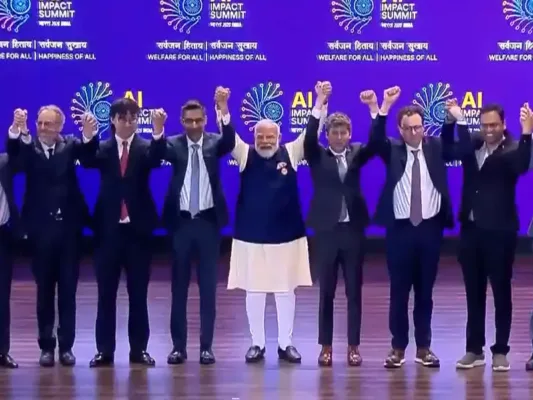
PM Modi, along with global tech leaders at the India AI Impact Summit 2026 in Delhi's Bharat Mandapam. Photograph: (ANI)

When the India AI Impact Summit 2026 unfolded at Bharat Mandapam in New Delhi, it wasn’t just another technology gathering—it was a turning point. For the first time, the Global South hosted a truly global AI summit, and India seized the moment to declare its ambition: to move from being a consumer of AI systems to a creator and leader in shaping their future.
Over five days, the summit brought together more than 20 Heads of State, 500 global tech leaders, and some of the most influential voices in AI. The theme, “Sarvajana Hitaya, Sarvajana Sukhaya” (Welfare for All, Happiness for All), captured the essence of India’s vision: AI not as a luxury for a few, but as a tool for inclusive growth and empowerment.
Pax Silica: Securing the Silicon Stack
One of the most consequential announcements was India’s entry into Pax Silica, a U.S.-led coalition aimed at securing the global semiconductor and AI supply chain. By joining as the 10th nation, India signalled its determination to reduce dependence on single-country suppliers, particularly China, for critical minerals and fabrication capacity.
This move is more than strategic—it’s existential. In a world where AI models are powered by chips and compute, control over the “silicon stack” is akin to control over oil in the 20th century. For India, Pax Silica represents both a safeguard and an opportunity: a safeguard against supply chain vulnerabilities, and an opportunity to anchor itself in the global AI economy.
Sovereign AI: India’s Own Models
Equally significant was India’s emphasis on Sovereign AI. Prime Minister Narendra Modi unveiled the MANAV framework—Moral/Ethical, Accountable, National Sovereignty, Accessible/Inclusive, and Valid/Legitimate—setting the tone for human-centric AI governance.
India showcased indigenous foundation models, most notably BharatGen, a multilingual, multimodal large language model trained on 22 Indian languages. Unlike Western models that are predominantly English-first, BharatGen is designed for India’s diverse linguistic and cultural landscape. It can process text, voice, and images, making it accessible to semi-literate populations who rely on voice commands.

By treating AI as critical national infrastructure, India is actively democratizing AI access through the IndiaAI Mission, offering over 38,000 GPUs at a heavily subsidised rate of approximately ₹65 per hour for startups, researchers, and innovators. This initiative, alongside 1,050 TPUs and AIKosh (hosting 7,500+ datasets), aims to boost local AI development, with 5G covering 99.9% of districts. This approach shifts the focus from “who has the most money” to “who has the best idea,” enabling innovation from small towns and universities rather than just elite hubs.
ALSO READ: Why India stayed civilian while Pakistan slipped into Khaki rule
Investment at an Unprecedented Scale
The summit was also a showcase of financial muscle. Reliance announced a staggering ₹10 lakh crore ($120B+) investment over seven years to drive AI transformation. The Adani Group committed $100 billion toward sovereign, green-energy-powered AI infrastructure.

Global tech giants followed suit:
- Amazonpledged ₹2.9 lakh crore.
- Microsoftcommitted ₹1.5 lakh crore.
- Googleannounced ₹1.25 lakh crore for a 1 GW AI hub in Vizag.
Together, these commitments—over $250 billion—represent one of the largest coordinated investments in AI infrastructure anywhere in the world. For India, this isn’t just about building data centres and semiconductor fabs; it’s about creating sovereign compute capacity that can serve as the backbone of its AI ecosystem.
Healthcare, Agriculture, and Education: AI for All
The summit wasn’t limited to grand strategy—it also focused on sectoral breakthroughs.
- Healthcare: The launch of SAHI (Strategy for AI in Healthcare for India) and BODH, a benchmarking platform for health data, promises safer, bias-free diagnostic models. These initiatives aim to ensure that AI in healthcare is ethical, inclusive, and reliable.
- Agriculture: The unveiling of Bharat-VISTAAR marked a major step toward AI-powered farming. This multilingual platform provides farmers with real-time, location-specific advice on pests, irrigation, and weather. Sundar Pichai highlighted the use of neural models to deliver AI-powered monsoon forecasts, potentially transforming climate resilience for millions of farmers.
- Education & Skilling: Programs like YUVAi and AI Pragya aim to democratize AI skills, ensuring that innovation isn’t confined to elite institutions but reaches Tier 2 and Tier 3 cities. By embedding AI courses in undergraduate and postgraduate curricula, India is building a talent pipeline that could rival Silicon Valley.
Global Cooperation and Ethical Leadership
The summit also emphasised international cooperation. Leaders like Emmanuel Macron, Lula da Silva, and António Guterres joined Modi in calling for global standards on deepfakes and watermarking. The message was clear: AI must be governed responsibly to protect open societies.
India’s leadership here is notable. By shifting the narrative from risk-centric regulation to practical deployment and affordable access, India positioned itself as a voice for the Global South. The emphasis on inclusivity—AI for All—resonated with emerging economies that often feel sidelined in global tech debates.
The Economic Stakes
Analysts estimate that AI could add between $500–600 billion and $1.7 trillion to India’s economy by 2035. Already, India ranks third globally on Stanford’s AI Vibrancy Index, trailing only the U.S. and China. It leads the world in AI skill penetration and contributes nearly 20% of global generative AI projects on GitHub.
The commitments announced at the summit are expected to benefit Indian stocks in mining, metals, and electronics, establishing a price floor for critical minerals. Companies like Dixon Technologies and NALCO could see significant gains as India strengthens its role in the semiconductor supply chain.
A Controversial Moment
Not everything went smoothly. The summit faced brief controversy when Galgotias University was asked to leave after allegedly showcasing a Chinese-made robotic dog as an indigenous innovation. The incident sparked debate on domestic R&D authenticity, underscoring the challenges India faces in balancing ambition with credibility.
Why This Summit Matters
The India AI Impact Summit 2026 was more than a showcase of technology—it was a statement of intent. By hosting global leaders and securing massive investments, India demonstrated that the future of AI will not be dictated solely by Silicon Valley or Beijing. Instead, it will be shaped by inclusive, human-centric innovation that addresses the needs of billions.
India’s message was clear: it is no longer content to be a consumer of global AI systems. It is ready to be a creator, a standard-setter, and a leader in the AI-driven world.
The summit concluded with a powerful signal: India intends to move from being a “consumer” to a “creator” of global AI systems. With initiatives like Pax Silica, BharatGen, and the MANAV framework, India is building not just technology, but an ecosystem rooted in sovereignty, inclusivity, and ethics.
(Dr Rachna K Prasad is Asst Professor of Political Science at the University of Delhi. She can be contacted at drrachnaprasad24@gmail.com)