BJP flexes muscle with massive women’s ‘Akrosh March’, fires salvo at INDIA alliance
Ranchi, April 25: In a major political show of strength, the BJP on Saturday mobilised thousands of women in Ranchi for…
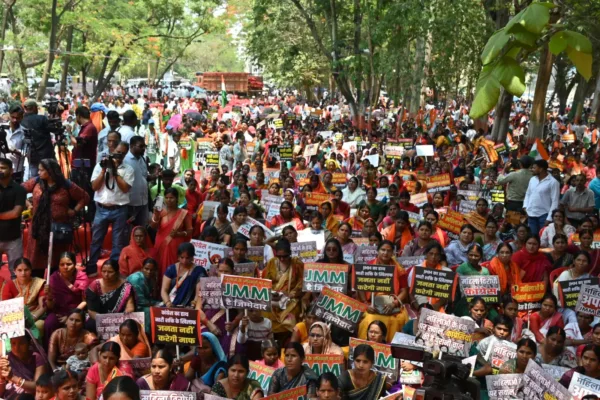
Ranchi, April 25: In a major political show of strength, the BJP on Saturday mobilised thousands of women in Ranchi for a ‘Mahila Akrosh March’, targeting the INDIA alliance over the Women’s Reservation Bill and broader issues of women’s rights and safety.
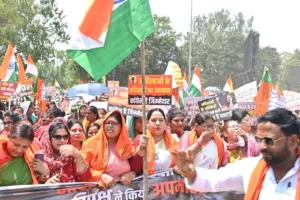
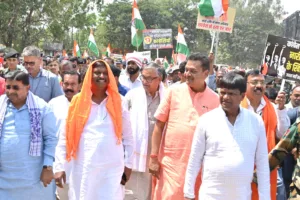
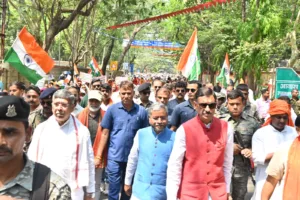
The large-scale mobilisation, held despite scorching heat, saw women gathering in huge numbers at Morabadi Ground before taking out a foot march to Albert Ekka Chowk. The event was led by Union Minister Annapurna Devi and attended by several senior BJP leaders, underlining its significance as a coordinated political exercise ahead of upcoming electoral battles.
Massive Mobilisation Signals Political Messaging
Women from across Jharkhand travelled to Ranchi to participate in the march, which began with a public meeting at Morabadi Ground. The crowd later moved through the city’s main roads, raising slogans in support of Nari Shakti and carrying placards critical of the opposition alliance.
The scale of participation and organisation reflected the BJP’s attempt to consolidate women voters and project grassroots support around the issue of political reservation for women. From Morabadi to Albert Ekka Chowk, the rally turned into a strong visual display of political mobilisation, with party leaders describing it as a “people’s movement” rather than just a protest.

Top Leaders Target INDIA Alliance
Addressing the gathering, Union Minister Annapurna Devi accused the INDIA alliance, including Congress and JMM, of maintaining an “anti-women mindset” and opposing the Nari Shakti Vandan Adhiniyam. She said that Prime Minister Narendra Modi has consistently prioritised women’s empowerment, citing initiatives like Beti Bachao, Beti Padhao and economic schemes aimed at creating “Lakhpati Didis.”
She alleged that opposition parties not only failed to support the Women’s Reservation Bill but also “insulted women” through their conduct during parliamentary proceedings. She warned that women voters would respond strongly in upcoming elections.

BJP state president Aditya Sahu echoed similar sentiments, accusing opposition parties of misleading women and failing to ensure their political participation.
Leader of the Opposition Babulal Marandi said the visible turnout in Ranchi reflected growing anger among women across the state. He claimed that the opposition had deprived women of their rightful representation by not supporting the reservation bill and warned of political consequences.
Union Minister of State for Defence Sanjay Seth also addressed the gathering, stating that the scale of participation demonstrated that women were becoming a decisive political force. Former Chief Minister Arjun Munda alleged that the opposition had “betrayed” women by opposing the bill.
Wider Political Context and Narrative
The BJP used the platform to frame the march as part of a larger national narrative on women’s empowerment under Prime Minister Narendra Modi, contrasting it with what it described as the opposition’s reluctance to support structural reforms like reservation in legislatures.
Speakers, including Rajya Sabha member Deepak Prakash, repeatedly emphasised that women are no longer just a voting bloc but an active political force capable of influencing electoral outcomes. The march was positioned as both a protest and a mobilisation effort aimed at shaping political discourse in Jharkhand.
Prominent figures, including Padma Shri awardees Chhutni Mahato and Jamuna Tudu, also spoke at the event, lending social and symbolic weight to the programme. BJP MLA Neera Yadav was among other leaders present who highlighted the need for greater representation of women in governance.
Focus on Women Voters Ahead of Elections
The event is being seen as part of the BJP’s broader strategy to consolidate women voters in Jharkhand by combining welfare narratives with political messaging. The strong turnout, especially in challenging weather conditions, was projected by party leaders as evidence of growing support among women.
The rally concluded at Albert Ekka Chowk, with leaders reiterating their call for continued mobilisation and engagement on issues of women’s rights, safety and representation.