Suvendu Adhikari named West Bengal CM after BJP win
Kolkata, May 8: Suvendu Adhikari will be the next Chief Minister of West Bengal after the BJP’s victory in the 2026…
Source: PTI
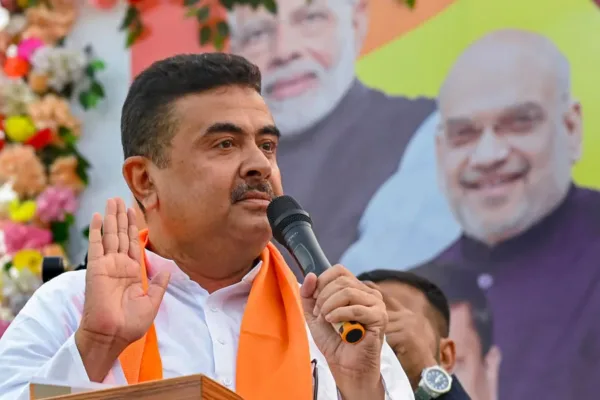
Kolkata, May 8: Suvendu Adhikari will be the next Chief Minister of West Bengal after the BJP’s victory in the 2026 Assembly elections, with Union Home Minister Amit Shah announcing his name as the party’s chief ministerial choice.
Adhikari is expected to meet Governor R N Ravi later this evening to stake a claim to form the government.
Once regarded as one of Mamata Banerjee’s closest political associates and a prominent face of the Trinamool Congress’s anti-land acquisition movement in Nandigram, Adhikari’s rise as the BJP’s most powerful leader in Bengal marks one of the state’s most dramatic political transformations.
Suvendu Adhikari Defeats Mamata Banerjee in Bhabanipur
Adhikari not only repeated his 2021 victory over Mamata Banerjee in Nandigram but also delivered a major political blow by defeating the Trinamool Congress chief in her stronghold of Bhabanipur by 15,105 votes in the 2026 Assembly elections.
He also retained Nandigram with a margin of 9,665 votes, significantly improving on his earlier victory margin of 1,956 votes.

Political observers say Adhikari’s victories in both constituencies, along with the BJP’s sweep of all 16 Assembly seats in Purba Medinipur district, firmly established him as the frontrunner for the chief minister’s post.
The BJP had earlier indicated that its chief ministerial candidate would be “born and brought up in Bengal” and educated in Bengali medium schools — criteria that Adhikari fits.
From Mamata Banerjee Loyalist to BJP’s Bengal Face
Adhikari’s political journey has been marked by a dramatic shift from being a trusted Trinamool Congress leader to becoming one of Mamata Banerjee’s fiercest critics.

His aggressive campaign style and strong positions on issues such as illegal immigration, governance and law and order helped him emerge as a central figure in Bengal politics and a prominent face of the BJP’s Hindutva-driven campaign in the state.
He spent much of his early political career building influence in the coastal and industrial regions of Purba Medinipur before quitting the Trinamool Congress in 2020 and joining the BJP.
His switch was seen as a major turning point in Bengal politics.
Nandigram Movement Changed Bengal Politics
Adhikari first rose to prominence during the 2007 anti-land acquisition movement in Nandigram, which became a turning point in Bengal politics and helped Mamata Banerjee’s Trinamool Congress challenge the then Left Front government.
The movement catapulted Adhikari into the front ranks of the TMC.
He later became a member of the party’s core committee and president of the Trinamool Youth Congress. He also won the Tamluk Lok Sabha seat in both 2009 and 2014.
After the Trinamool Congress came to power in 2011, many considered Adhikari a possible political successor to Mamata Banerjee.
Rift with Abhishek Banerjee Deepened Differences
However, tensions reportedly emerged after Mamata Banerjee introduced her nephew Abhishek Banerjee into active politics in 2011.
Abhishek was made president of the All India Trinamool Yuva, a parallel youth organisation within the party, a move that allegedly upset Adhikari.
“It was done just to keep me in check. Despite working hard, I was always an employee in TMC and never respected as a fellow warrior. Where was the nephew when Nandigram was burning? I was there fighting alone,” Adhikari had later said, calling the TMC a “private limited company”.
In 2014, Adhikari was removed as TMC Youth Congress president and later lost several organisational responsibilities within the party.
Though Mamata Banerjee inducted him into the state cabinet in 2016 and handed him multiple portfolios, political differences continued to grow.
After the TMC’s setback in the 2019 Lok Sabha elections and the abolition of organisational observer posts, Adhikari eventually left the party and joined the BJP in 2020.
BJP’s New Power Centre in Bengal
Since joining the BJP, Adhikari has emerged as the party’s most influential Bengal leader and currently serves as the Leader of Opposition in the West Bengal Assembly.
Known for his sharp attacks on the Trinamool Congress government, Adhikari has positioned himself as a strong advocate of Hindutva politics in Bengal.
His rise has also strengthened the political influence of the Adhikari family in South Bengal, particularly in Purba Medinipur.
With the BJP now poised to form the government in West Bengal, Adhikari’s elevation as chief minister marks a historic political shift in the state after years of Trinamool Congress dominance.