Jharkhand RS polls: JMM sure of one seat, 2nd-preference votes key to second battle
Ranchi, May 22: The political battle for the June 2026 Rajya Sabha elections in Jharkhand has intensified, with the Jharkhand Mukti Morcha…
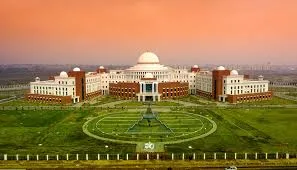
Jharkhand Assembly
Ranchi, May 22: The political battle for the June 2026 Rajya Sabha elections in Jharkhand has intensified, with the Jharkhand Mukti Morcha (JMM) almost certain to secure one seat, while the fight for the second seat is expected to depend heavily on second-preference votes.
One seat from Jharkhand is falling vacant following the completion of the tenure of BJP MP Deepak Prakash, while the second seat became vacant after the demise of JMM founder and former Chief Minister Shibu Soren.
With the ruling alliance holding a clear majority in the 81-member Jharkhand Assembly, the numbers theoretically favour two seats for the coalition. However, the electoral arithmetic, possibility of invalid ballots, and dependence on second-preference votes have made the second contest highly unpredictable.
28 first-preference votes needed for victory
If all 81 MLAs cast valid votes, a candidate will need a quota of 2,701 points — equivalent to 28 first-preference votes — to win a Rajya Sabha seat.
Current strength in Jharkhand Assembly
Ruling Alliance – 56 votes
- JMM: 34
- Congress: 16
- RJD: 4
- CPI-ML: 2
Opposition – 24 votes

- BJP: 21
- AJSU: 1
- JDU: 1
- LJP: 1
Apart from these, one Independent-backed vote linked to the Jharkhand Loktantrik Krantikari Morcha (JLKM) remains politically unaligned, adding another layer of uncertainty.
ALSO READ: Rajya Sabha polls announced for 26 seats; 2 seats from Jharkhand in focus
Why the second seat is tricky for JMM alliance
For the JMM, allocating exactly 28 votes to its first candidate carries risk, as even one invalid vote could upset the calculations.

If the party uses 30 to 32 first-preference votes to comfortably elect its first candidate, the ruling alliance’s second nominee could be left with only 24 to 26 votes. In such a situation, the alliance may need support from opposition MLAs or rely heavily on second-preference vote transfers.
The BJP-led opposition, despite lacking the required numbers on paper, is also expected to bank on second-preference strategies to remain competitive for the second seat.
Jharkhand’s Rajya Sabha history full of surprises
Jharkhand has witnessed several unexpected Rajya Sabha outcomes where political strategy outweighed straightforward arithmetic.
2008: Parimal Nathwani’s surprise victory
In the 2008 Rajya Sabha election, BJP candidate J.P.N. Singh won comfortably with 35 first-preference votes.
The real drama unfolded in the battle for the second seat. Independent candidate Parimal Nathwani secured only 16 first-preference votes, while R.K. Anand received 17. Despite trailing initially, Nathwani ultimately won with the help of second-preference votes.
Interestingly, although JMM had 17 MLAs at the time, its official candidate Kishori Lal managed to secure only 8 votes.
2014: Strategic uncontested election
In 2014, the JMM-Congress-RJD alliance was in power, while the BJP and AJSU were in opposition.
Despite having only five MLAs, the RJD fielded Prem Chand Gupta as its candidate. At the same time, Parimal Nathwani again entered the race as an Independent backed by the BJP-AJSU.
The political calculations worked in such a way that no third candidate entered the contest, resulting in both candidates being elected unopposed.
Parimal Nathwani, who represented Jharkhand in the Rajya Sabha in 2008 and 2014 as an Independent, is currently a Rajya Sabha MP from Andhra Pradesh backed by the YSR Congress Party (YSRCP). His current term is also nearing completion.
All eyes now on political strategy
With one seat almost certain for the JMM, the real battle lies in the contest for the second seat. Political parties are expected to carefully manage first- and second-preference votes while keeping an eye on possible cross-voting and strategic alliances.
As the June 2026 election approaches, Jharkhand once again appears set for a high-stakes Rajya Sabha contest where political strategy may matter more than simple numbers.
(The writer retired as Joint Secretary of the Jharkhand Assembly)