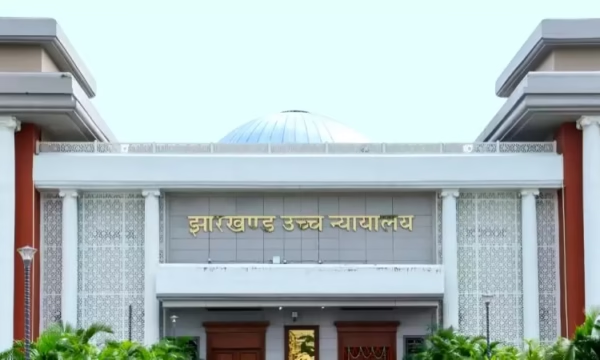
Jharkhand HC orders circle officers to verify and authenticate online land records
Ranchi, June 10: In a significant order aimed at addressing recurring discrepancies in Jharkhand’s digital land records, the Jharkhand High Court has…

JUSTICE ANANDA SEN
Ranchi, June 10: In a significant order aimed at addressing recurring discrepancies in Jharkhand’s digital land records, the Jharkhand High Court has directed Circle Officers across the state to verify and authenticate online land records by affixing their digital signatures, ensuring that digital entries accurately reflect physical land records.
Justice Ananda Sen passed the direction while hearing a petition filed by Ram Prakash Bhagat @ Ram Prakash Oraon, a resident of Lohardaga district, who alleged that the names recorded in online land records did not match the entries contained in the physical revenue records.
Petitioner Seeks Correction in Online Land Records
The petitioner approached the High Court seeking correction of the name of the raiyat (landholder) in Register-II, rent receipts and current survey records relating to land situated in Baridih village under Kuru Circle in Lohardaga district.
According to the petition, the name of the petitioner’s ancestor was correctly recorded in the Revisional Survey Khatiyan and physical records, but the current survey records and online land database reflected the name of another person. The petitioner claimed that despite submitting representations before the Circle Officer, no corrective action had been taken.
Court Directs Circle Officer to Decide Representation
Taking note of the grievance, the High Court directed the petitioner to approach the Circle Officer, Kuru, within three weeks. The Circle Officer has been instructed to examine the records and pass an appropriate order after verification.
The court further directed that if the physical records confirm the petitioner’s claim, necessary corrections should be carried out. The entire exercise must be completed within 12 weeks from the receipt of the court’s order.

High Court Flags Widespread Errors in Digital Land Records
During the hearing, Justice Sen observed that several similar writ petitions have been reaching the High Court, with citizens complaining that entries on the state’s online land records portal often do not match the corresponding physical registers.
The court noted that discrepancies commonly relate to names of raiyats, land area, plot numbers and other details. It observed that while physical records are often accurate, errors have crept into digital records due to mistakes during data entry by personnel engaged through outsourced agencies.
No Verification Mechanism in Place, Says Court
The High Court expressed concern that there appears to be no established mechanism to verify whether online entries are checked and authenticated by revenue officials before being uploaded.

The court noted the absence of any indication on the digital portal showing that revenue authorities had verified the entries, raising questions about the reliability of the online records being relied upon by citizens.
Online Records Must Be Mirror Copy of Physical Registers
Emphasising the importance of accurate digital governance, the court stated that online land records should be a “mirror copy” of physical registers maintained by the revenue department.
To ensure accuracy, the court directed that all online land record entries be verified and cross-checked with Register-II and other physical records by the respective Circle Officers before being authenticated.
Digital Signature of Circle Officer Made Mandatory
In a far-reaching direction, the High Court ordered that after verification, Circle Officers must affix their digital signatures on online land records.
Only those entries that have been authenticated with the digital signature of the Circle Officer should be reflected on the online portal. The digital signature will serve as proof that the entries have been verified and accurately correspond to the physical records maintained by the government.
The court also directed the state government to make necessary software modifications, if required, to implement the authentication mechanism.
Existing Digital Records Also to Be Verified
The High Court clarified that the directive would not apply only to future entries. All land records already uploaded to the digital platform must also be reviewed and authenticated by Circle Officers.
If any discrepancies are detected during verification, officers have been directed to carry out corrections in accordance with the prescribed procedure and standard operating protocols.
The court further observed that if raiyats point out errors in future, authorities should rectify them administratively wherever legally permissible, without compelling citizens to approach courts repeatedly.
Revenue Secretary Directed to Ensure Compliance
Noting the importance of the issue, the High Court directed the Secretary, Department of Revenue, Registration and Land Reforms, who was present during the hearing through virtual mode, to ensure immediate implementation of the order across the state.
The court instructed the department to issue necessary administrative directions to all concerned officials and also ordered that copies of the judgment be sent to the Chief Secretary and the Revenue Secretary for prompt action.
Significant Push for Land Record Transparency
The order is expected to have statewide implications as it seeks to strengthen the credibility of Jharkhand’s digital land records system and reduce litigation arising from errors in online entries. By making Circle Officers directly responsible for verification and authentication, the High Court has sought to ensure greater transparency and accountability in land record management.