Ranchi police investigation failures under spotlight as courts acquit accused in three cases
THE JHARKHAND STORY NETWORK Ranchi, September 8: The quality of criminal investigations and the prosecution process has come under scrutiny in Ranchi…
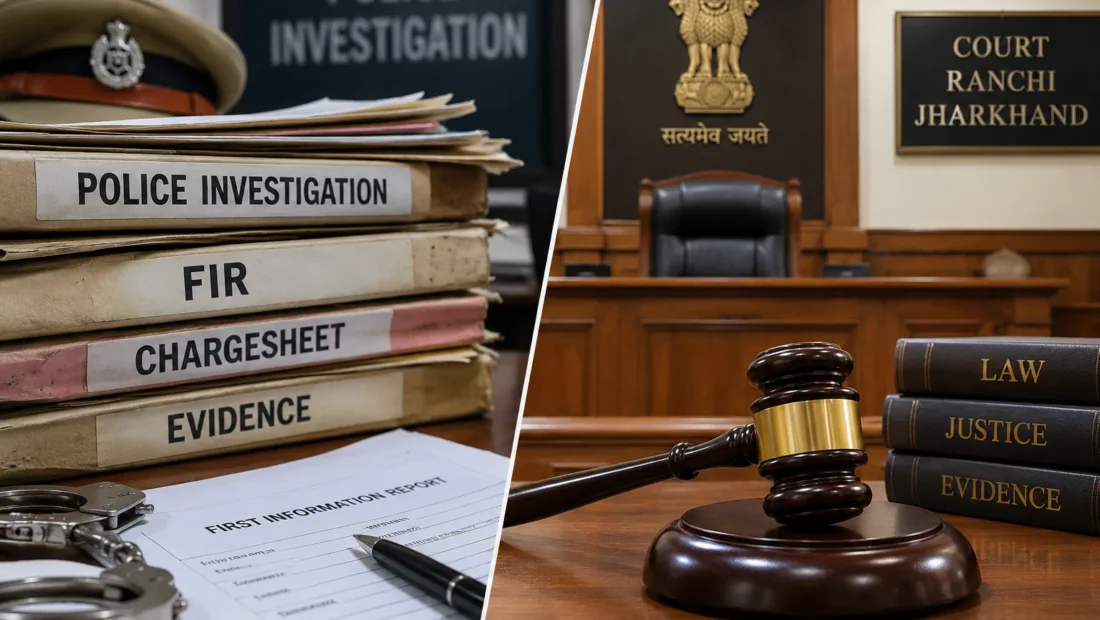
Representative Image.
THE JHARKHAND STORY NETWORK
Ranchi, September 8: The quality of criminal investigations and the prosecution process has come under scrutiny in Ranchi after courts acquitted accused in three separate cases through judgments pronounced on September 5 and 7, with the proceedings revealing serious gaps in the evidence presented before the courts.

The three cases—an Arms Act case, a case involving alleged assault linked to witchcraft accusations, and an electricity theft case—highlight different weaknesses. In one, the court found serious deficiencies in the seizure and chain of custody of alleged weapons. In another, the prosecution failed to produce a single witness despite repeated opportunities. In the third, involving alleged electricity theft, not a single prosecution witness appeared during more than eight years of trial, leaving the court with what it described as a “case of no evidence”.
The judgments do not, by themselves, establish deliberate misconduct by investigating officers. But taken together, they raise questions about the ability of the police and prosecution machinery to carry cases from investigation to a legally sustainable conclusion.
Arms case: court finds gaps in seizure and chain of custody
In S.T. Case No. 567/2016 arising from Silli P.S. Case No. 76/2007, Additional Judicial Commissioner-XVIII, Ranchi, Kuldeep, acquitted six accused under Sections 25(1-A), 26(2) and 35 of the Arms Act.
The judgment was pronounced on September 5, 2026.

The court found that the two independent seizure witnesses had turned hostile and stated during cross-examination that their signatures had allegedly been obtained on blank papers and that no search or seizure had taken place in their presence.
The court also pointed to contradictions and lapses in the testimony of police witnesses. One police witness could not identify the accused in court or specify which weapon had allegedly been recovered from which accused. Another admitted that his name and signature were absent from the seizure list, that he had not been examined by the investigating officer during the investigation and that he could not confirm whether the weapons had been sealed at the spot.
The court concluded that the prosecution had failed to establish a reliable chain of custody supported by trustworthy independent evidence and gave all six accused the benefit of doubt.

Witchcraft-related assault case: no prosecution witness produced
In S.T. Case No. 595/2023 arising from Lapung P.S. Case No. 18/2021, six accused faced trial under Sections 307/34, 341/34 and 324/34 of the IPC and Sections 3 and 4 of the Prevention of Witch (Daain) Practices Act.
The judgment was pronounced on September 5, 2026, by Additional Judicial Commissioner-XV-cum-Special Judge (FTC), Ranchi, Amit Shekhar.
The case was chargesheeted in September 2021 and charges were framed on May 3, 2025. But the prosecution subsequently failed to produce a single witness.
The court recorded that summons were issued in July 2025, followed by a bailable warrant in December 2025. Communications were subsequently sent to the concerned police station and the Superintendent of Police, Ranchi, but no witness appeared. Even after repeated directions and a final opportunity, the prosecution could not produce any witness.
After more than a year since framing of charges, the prosecution evidence was closed. The court described the matter as a “case of no evidence” and acquitted all six accused, holding that the charges had not been proved beyond reasonable doubt.
Electricity theft case: eight years, but no witness
The third case presents perhaps the starkest example of a prosecution collapsing for want of evidence.
In Electricity Case No. 2003862/2013, arising from Chanho P.S. Case No. 70/2013, accused Nezam Ansari faced trial under Section 135 of the Electricity Act over an allegation of illegal electricity consumption.
According to the prosecution case, an inspection at Ansari’s house on July 16, 2013, allegedly found an electricity wire being bypassed to illegally consume power, causing an alleged revenue loss of Rs 85,848.
The police filed a chargesheet in May 2015. The charge under Section 135 of the Electricity Act was framed on August 29, 2018.
But the case ultimately suffered the same fundamental problem as the Lapung matter: the prosecution could not produce a single witness.
The judgment was pronounced on September 7, 2026, by Amit Shekhar, Additional Judicial Commissioner-XV-cum-Special Judge, Electricity, Ranchi.
The court recorded that summons were issued to prosecution witnesses in November and December 2018. No witness appeared. Despite repeated directions to the Special Public Prosecutor to produce witnesses, none was examined.
“More than eight years have passed,” the court noted, yet the prosecution had failed to produce any witness despite sufficient opportunities. The court consequently closed the prosecution evidence and held that it was a “case of no evidence”.
The court acquitted Ansari under Section 135 of the Electricity Act and ordered that he be set at liberty.
Three cases, different failures, same outcome
The three judgments reveal failures at different stages of criminal prosecution.
The Arms Act case raises questions about the manner in which the alleged recovery was documented and preserved, with the court finding gaps in independent corroboration, sealing and chain of custody.
The Lapung case exposes a failure to bring witnesses before the court despite repeated judicial directions.
The electricity theft case goes even further: the alleged offence dates back to 2013, charges were framed in 2018, and yet by the time judgment was pronounced in September 2026, the prosecution had failed to examine even one witness.
The common thread is that a police case does not end with registration of an FIR or filing of a chargesheet. Evidence has to be properly collected, preserved, documented and ultimately presented before the court through competent witnesses.
For the criminal justice system, these judgments underline a basic but critical lesson: a weak investigation or an ineffective prosecution can leave even a chargesheeted case with no legally usable evidence at the stage of trial.
Judgments at a glance
| Case | Judgment date | Judge | Key issue |
| Silli Arms Act case, S.T. 567/2016 | September 5, 2026 | Kuldeep, AJC-XVIII, Ranchi | Hostile seizure witnesses, contradictions and chain-of-custody concerns |
| Lapung witchcraft-related assault case, S.T. 595/2023 | September 5, 2026 | Amit Shekhar, AJC-XV-cum-FTC, Ranchi | No prosecution witness produced despite repeated opportunities |
| Chanho electricity theft case, Electricity Case 2003862/2013 | September 7, 2026 | Amit Shekhar, AJC-XV-cum-Special Judge, Electricity, Ranchi | No prosecution witness produced for more than eight years after framing of charges |