Illegal sand mining despite NGT ban comes under spotlight amid Jairam Mahto-police row
SUMAN K SHRIVASTAVA RANCHI, September 8: Jharkhand’s seasonal ban on river sand mining has come under scrutiny amid allegations that sand-laden tractors…
SUMAN K SHRIVASTAVA
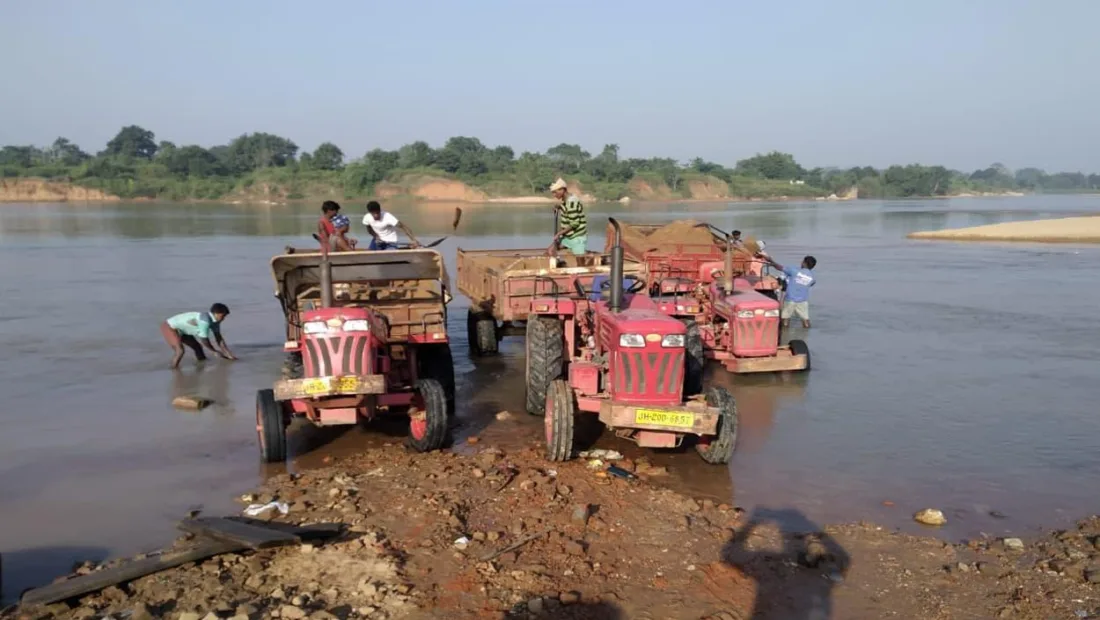
RANCHI, September 8: Jharkhand’s seasonal ban on river sand mining has come under scrutiny amid allegations that sand-laden tractors continue to operate in the state, raising questions over the enforcement of the prohibition and the possible existence of an illegal sand supply chain.
The issue has come into sharper focus following the ongoing confrontation between Jharkhand Loktantrik Krantikari Morcha (JKLM) MLA Jairam Mahto and the police over an alleged abusive telephone conversation with a police officer.
While the police association has made the alleged misconduct by the MLA the centre of its protest, Mahto has alleged that police personnel were demanding money from tractors carrying sand. The allegations have not been independently established.
However, the controversy has inadvertently brought a larger and more important question into the open:
If sand lifting from riverbeds is prohibited during the monsoon, how are sand-laden tractors continuing to operate, where is the sand coming from and why has the administration failed to stop it?

Ban on sand lifting till October 15
The seasonal restriction on river sand mining is in force in Jharkhand during the monsoon, with sand lifting prohibited from June 10 to October 15.
The restriction is intended to prevent indiscriminate extraction from riverbeds during the rainy season and protect river ecology. District administrations and mining authorities are responsible for enforcing the ban and taking action against illegal extraction and transportation.
Despite this, complaints of illegal sand lifting and transportation have continued to emerge from different parts of the state.

The concern is not merely about individual tractor operators violating the ban. If vehicles are regularly carrying sand, it raises the possibility of a wider network involving extraction, transportation, storage and sale.
The Jairam Mahto episode brings the issue into focus
The ongoing dispute between Dumri MLA Jairam Mahto and the police has provided a window into this otherwise largely hidden trade.
Mahto has alleged that police personnel were collecting money from sand-carrying tractors. The allegations relate to the movement of vehicles carrying sand and have become part of the political confrontation between the MLA and police officials.
The Jharkhand Police Association, however, has objected to the MLA’s alleged conduct towards a police officer and has demanded action against him.
The two issues need to be examined separately.
The allegation of abusive language against a police officer can be investigated through the appropriate legal process. But the allegations surrounding sand-carrying tractors raise an entirely different administrative question:
Why are vehicles carrying river sand operating during the period when sand lifting is banned?
Political counter-allegations also surface
Jairam Mahto’s political detractors have meanwhile raised a counter-question, alleging that the MLA’s interest in the movement of sand-carrying tractors could itself be linked to financial considerations.
Some of his critics have gone further, alleging that the MLA or people associated with him could have a “cut” in the sand trade.
Such claims should be investigated through documentary and financial evidence rather than treated as fact. Vehicle ownership records, transport documents, financial transactions, call records and statements of those involved could help establish whether any political or administrative nexus exists.
Dullu Mahto raises possibility of financial interests
Dhanbad MP Dullu Mahto has added a new dimension to the controversy by suggesting that the dispute could have an economic angle.
Speaking in Dhanbad, he said the questions being raised by Jairam Mahto and the confrontation that followed could also be linked to a fight over money.
He cited the example of toll gates and said that situations sometimes settle after two or three vehicles are stopped. Referring to alleged sand theft, he suggested that if a settlement had not taken place in a particular case, it could also be one reason for the subsequent dispute and public statements.
Dullu Mahto also questioned the administration’s role in alleged illegal mining, saying that the administration could not be considered completely above suspicion when allegations of coal, iron and sand theft arise.
He called for such allegations to be investigated.
The MP further alleged that political leaders sometimes begin raising their voices when they allegedly do not receive a share from such activities.
The real question: where is the sand coming from?
The political allegations should not obscure the central issue.
If river sand lifting is banned until October 15, the authorities should be able to identify the source of sand being transported by vehicles during the prohibited period.
There are several straightforward questions that the district administration and mining authorities need to answer:
From which river or sand ghat is the sand being extracted?
Do the vehicles carrying it have valid documents permitting transportation?
Who owns the tractors and who is receiving the sand?
Are there designated stockyards from which the material is being transported?
And most importantly:
How many vehicles carrying illegally mined sand have been seized during the ban period, and what action has been taken against their operators and those behind the supply chain?
Why administration’s enforcement matters
Illegal sand mining is not simply a law-and-order issue.
It involves the mining department, district administration, police, transport authorities and environmental regulators.
If extraction takes place from riverbeds in violation of the seasonal restriction, it can cause environmental damage while depriving the state of legitimate revenue.
At the same time, a prolonged shortage of legally available sand during the ban can create an incentive for illegal operators to charge a premium, making the trade increasingly lucrative.
This is why enforcement at the source is more important than merely intercepting tractors on the road.
Allegations of ‘collection’ need investigation
The allegation that police personnel are collecting money from sand-laden vehicles is serious and should not be dismissed merely because it has emerged amid a political dispute.
At the same time, it cannot be treated as fact without evidence.
If such a system exists, an independent inquiry should establish who collects the money, from whom, how much is allegedly collected and whether the money reaches anyone beyond the person collecting it.
Similarly, if the allegation is found to be false, the investigation should establish that clearly.
The same standard should apply to allegations of political beneficiaries.
Who benefits from illegal sand?
The controversy ultimately raises a larger question about the economics of Jharkhand’s illegal sand trade.
If sand mining is banned but trucks and tractors continue to carry the material, somebody is extracting it, somebody is transporting it and somebody is buying it.
There may also be intermediaries involved in loading, storage and distribution.
An effective investigation would therefore need to go beyond catching individual tractor drivers.
It should examine the entire chain—from the riverbank to the final buyer.
Jairam row should not divert attention from sand mining
The alleged abuse of a police officer by an elected representative is a matter that can be dealt with separately under the law.
But the controversy should not end there.
The more consequential public-interest issue is whether illegal sand mining and transportation are continuing despite the NGT-related seasonal prohibition.
If the administration has conducted regular raids and seizures, it should make the enforcement figures public.
If no significant illegal mining is taking place, the authorities should explain how they are ensuring compliance.
And if illegal extraction is continuing, the administration needs to explain why the operators have not been stopped.
The unanswered questions
The Jairam Mahto-police confrontation may have brought the sand issue into public debate, but the controversy has exposed a question that goes beyond political rivalry.
If sand lifting is banned until October 15, how is the material reaching the market?
Who is extracting it?
Who is transporting it?
Who is paying whom to keep the trade moving, if the allegations are true?
And above all:
Why is the district administration silent if illegal sand mining is continuing despite the ban?
These questions can only be settled through a transparent investigation and publicly available enforcement data—not through competing political allegations.