
IIT (ISM) alumnus develops high-endurance drone that flies 78 minutes at 14,000 feet in Army trial
THE JHARKHAND STORY NETWORK Dhanbad, September 15: An IIT (ISM) Dhanbad alumnus has developed a home-grown high-endurance drone that flew for 1…
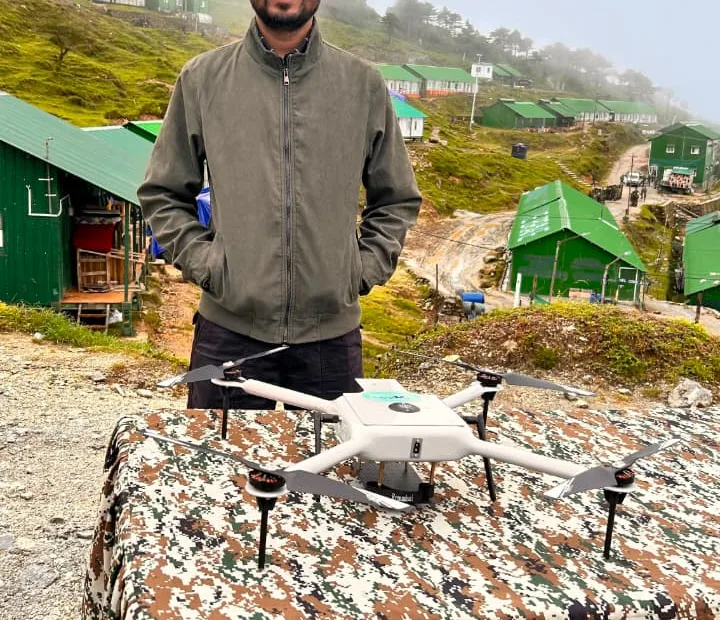
Sourav Singh
THE JHARKHAND STORY NETWORK
Dhanbad, September 15: An IIT (ISM) Dhanbad alumnus has developed a home-grown high-endurance drone that flew for 1 hour 18 minutes 26 seconds at an altitude of 14,000 feet, nearly twice the 45-minute flight target set by the Indian Army during high-altitude trials in Arunachal Pradesh.
The achievement marks a significant milestone for the young start-up behind the drone and highlights the growing capabilities of indigenous technology for defence operations in challenging terrains.
IIT (ISM) alumnus behind the indigenous drone
Sourav Singh, an IIT (ISM) Dhanbad alumnus from the 2020 batch, completed his M.Tech in Mining Engineering in 2022. He is the co-founder of Zenith Unmanned Systems Private Limited, a start-up established in 2025 and incubated at the Centre of Innovation, Incubation & Entrepreneurship (CIIE), IIT (ISM) Dhanbad.
Named Vijay Z1, the drone is an unmanned aerial vehicle (UAV) designed as a compact, high-endurance, all-weather quadcopter for surveillance and other operations in difficult terrain.
The Vijay Z1 project began in August 2025, with the first prototype recording more than 100 minutes of flight time. The team has since developed five prototypes, with the sixth and latest version serving as the final iteration.

Completed in June 2026, the latest model has more than 85 per cent indigenous content, including a carbon-fibre frame designed and developed entirely by the team.
More than 1,000 hours of testing
The drone has undergone more than 1,000 hours of ground and crash testing. It has recorded a flight time of 2 hours 22 minutes at mean sea level, 1 hour 20 minutes 33 seconds at 12,000 feet and 1 hour 18 minutes 26 seconds at 14,000 feet.
Weighing 2.7 kg, the fully electric drone can operate at altitudes of up to 4,200 metres and has a range of 40 km. It can carry a payload of up to 500 grams, expandable to 1.2 kg.

Its carbon-fibre body has been designed to operate in rain, dust, snow and extreme heat.
The Indian Army’s Eastern Command tested Vijay Z1 on August 3 and 4, 2026, at a high-altitude base camp and above Sela Top in Arunachal Pradesh.
Against the Army’s target of 45 minutes of continuous flight, the drone achieved 1 hour 20 minutes 33 seconds at 12,000 feet and 1 hour 18 minutes 26 seconds at 14,000 feet, despite rain and foggy conditions.
Procurement-level validation underway
Following the trials, the company received a positive response and interest in the drone’s early induction. Procurement-level validation testing is currently underway in September 2026.
“A self-reliant Bharat cannot depend on others for the technologies that safeguard its sovereignty and future. Defence technology is of paramount importance in achieving that vision,” said Sourav Singh.
IIT (ISM) lauds alumni-led innovation
Prof. Alok Das, Dean, Innovation & Corporate Relations, IIT (ISM) Dhanbad, said, “Vijay Z1 is a good example of how ideas developed by our alumni can be turned into useful technology. It also shows the growing potential of young entrepreneurs from the IIT (ISM) ecosystem to develop indigenous solutions for important national needs.”
Zenith Unmanned Systems is currently a bootstrapped start-up with a manufacturing capacity of 90 drones a month.
The company is also developing other unmanned systems and hybrid-propulsion variants. A compact training drone with more than 50 minutes of flight endurance is also ready for commercialisation.