BJP-Hemant Soren face-off looms over special Assembly session on MMDR, SIR
SUMAN K SHRVASTAVA Ranchi, November 23: A political confrontation is building in Jharkhand ahead of the two-day special Assembly session on November…
SUMAN K SHRVASTAVA
Ranchi, November 23: A political confrontation is building in Jharkhand ahead of the two-day special Assembly session on November 25 and 26, with the BJP questioning the Hemant Soren government’s motives and the ruling alliance preparing to challenge the Centre’s Mines and Minerals (Development and Regulation) Amendment Act, 2026 (MMDR), and the ongoing Special Intensive Revision (SIR) of electoral rolls.
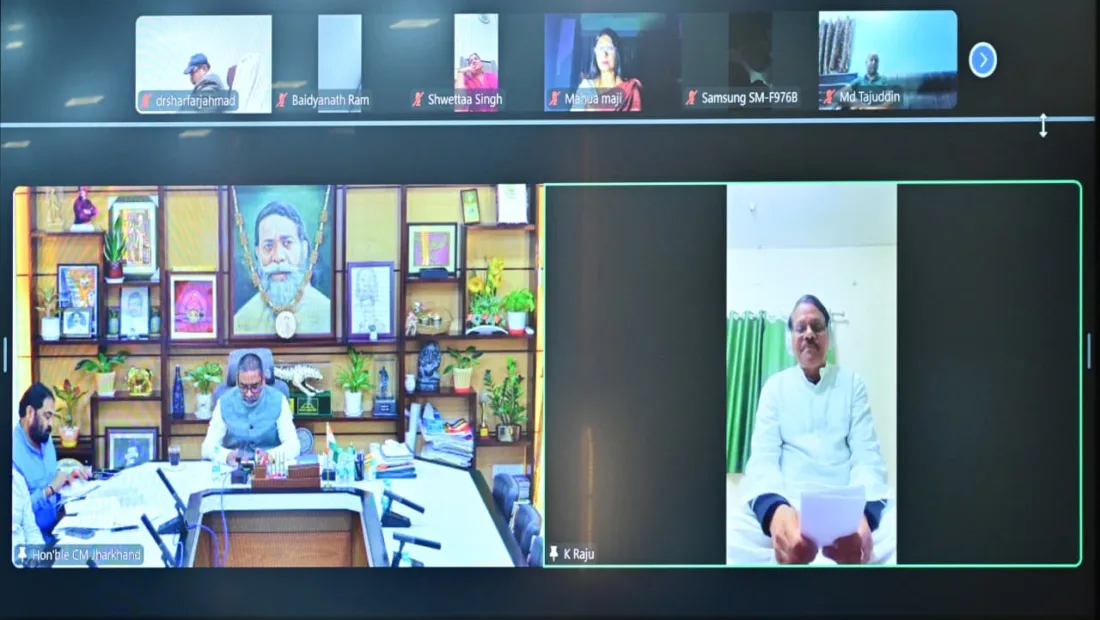
Chief Minister Hemant Soren held a virtual meeting with ministers and legislators of the ruling alliance on Monday from his official residence on Kanke Road to coordinate the government’s strategy. The meeting focused on preparing a common position on both issues and ensuring that legislators were equipped to defend it during the Assembly debate.
The BJP has described the special session as politically motivated, accusing the government of using MMDR and SIR to promote a political narrative. The ruling alliance, meanwhile, maintains that the two issues have serious implications for Jharkhand’s financial interests and the electoral rights of its people.
The contrasting positions indicate that the session could develop into a wider political contest over Centre-state relations, control over mineral revenue and the conduct of electoral roll revision.
MMDR: A question of state revenue and federal powers
The MMDR Amendment Act is likely to be the more consequential of the two issues for Jharkhand’s finances. The ruling alliance, comprising the JMM, Congress, RJD and Left parties, is concerned that provisions of the amended law could restrict the state’s powers to impose cess on mineral-bearing land.

For a mineral-rich state such as Jharkhand, the issue extends beyond a legal disagreement. Mineral resources are central to its industrial economy and public finances. Any restriction on the state’s ability to raise revenue from mineral-bearing land could have implications for fiscal planning and funding for welfare and development programmes.
The government fears that the amended legal framework could constrain its revenue-raising powers. Its argument is likely to centre on protecting the state’s financial interests and its position in matters concerning mineral resources.
Jharkhand Congress in-charge K Raju reportedly raised similar concerns during the meeting. He argued that the amendment had been introduced without adequate consultation with mineral-producing states and warned that restrictions on additional taxes or cess could result in substantial revenue losses.

Raju also expressed concern that reduced mineral revenue could put pressure on welfare schemes and development projects. The scale of any potential loss, however, will depend on the interpretation and implementation of the amended provisions.
The BJP has challenged the government’s position, arguing that the legislation applies nationally. Its leaders have also questioned the state’s concerns over coal-related taxation and accused the government of opposing the amendment for political reasons.
SIR: Electoral integrity becomes a political flashpoint
The second major issue, SIR, carries a different but equally sensitive political dimension. The ruling alliance is concerned about notices issued to voters, pending hearings and the possibility of eligible electors being excluded from the revised electoral rolls.
K Raju reportedly told the Chief Minister that the process could adversely affect ordinary citizens, particularly people from deprived and tribal communities, if it was conducted without adequate time and transparency. He called for an extension of the process and safeguards to ensure that genuine voters were not left out.
The government’s likely approach in the Assembly will be to question the implementation of SIR and seek greater accountability in voter verification and the handling of objections.
The issue also places the ruling alliance in a politically challenging position. SIR is an Election Commission exercise implemented through the electoral administration, including state-level officials and Booth Level Officers. The government will therefore need to distinguish between concerns over the conduct of the exercise and the constitutional authority responsible for carrying it out.
The BJP, for its part, has argued that SIR is a constitutional exercise being conducted by the Election Commission and has questioned why the state government is opposing a process implemented through its own administrative machinery. It has challenged the ruling parties to provide specific evidence of eligible voters being wrongly excluded.
BJP and ruling alliance prepare for political showdown
The BJP has also questioned the ruling parties’ criticism of EVMs, arguing that JMM, Congress and RJD legislators themselves won elections conducted through the same voting system. The ruling alliance, meanwhile, is seeking to frame SIR as an issue of protecting voting rights and preventing the exclusion of eligible citizens.
The special session is thus likely to become a test of political messaging as much as legislative debate. While the BJP is expected to challenge the government’s rationale for convening the session, the ruling alliance will seek to establish that the MMDR amendment threatens the state’s fiscal interests and that SIR requires stronger safeguards.
For Soren, the immediate challenge will be to maintain unity among the JMM, Congress, RJD and Left legislators while presenting a coherent case on both issues. The government’s ability to translate its political objections into clear legislative arguments and resolutions will determine the impact of the special session.