IIT (ISM) Dhanbad hosts launch of Hindi Khand-Kavya ‘Saubhadra-Shaurya’
THE JHARKHAND STORY NETWORK Dhanbad, November 24: The Indian Institute of Technology (Indian School of Mines), Dhanbad, hosted the launch of ,…
THE JHARKHAND STORY NETWORK
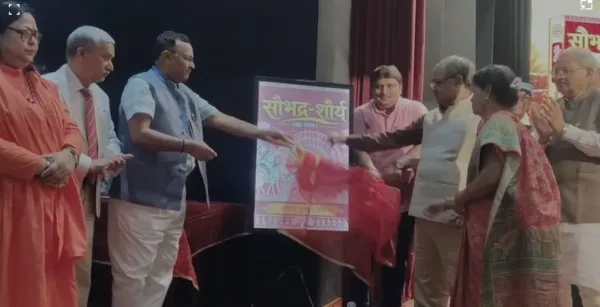
Dhanbad, November 24: The Indian Institute of Technology (Indian School of Mines), Dhanbad, hosted the launch of , a Hindi Khand-Kavya based on the valour, sacrifice and courage of Abhimanyu, the legendary warrior of the Mahabharata, at Penman Auditorium on Tuesday.
The literary event was presided over by IIT (ISM) Director Prof. Sukumar Mishra, who attended as the chief guest. The book has been authored by young litterateur and educationist Satyam Kumar Rai.
The programme was attended by Prof. Ram Kumar Singh, Vice-Chancellor of Binod Bihari Mahto Koylanchal University (BBMKU); IIT (ISM) Deputy Director Prof. Dheeraj Kumar; eminent educationist and former Jharkhand Academic Council chairman Phul Singh; Dr. Suyagan Rai; Dr. Saurabh Rai of Banaras Hindu University (BHU); Dr. Mithilesh; the author’s mother, Kalindi Rai; and several principals, academicians and literary personalities.
Director links epic narratives with scientific inquiry
Addressing the gathering, Prof. Sukumar Mishra highlighted the importance of examining traditional knowledge and India’s epics through the perspective of scientific inquiry and research.
He cited the example of a professor at a foreign university who, despite never having visited India or knowing Hindi, kept English translations of the Mahabharata, Ramayana and Bhagavad Gita in his laboratory. The professor reportedly explained that these texts offered ideas and inspiration for thinking and research.
Drawing a connection with Abhimanyu’s story, Prof. Mishra said traditional narratives should not be treated merely as stories but also examined through the lens of scientific curiosity.
Referring to the account of Abhimanyu hearing about the Chakravyuh while in his mother’s womb, he said such narratives could prompt fundamental questions about the functioning and development of the human brain.
He emphasised that curiosity about these accounts could encourage research into brain development, cognition and the possibilities of human understanding.
Referring to research undertaken by one of his former students, now a professor at IIT Delhi, he also spoke about studies challenging earlier medical assumptions regarding the development of vision among children born blind.
Prof. Mishra observed that India’s large and diverse population offered valuable opportunities for research that could contribute to global scientific understanding.
He said the purpose of engaging with India’s traditional knowledge was to generate new ideas and translate them into research and innovation. He also stressed the importance of developing indigenous technologies and products, noting that scientific research and innovation were essential for the country’s progress.
BBMKU Vice-Chancellor appreciates author’s efforts
Speaking on the occasion, BBMKU Vice-Chancellor Prof. Ram Kumar Singh emphasised the need to adapt to changing times while remaining conscious of the contributions of earlier generations.
He appreciated the author’s efforts to bring Abhimanyu’s heroic saga before contemporary readers and particularly acknowledged his mother’s role in nurturing his literary journey.
He said such works offered an opportunity for introspection and a deeper understanding of the values and sacrifices associated with India’s cultural heritage.
Author highlights Abhimanyu’s sacrifice and human emotions
Sharing excerpts from his book, author Satyam Kumar Rai said Abhimanyu’s story was not merely a tale of valour but also one of pain, sacrifice and human emotions.
Explaining the inspiration behind the work, he said, “Some characters are not written; they enter the writer’s heart. Some heroic tales are not written in blood but emerge through the writer’s tears. Saubhadra-Shaurya is one such immortal story that made me take up the pen, moved me emotionally and stirred my soul.”
He said the Khand-Kavya explores the emotions of a mother who knows she may lose her son, a newly married pregnant wife who sends her husband to the battlefield despite anticipating separation, and a sixteen-year-old warrior who shoulders the responsibility of his family and society.
Highlighting the central message of the book, Rai said, “Your age may be short, but your accomplishments should be great. The significance of life does not lie in how long one lives, but in how one lives.”
He said Abhimanyu’s life continued to inspire generations through his courage, commitment and sacrifice.
The programme brought together representatives from academic institutions, schools and the literary community, providing a platform to reflect on the relevance of India’s epic traditions and their enduring message for the younger generation.