






THE JHARKHAND STORY NETWORK
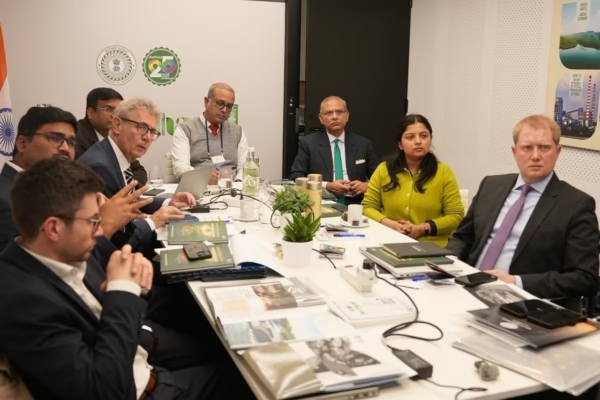
Davos/Ranchi, January 22: Jharkhand’s long-term strategy for critical minerals received strong endorsement from global policymakers, industry leaders and researchers at the World Economic Forum (WEF) Annual Meeting in Davos, where the state hosted a dedicated Global Hybrid Round Table under the guidance of Chief Minister Hemant Soren.

The session, titled “Jharkhand’s Critical Minerals Opportunity: From Geology to Value Creation,” focused on how mineral-rich regions can move beyond extraction to become hubs of processing, manufacturing and technology-driven growth.
Jharkhand at the Centre of India’s Critical Minerals Strategy
Opening the discussion, Arava Rajkamal, Secretary, Mines and Industries, Government of Jharkhand, said that in an era defined by energy insecurity and clean-technology demand, critical minerals have become central to global geo-economics and geo-security.

He highlighted that Jharkhand is home to 20 of the 24 critical minerals identified by the Government of India, placing the state at the heart of India’s ambitions in energy transition, electric mobility, advanced materials and clean technologies.
From Resource Extraction to Value Creation
Former Union Minister of State for Finance and President of Eversource Capital, Jayant Sinha, stressed that mineral-rich states must prioritise local value addition and processing instead of exporting raw materials.
He underlined that value creation within the state would generate employment, industrial growth and long-term economic resilience, while also balancing development with environmental responsibility.
Industrial Roadmap Under Vision 2050
Rahul Sinha, Director of Mines, Government of Jharkhand, outlined the state’s geological strengths and policy initiatives aimed at accelerating exploration, scientific mining and responsible extraction. He invited global public and private stakeholders to partner with Jharkhand in building a sustainable critical minerals ecosystem.
Varun Ranjan, Managing Director of JIIDCO, presented Jharkhand’s long-term industrial roadmap under the Chief Minister’s Vision 2050, highlighting the shift towards downstream industries such as mineral processing, refining, electric vehicle components, magnets and battery technologies.
He said integrated industrial clusters would help retain value within the state, attract manufacturing investments and strengthen India’s clean energy supply chains.
ALSO READ: Centre approves major health boost for Jharkhand
Skills, Research and Institutional Capacity Key
Dr Mukesh Kumar, Director of the Global Supply Chain Observatory at the University of Cambridge, said natural resources alone are not enough to ensure global competitiveness.
He emphasised the need for specialised skills, research partnerships and strong institutions to help Jharkhand integrate into global value chains and convert mineral wealth into sustainable economic outcomes.
Global Experts Stress Sustainability and Risk Management
International experts Dennis, Lucas, Ben and Martin shared insights on global critical minerals markets, stressing the importance of diversified and resilient supply chains, advanced exploration technologies and clear policy frameworks to reduce investor risk.
They also highlighted that strong environmental, social and governance (ESG) standards and responsible mining practices are now essential for attracting global capital.
Policy Clarity and Timely Execution
In his concluding remarks, Prashant Kumar, Secretary, Finance, Government of Jharkhand, stressed the need for regulatory clarity, efficient approvals and competitive pricing to enable time-bound development of critical minerals.
He suggested unlocking the potential of brownfield mining projects for faster operationalisation, noting that many critical minerals coexist with existing deposits.
The state government screened a short film on Jharkhand’s Critical Minerals Landscape and Opportunities, highlighting its geological strengths and industrial potential.
A coffee table book on critical minerals in Jharkhand was also unveiled, outlining the state’s resource base and long-term vision for supporting India’s energy security and industrial growth.
A Young State with a Global Outlook
As Jharkhand marks 25 years of statehood, it is positioning itself as a globally integrated hub for sustainable industrialisation, guided by the principle of “Growth in Harmony with Nature.”
The state aims to ensure that its natural wealth translates into long-term livelihoods, economic growth and national energy security.