
India–New Zealand Trade Pact: How a once-in-a-generation deal was sealed
DR RACHNA K PRASAD or years, the prospect of a comprehensive trade agreement between India and New Zealand appeared more aspirational…
DR RACHNA K PRASAD

or years, the prospect of a comprehensive trade agreement between India and New Zealand appeared more aspirational than realistic. Negotiations began in 2010 with considerable optimism, as both countries explored the possibility of deepening economic ties through a Free Trade Agreement (FTA). Yet, after nine rounds of talks, the process stalled in 2015, largely due to unresolved disagreements over market access, agricultural protections, and differing trade priorities. For nearly a decade thereafter, the idea remained dormant, surfacing only occasionally in diplomatic conversations without any serious movement toward conclusion.
Then, in March 2025, a dramatic shift occurred. Trade negotiations were revived with remarkable urgency, and by December 2025, the deal had been finalized. On April 27, 2026, the agreement was formally signed in New Delhi, marking the culmination of sixteen years of intermittent engagement. The speed of this turnaround—nine months after years of stagnation—signals something far larger than a conventional trade breakthrough. It reflects a new era in which political will, strategic necessity, and changing geopolitical realities are capable of overcoming bureaucratic inertia.
At one level, the pact expands bilateral trade. At another, it reveals the emergence of a new Indo-Pacific economic logic, one built not only on commerce but also on trust, resilience, and diversified partnerships. In this sense, the India–New Zealand trade agreement is not merely a bilateral arrangement; it may well be a template for the future of India’s trade diplomacy.
Breaking Down the “100% Club”
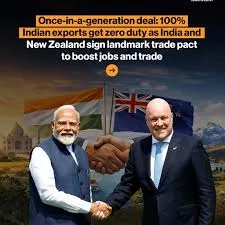
The most striking and headline-grabbing feature of the pact is New Zealand’s decision to provide duty-free access to all Indian export products—more than 8,200 tariff lines—from the very first day of implementation. This move places India in what many analysts are calling New Zealand’s “100% Club,” a rare category of partners granted complete tariff elimination across goods.

This is significant because trade liberalisation is usually phased in over years, sometimes decades. Sensitive products often remain excluded, and tariff reductions tend to follow negotiated schedules. Here, however, the dismantling of barriers is immediate. Indian exporters of textiles, garments, ceramics, leather goods, footwear, machinery, and engineering products can now enter New Zealand without facing duties that previously ranged up to 10 per cent.
For India’s export-oriented sectors, this dramatically improves competitiveness. Small and medium enterprises, often constrained by thin margins, stand to benefit the most. Sectors such as handloom products, artisanal crafts, and light engineering, which previously struggled against price disadvantages, may now find new opportunities in New Zealand’s consumer market.
Pharmaceuticals are expected to be among the biggest beneficiaries. By accepting inspection reports from regulators such as the US Food and Drug Administration and the European Medicines Agency, New Zealand has effectively removed costly duplicative compliance procedures. This reduces regulatory friction and lowers barriers for Indian pharmaceutical companies seeking expansion. It also aligns with India’s ambition to strengthen its global identity as the “pharmacy of the world.”

Similarly, leather and footwear producers, particularly those clustered in Agra’s GI-tagged manufacturing hub, gain substantial advantages. Indian ceramic exports from Morbi, engineering goods from industrial clusters in Gujarat and Maharashtra, and textile producers in Tamil Nadu and Punjab also stand poised to expand market share.
Commerce Minister Piyush Goyal emphasised this opportunity by calling the agreement “a gateway to the entire world,” particularly for Indian MSMEs seeking integration into global supply chains.
Beyond Goods: Mobility and Cultural Reciprocity
Unlike traditional first-generation FTAs focused narrowly on goods, this agreement is distinctly second-generation in character. It extends into services, mobility, and cultural recognition, treating trade not simply as an exchange of commodities but as a broader framework for human and institutional interaction.
A major innovation is the professional mobility pathway established for 5,000 Indian professionals, subject to a cap of 1,667 visas annually. Alongside this, the agreement introduces 1,000 working holiday visas for younger citizens, expanding opportunities for educational, cultural, and professional exchange.
The professions covered are unusually diverse. They include IT specialists, healthcare workers, chefs, music teachers, and skilled professionals across emerging sectors. This reflects recognition that modern trade increasingly depends on the movement of talent, not just goods.
Yet the most distinctive element is the agreement’s cultural reciprocity clause. For the first time, Indian traditional medicine systems—Ayurveda, Yoga, Unani, Siddha, and Homoeopathy—have been acknowledged within a trade agreement. In return, Māori health traditions receive recognition, creating a symbolic and substantive bridge between indigenous knowledge systems.
This is unprecedented. Trade agreements typically revolve around tariffs, quotas, and dispute mechanisms; they rarely engage with civilizational heritage. By incorporating indigenous and traditional practices, the pact broadens the definition of economic cooperation itself.
In doing so, it also reflects an emerging principle in international diplomacy: that cultural legitimacy can complement economic pragmatism. Trade, in this framework, becomes a vehicle not only for commerce but for recognition and exchange between traditions.
Protecting the “Milk of India”
No aspect of the negotiations was more politically sensitive than dairy. For New Zealand, dairy exports are a cornerstone of the economy. Companies such as Fonterra are global giants. For India, however, dairy is not merely an industry but a livelihood system involving nearly 80 million small-scale farmers.
Opening India’s dairy sector to large-scale New Zealand imports would have risked severe disruption for rural households dependent on milk income. Unsurprisingly, India drew a firm red line.
The final agreement excludes dairy and sugar entirely from tariff concessions. This exclusion is perhaps the most politically consequential feature of the pact, demonstrating India’s insistence that trade liberalization cannot come at the cost of vulnerable domestic sectors.
Other sensitive areas were similarly ring-fenced. Metals, gems and jewellery, onions, pulses, and select agricultural commodities remain protected.
Even in areas where concessions were made—such as apples, kiwifruit, and manuka honey—India avoided full liberalisation. Instead, it imposed quotas, safeguard measures, and minimum import prices. These mechanisms ensure controlled access rather than unrestricted market opening.
This calibrated approach reflects a sophisticated balancing act. India secured sweeping access for its exports while preserving protections for politically and socially sensitive sectors. The compromise also strengthens a broader lesson for trade negotiations: openness need not mean vulnerability if protections are strategically designed.
Investment as the Engine of Growth
Trade liberalisation is only one dimension of the pact. Equally significant is its investment architecture. New Zealand has pledged $20 billion in foreign direct investment over the next fifteen years, targeting infrastructure, renewable energy, agrotech, and advanced technologies. This transforms the agreement from a transactional trade deal into a broader development partnership.
One of its most promising components is the Agri-Technology Action Plan. Through this initiative, New Zealand’s expertise in horticulture, post-harvest systems, and agricultural productivity will be leveraged to support Indian farmers.
Collaboration in kiwi cultivation, apple production, honey value chains, irrigation techniques, and supply-chain logistics could contribute meaningfully to agricultural modernisation. Importantly, this collaboration proceeds despite dairy exclusion, showing that cooperation in agriculture can advance even where market access remains politically constrained.
Renewable energy collaboration also offers long-term potential. New Zealand’s expertise in sustainability and clean technologies aligns closely with India’s ambitious green transition goals. This could create opportunities in solar infrastructure, green hydrogen, and climate-resilient systems.
Viewed in this light, the agreement is not simply about increasing trade volumes. It is about building productive capacity, strengthening resilience, and fostering long-term structural transformation.
A New Geopolitical Calculus
The significance of the pact cannot be understood solely through economics. Its geopolitical implications are equally profound. Since withdrawing from the China-centric Regional Comprehensive Economic Partnership in 2019, India has pursued a deliberate strategy of bilateral and mini-lateral trade arrangements with trusted partners rather than joining broad multilateral structures dominated by strategic rivals.
Deals with the United Arab Emirates, Australia, the United Kingdom, and the European Free Trade Association bloc reflect this approach.
New Zealand now joins that growing network. This matters because New Zealand occupies a strategic position in Oceania and the wider Pacific. Through this pact, India gains a stronger economic foothold in a region where geopolitical competition is intensifying.
Prime Minister Christopher Luxon described the agreement as a “once-in-a-generation” pact grounded in trust and shared values. His remark captures its strategic dimension.
The agreement supports India’s broader Indo-Pacific vision—one aimed at supply chain diversification, resilient partnerships, and reduced overdependence on concentrated economic relationships.
In that sense, the pact is also part of a larger geopolitical recalibration in which trade agreements increasingly function as instruments of strategy.
The Road Ahead: Toward $5 Billion
At present, bilateral merchandise trade between India and New Zealand stands at approximately $1.3 billion, while total trade is about $2.4 billion. These figures remain modest compared with India’s trade with larger partners.
The agreement seeks to change that. Both governments have set a target of raising trade to $5 billion by 2030. Achieving this would require sustained growth in goods exports, services flows, investment, and professional mobility.
The target is ambitious but not implausible. Tariff elimination, regulatory facilitation, and investment commitments together create the conditions for rapid expansion.
The speed of the deal itself is instructive. That negotiations could move from revival in March 2025 to signature by April 2026 after sixteen years of deadlock suggests that political commitment can dramatically compress timelines when interests align.
This has implications beyond New Zealand. It strengthens India’s credibility as a serious trade negotiator capable of balancing domestic protections with international ambition.
It also provides a model for future agreements—one in which bold liberalisation can coexist with carefully crafted safeguards.
A Blueprint for Future Trade Diplomacy
Perhaps the pact’s most enduring significance lies in what it reveals about the evolution of trade diplomacy itself.
Traditionally, trade agreements were judged mainly by tariff cuts. This agreement suggests a broader paradigm.
It combines market access with strategic protections. It integrates mobility provisions with investment commitments. It recognises indigenous knowledge systems while promoting modern professional exchange. It links bilateral trade to a wider Indo-Pacific strategy.
In short, it is multidimensional. That multidimensionality may be precisely what makes it relevant as a blueprint. Future trade agreements—especially in politically sensitive democracies—may increasingly need to look like this: economically ambitious, politically calibrated, socially conscious, and strategically embedded.
India appears to be moving in that direction.
A Pact That Could Reshape the Indo-Pacific
The India–New Zealand trade pact is far more than another free trade agreement. It is a model for reconciling domestic sensitivities with global ambition. By protecting dairy farmers while opening markets for textiles and pharmaceuticals, by recognising indigenous traditions alongside professional mobility, and by coupling trade liberalisation with long-term investment, the agreement establishes a new benchmark.
Its importance lies not only in what it does for bilateral trade but in what it signals about the future of economic diplomacy. It shows that entrenched deadlocks can be overcome when negotiations are guided by pragmatism rather than rigid orthodoxy. It shows that trade can incorporate cultural reciprocity without losing commercial seriousness. And it shows that strategic partnerships in the Indo-Pacific are increasingly being shaped through economic architecture as much as through security arrangements.
If implemented effectively, this pact could do more than double trade flows. It could influence how India negotiates future agreements, how middle powers structure partnerships, and how the Indo-Pacific’s economic order evolves in the decades ahead.
That is why this agreement matters. It is not simply a bilateral deal between India and New Zealand. It may be a glimpse of the next generation of global trade itself.
(Dr Rachna K Prasad is Assistant Professor of Political Science at the University of Delhi. She can be contacted at drrachnaprasad24@gmail.com)