






THE JHARKHAND STORY NETWORK
Ranchi, February 14: State Chief Secretary L Khiangte today affirmed the state government’s commitment to steering Jharkhand towards a green economy and strengthening
India’s journey towards climate goals and net-zero target.

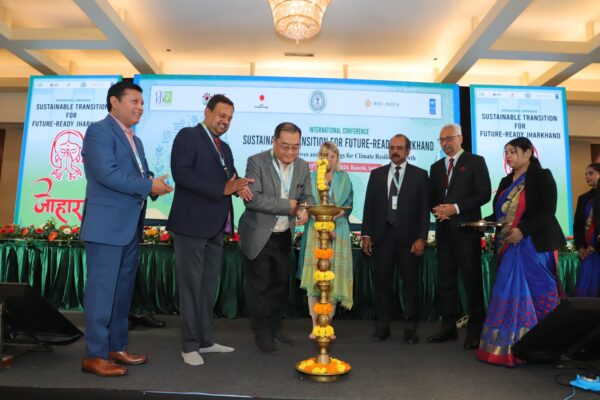
Speaking at a two-day international conference on ‘Sustainable transition for future-ready Jharkhand: Global perspectives & learnings for climate resilient growth’, he underscored the profound significance of sustainable transition as a catalyst for holistic advancement.
Need for partnerships
Emphasising no one is left behind in the transition phase, he outlined the need for multi-stakeholder collaborations and partnerships.
The conference has been organised by the Task Force on Sustainable Just Transition, Government of Jharkhand, with support from the Centre for Environment and Energy Development (CEED) and in association with the United Nations Development Program (UNDP-India) and World Resources Institute (WRI-India).
Confluence of leaders and experts
The conference witnessed the confluence of leaders and renowned experts from multilateral organisations,
Philanthropists and industries, alongside experts hailing from about thirty nations, include influential voices from Japan, the USA, Germany, South Africa, South Korea, and Indonesia.
Also Read: IIT ISM Dhanbad: McGill University professor tells mining companies to recruit women
Multi-sectoral strategies
Further elucidating the conference’s objectives, AK Rastogi, Chairperson, Task Force-Sustainable Just Transition, marked this conference as a monumental milestone, offering a comprehensive array of multi-sectoral strategies on environmental, social, gender and economic considerations. He added that the initiative adopts a proactive, opportunity-driven lens to acknowledge Jharkhand’s potential in realising climate-compatible growth, setting a precedent for worldwide transformative action.
Jharkhand a beacon for other states
Speaking on the occasion, Manoj Singh, Additional Chief Secretary, Department of Environment, Forest and Climate Change, Govt. of Uttar Pradesh, pointed out that Jharkhand has become a beacon for other states by outlining the sustainable transition strategies. “To envision a climate-compatible
decarbonised tomorrow, embracing low-carbon innovations and transformative strategy are paramount,” he added.
Game-changing technologies
Ms Isabelle Tschan, Resident Representative, UNDP-India, emphasised creating knowledge-sharing platforms and bringing in tech know-how
on innovative and game-changing technologies to bolster clean energy infrastructure, investment, and
alternative livelihood for benefiting the state and community at the last mile.
While lauding the state’s initiative, Ramapati Kumar, CEO of CEED, emphasised its role in fostering a
a collaborative forum where the finest global ideas converge, poised for replication at the subnational level to yield tangible results.
Kumar further underscored the need for a climate governance approach to create a conducive policy atmosphere, financial mechanisms and onboarding stakeholders to achieve the state’s goals on climate resilience and energy security.
Who all participated in conference?
The collaborative dialogue witnessed the active participation of high-level delegates from the UNDP India, WRI
India, World Bank, Asian Development Bank, International Labour Organisation, Coal India Ltd., Central Coalfields Ltd., Steel Authority India Ltd, National Thermal Power Corporation, National Productivity Council,
Indian Institute of Forest Management, MacArthur Foundation, Stitching SED Fund, Shakti Sustainable Energy Foundation, GIZ-India, Open Energy Transition-Germany, International Council on Clean Transportation, International Energy Economics and Financial Analysis (IEEFA), The Climate Group, India Climate Collaborative, Climate Policy Institute, Climate Bond Initiative, BEST-Maharashtra, among others.
Senior officials from the central and state government departments & agencies— notably from Uttar Pradesh, Tamil Nadu, Karnataka, Maharashtra, Bihar, West Bengal, Chhattisgarh, Odisha, Jammu & Kashmir, and Jharkhand also attended the meet.
