






THE JHARKHAND STORY NETWORK
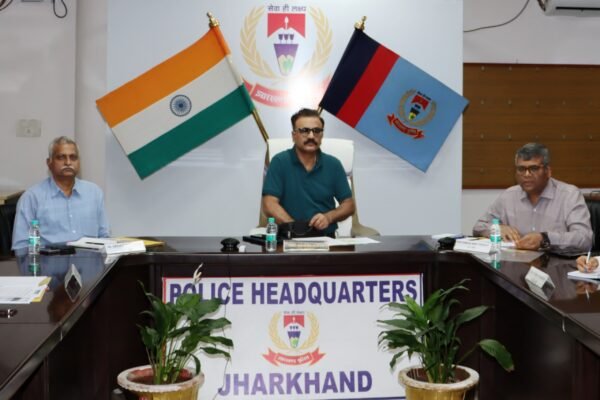
Ranchi, May 1: Amid a political row over his appointment, Jharkhand’s Director General of Police, Anurag Gupta, held a high-level review meeting today, sharpening the police’s focus on combating left-wing extremism. The meeting, held at the Police Headquarters Auditorium in Ranchi, saw participation from top police officials across the state, both in person and via video conferencing.

Targeting Maoist Infrastructure and Influence
At the core of the meeting was a renewed call to dismantle the operational and financial backbone of Maoist and splinter groups in Jharkhand. Gupta issued 12 detailed directives to Superintendents of Police, focusing on strategic action, intelligence gathering, and community outreach.
Key Directives Issued by DGP Anurag Gupta
- Review of Past Cases: All district SPs are to examine previous cases involving threats or levy collection by Maoists, splinter groups, or criminal gangs. They must verify whether FIRs were filed where applicable.
- Speedy Action on Registered Cases: Immediate steps must be taken on cases linked to Maoist-led arson or sabotage, especially in high-risk districts.
- Attachment of Properties: Effective legal action should be initiated to attach and confiscate properties belonging to absconding Maoist or splinter group operatives.
- Documentation of Militancy-linked Assets: SPs must identify and update records of assets acquired through extremist activities and ensure necessary legal steps are taken.
- Know Your Enemy Initiative: Detailed profiles of active Maoist and splinter group members must be prepared and shared with field officers to strengthen area-specific vigilance.
- Fast-tracking Intelligence: SPs in affected districts must promptly act on intelligence reports received from the State Intelligence Branch and other units.
- Bounty Proposals: Timely proposals for rewards should be submitted for the arrest of absconding extremists.
- Mainstreaming and Surrender Policy: District units must actively promote surrender policies and publicise anti-Naxal efforts to encourage more defectors.
- Strengthening Intelligence Networks: Intelligence collection should be intensified through local police station in-charges, informers, and digital surveillance methods.
- Contractor Coordination: Regular meetings should be held with contractors and workers of development agencies to ensure security and information sharing.
- Post-project Surveillance: SPs must coordinate with agencies to install CCTV systems at key sites after project completion for enhanced monitoring.
- Monitoring Released Extremists: Police stations must be instructed to monitor Naxal/criminal elements released on bail.
Also Read: Jharkhand HC judge recuses himself from Alamgir Alam bail hearing

MHA Directs Retirement of DGP Anurag Gupta by April 30
Notably, the Union Ministry of Home Affairs (MHA) issued a directive on April 22 to the Jharkhand government, stating that Director General of Police (DGP) Anurag Gupta must retire on April 30, 2025, upon reaching the age of 60. The MHA emphasized that any extension beyond this date would contravene Rule 16(1) of the All India Services (Death-cum-Retirement Benefits) Rules, 1958, and the Supreme Court’s guidelines in the Prakash Singh case. The MHA’s letter highlighted that the central government had not granted an extension to Gupta and that his continuation in service beyond the retirement date would be “not legitimate.”
Jharkhand Government Challenges MHA’s Directive
In response, the Jharkhand government has contested the MHA’s directive, asserting that Gupta’s appointment as DGP was in accordance with the state’s “Selection and Appointment Rules 2025,” which provide for a fixed two-year tenure for the DGP. The state maintains that Gupta’s tenure, beginning on February 2, 2025, should extend until July 26, 2026.
Chief Minister Hemant Soren, upon returning from an overseas trip on April 30, met with Gupta and subsequently communicated to the MHA, requesting that no decision be made regarding Gupta’s retirement until the ongoing legal proceedings are resolved.
Legal Challenges and Political Repercussions
The appointment faced legal challenges, with BJP leader Babulal Marandi filing a petition in the Supreme Court, alleging that Gupta’s appointment violates the apex court’s directives in the Prakash Singh case, which mandates that the DGP be selected from a panel recommended by the Union Public Service Commission (UPSC).
The Supreme Court is scheduled to hear the contempt petition on May 6, while the Jharkhand High Court has listed the matter for hearing on June 16.