







THE JHARKHAND STORY NETWORK
Ranchi, February 21: Jharkhand’s economy has expanded significantly over the past decade, with the state’s income doubling since 2011-12 and average per person income crossing ₹1 lakh for the first time. These findings were presented in the Economic Survey 2025–26, tabled in the Assembly on Saturday.
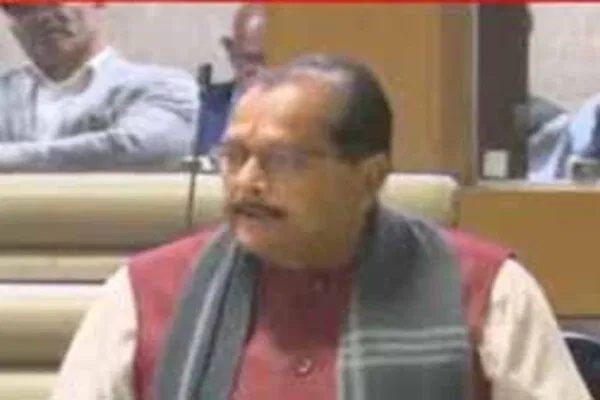
Presenting the report, Finance Minister Radhakrishna Kishore said the state’s Gross State Domestic Product (GSDP) at constant (2011-12) prices rose from ₹1,50,918 crore in 2011-12 to ₹3,03,178 crore in 2024-25 — effectively doubling in 13 years.
Between 2018-19 and 2024-25, Jharkhand’s growth rate surpassed the national average in four out of seven years. Even during the pandemic year, when economies shrank across the country, Jharkhand’s contraction of 5.30 per cent was slightly better than the national decline of 5.8 per cent.

Growth to Continue
The survey projects that real GSDP will reach ₹3,21,892 crore in 2025-26 and ₹3,41,064 crore in 2026-27. At current prices, the state’s economy is expected to cross ₹5.6 lakh crore in 2025-26 and approach ₹6.1 lakh crore the following year.
The state has maintained a growth rate of over 7 per cent for the past four years.
ALSO READ: Jharkhand Govt fully vigilant on financial management: Radhakrishna Kishore
Per Capita Income Rises Sharply
Per capita income at current prices increased to ₹1,16,663 in 2024-25, compared to ₹60,000 in 2016-17. It is projected to rise further to ₹1.25 lakh in 2025-26 and ₹1.35 lakh in 2026-27.
At constant prices, real per capita income reached ₹68,357 in 2024-25, reflecting a 65.7 per cent increase over 2011-12 levels.
Services Sector Leads the Way
The services sector has now become the largest contributor to Jharkhand’s economy. Its share in Gross State Value Added (GSVA) rose from 38.5 per cent in 2011-12 to 45.56 per cent in 2024-25.
The sector is expected to generate ₹1,37,730 crore in 2025-26 and ₹1,48,479 crore in 2026-27.
Within the industrial sector, the share of manufacturing has increased from 47.7 per cent to 55.4 per cent.
Agriculture Continues to Grow
Agriculture and allied activities are projected to contribute 12.3 per cent to GSVA in 2025-26, with output estimated at ₹28,470 crore — a 34 per cent increase. However, agriculture’s overall share in the state economy has gradually declined over time.
Poverty Falls, Inflation Eases
The report notes a significant drop in poverty. The poverty rate declined from 42.10 per cent in 2015-16 to 28.81 per cent in 2019-21 — a reduction of 13.29 per cent, which is better than the national average.
Inflation has also eased, falling from 6 per cent in 2023-24 to 4 per cent in 2024-25.
Budget and Fiscal Discipline
Jharkhand’s budget has grown nearly twentyfold since the state was formed. It increased from ₹6,067 crore in 2001-02 to ₹1,16,892 crore in 2024-25, and is estimated at ₹1,45,400 crore for 2025-26. Total expenditure crossed ₹1 lakh crore for the first time in 2023-24.
The state has largely maintained fiscal discipline, keeping its fiscal deficit within the FRBM limit of 3 per cent of GSDP in all years except 2020-21, when it rose to 5 per cent due to the pandemic.
Banking infrastructure has expanded steadily. By September 2025, Jharkhand had 3,449 bank branches and 3,338 ATMs. Deposits rose by 220 per cent to ₹3,79,735 crore between March 2014 and September 2025, while bank advances increased by 124 per cent to ₹1,58,714 crore.
The survey also highlights steady growth in the state’s own revenue, which has recorded an average annual increase of 14.2 per cent.
Overall, the Economic Survey presents Jharkhand as a state experiencing steady economic expansion, rising incomes and improving financial stability.
