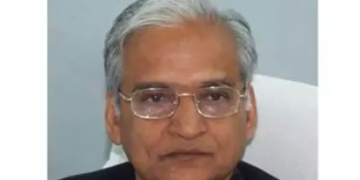








SUMAN K SHRIVASTAVA
 Ranchi, December 21: The Jharkhand Hindu Marriage Registration Rules, 2002 were framed for an India where marriage, family, and law lived close to one another. Registration meant walking into a government office, standing before a Registrar, and affirming identity in flesh and voice. Rule 4(3), requiring that an application “shall be presented personally,” reflected a world where personal presence was assumed, not debated.
The law was careful, not cruel. Its purpose was to prevent false claims, protect women, and give legal recognition to a social institution older than the State itself. But the Rules did not foresee an India whose marriages would later stretch across oceans—solemnised in Ranchi, lived in London, and scrutinised in Stockholm.

By 2012, that unseen future had arrived.
A Marriage Recognised by Fire, Questioned by Paper
Upasana Bali and Manish Bali were married in December 2002 in Ranchi, according to Hindu rites. Nothing about the ceremony was disputed. Years later, however, their life had become multinational. The wife, an Australian citizen. The husband, a Swedish citizen. Both were residing lawfully in the United Kingdom.
Their son was born in London in January 2012. It was then that the absence of a single document—the marriage certificate—began to shape the child’s legal identity. Swedish authorities demanded proof that the parents were legally married. Without it, the child could not be recognised as a Swedish citizen. Without recognition, no passport could be issued. Without a passport, the family could not travel to India—even to attend a wedding within the family.
The law demanded their physical presence in Jharkhand. Life made that impossible. The infant could not travel without documents. The parents could not leave the child behind. The procedure had become a closed circle.
The Legal Question Beneath the Human Story
The petition challenged Rule 4(3), but the Jharkhand High Court chose a narrower, wiser path. Rather than striking at the rule’s constitutionality, the Court asked a more fundamental question:
Does “personal presence” mean physical presence alone—or does it mean meaningful presence?
Justice Prakash Tatia, authoring the judgment, approached this question not as an administrator but as a jurist deeply aware that procedure is meant to serve justice, not suffocate it.
ALSO READ: Jharkhand HC@25: Tribal custom, Constitutional courts, and promise of family justice
A Judgment Built Brick by Brick
What gives this decision its strength is not sympathy, but structure.
Justice Tatia anchored his reasoning in a long line of judicial thought, drawing extensively from Supreme Court precedents that treated law as a living instrument. He cited State of Maharashtra v. Dr. Praful B. Desai, where the Supreme Court held that presence through video conferencing satisfies legal requirements of personal appearance.
From there, the judgment expanded outward—quoting Francis Bennion on statutory interpretation, invoking the doctrine of “ongoing statutes,” and reminding that laws must be read as “always speaking.” Justice Tatia reinforced this with reflections from cases like National Textile Workers’ Union v. P.R. Ramakrishnan, where the Supreme Court warned against allowing outdated interpretations to choke social progress.
The judgment also drew from cases involving:
- Recording of evidence by video conferencing
- Service of notices through modern postal methods
- Interpretation of old statutes in light of new technology
This was not an isolated conclusion. It was the result of accumulated legal wisdom.
From Criminal Trials to Marriage Registrations
One of the most striking aspects of the judgment is its journey across legal domains. Justice Tatia borrowed principles developed in criminal law—where liberty and constitutional rights are at stake—and applied them to a civil, domestic matter.
If an accused person’s right to a fair trial can be protected through video conferencing, the Court reasoned, then surely a Registrar’s duty to verify identity can be fulfilled the same way.
Physical presence without interaction, the judgment observed, would be meaningless. The real purpose of appearance is to allow questioning, observation, and satisfaction. Technology, therefore, does not dilute the law—it fulfils it.
Understanding the Spirit of the Jharkhand Rules
The Court emphasised that the Jharkhand Hindu Marriage Registration Rules, 2002, were never intended to create impossibility. Their object was verification, not hardship.
Justice Tatia read the Rules purposively, holding that:
- Applications may be submitted through a power of attorney
- Registrars may verify parties through video conferencing
- Such verification satisfies the requirement of personal presence
This interpretation preserved the law while saving the family.
Technology as Justice’s Silent Ally
In 2012, video conferencing was still described as “cheap and easily available,” not yet institutionalised. Justice Tatia even noted common platforms like Skype and internet-based services—an almost modest observation that now feels prophetic.
Today, that vision has fully materialised. E-courts, virtual hearings, digital records, and online verification are no longer exceptions. They are the backbone of modern justice delivery.
What this judgment cautiously permitted, the future would firmly adopt.
A Certificate That Meant Belonging
The Court allowed the writ petition and directed the Registrar to act swiftly, conscious that delay would deepen the family’s hardship. The order was practical, humane, and precise—issue the certificate within ten days, if no legal impediment existed.
At stake was not merely a document, but a child’s identity, a family’s movement, and a marriage’s legal acknowledgement.
This judgment stands as a quiet reminder that law achieves its highest purpose when it listens carefully to human lives—and is willing, when necessary, to let justice travel farther than geography once allowed.
