
Jharkhand High Court: Courts cannot rewrite tender terms, must defer to expert evaluation
THE JHARKHAND STORY NETWORK Ranchi, September 2: The Jharkhand High Court has reiterated that constitutional courts cannot sit in appeal over decisions…
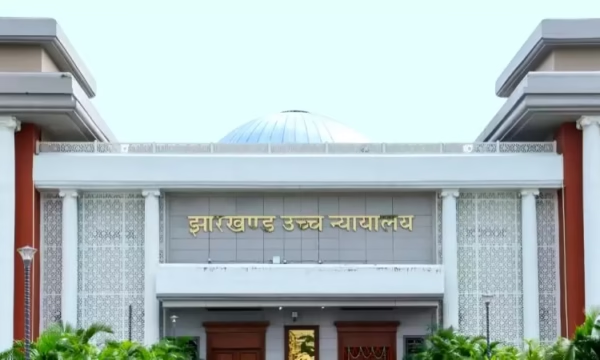
THE JHARKHAND STORY NETWORK
Ranchi, September 2: The Jharkhand High Court has reiterated that constitutional courts cannot sit in appeal over decisions taken by tendering authorities or rewrite the terms of a tender to suit a bidder, stressing that judicial review in contractual matters is confined primarily to examining the legality and fairness of the decision-making process.
A Division Bench comprising Chief Justice M.S. Sonak and Justice Rajesh Shankar observed while dismissing a petition filed by M/s United Air Express challenging its technical disqualification from a tender floated by Steel Authority of India Limited (SAIL) for comprehensive outsourcing services at Bokaro Steel Plant.
The court held that where an evaluation committee has considered a bidder’s claim in accordance with the tender conditions and followed a fair and transparent process, a constitutional court cannot substitute its own interpretation merely because another interpretation may appear possible.
Court cannot act as a “superboard” in tender disputes
Referring to a series of Supreme Court judgments, including Tata Cellular v. Union of India, Michigan Rubber v. State of Karnataka and Afcons Infrastructure v. Nagpur Metro Rail Corporation, the High Court said judicial review is concerned primarily with how a decision was made, rather than whether the court agrees with the merits of that decision.
The Bench noted that the court’s role is to examine whether the authority exceeded its powers, committed an error of law, violated principles of natural justice, reached a decision that no reasonable authority could have reached, or abused its powers.

The court emphasised that judges are not expected to function as a “superboard” by substituting their own assessment for that of administrators or expert evaluation committees.
It further observed that tendering authorities must have a degree of freedom of contract, while their decisions remain subject to safeguards against arbitrariness, bias, mala fides and irrationality.

Tender terms generally remain within domain of tendering authority
The High Court specifically stressed that the terms of an invitation to tender ordinarily cannot be subjected to judicial scrutiny merely because a bidder disputes their interpretation.
The court said tender decisions are frequently made through multiple administrative levels and involve qualitative assessments by experts. Courts generally lack the specialised expertise required to replace such assessments with their own.
At the same time, the Bench clarified that judicial restraint does not mean complete immunity for tender authorities. Courts can intervene where the decision-making process is illegal, irrational, arbitrary, perverse, procedurally improper, mala fide or intended to favour a particular bidder.
The court relied on the Supreme Court’s formulation that the question is whether something has gone wrong “of a nature and degree” that requires judicial intervention.
United Air Express challenged technical disqualification
The dispute arose from a SAIL bid invitation dated November 4, 2025, subsequently modified by a corrigendum dated December 6, 2025, for “Comprehensive Outsourcing Services – MRD” at Bokaro Steel Plant.
United Air Express had challenged SAIL’s decision declaring it technically ineligible. The company contended that the tender did not require the prescribed experience to have been obtained through a single work order and argued that its experience with Tata Steel satisfied the eligibility requirement.
SAIL, however, maintained that the tender required experience in similar work and that the documents submitted by the petitioner did not establish the required experience in a single work order.
The petitioner had relied on two work orders issued by Tata Steel and subsequently attempted to establish that the two orders formed part of a single integrated project.
Court finds evaluation process fair and transparent
The High Court noted that SAIL did not immediately reject the bid. Instead, the petitioner was given three opportunities to clarify its eligibility and submit additional documents.
The Evaluation Committee considered the explanations and additional material but continued to hold that the bidder did not satisfy the prescribed technical eligibility criteria.
The Bench held that the fact that the Evaluation Committee did not accept the petitioner’s explanation could not, by itself, establish unfairness, arbitrariness or lack of transparency.
“Merely because the evaluation committee … did not agree with the petitioner’s clarifications,” the court said in substance, it could not be concluded that the decision-making process was unfair or unreasonable.
Court rejects attempt to reinterpret ‘work’ and ‘work order’
A key issue before the court was the petitioner’s argument that two separate work orders should be treated as parts of one composite work.
The court was not persuaded.
It noted that the eligibility conditions repeatedly referred to completion of similar works meeting specified financial thresholds and that the documents submitted by the petitioner prima facie related to two distinct work orders dated May 4, 2018 and August 1, 2021.
The Bench also rejected reliance on a later certificate produced during the court proceedings to explain the relationship between the two work orders. The court noted that the certificate was obtained after the arguments had substantially progressed and sought to establish that the two orders were part of a single work.
The judges said post-facto explanations could not ordinarily be used to undermine the tender-stage evaluation, particularly when the petitioner had been given several opportunities to clarify its position during the evaluation process.
Different interpretation is not enough for court intervention
The judgment contains an important clarification on the interpretation of tender conditions.
Relying on Afcons Infrastructure, the High Court said constitutional courts should defer to the tendering authority’s understanding and appreciation of tender documents unless that interpretation is shown to be perverse, mala fide or intended to favour a particular bidder.
Even where the authority’s interpretation may not be acceptable to the court, that disagreement alone does not justify interference.
The Bench also referred to the Supreme Court’s ruling in Michigan Rubber, observing that courts should not interfere merely because they believe that different tender conditions would have been fairer, wiser or more logical.
When can courts interfere in tender matters?
The judgment effectively sets out the boundaries of judicial review in public tenders.
A court can examine whether:
- the tendering authority exceeded its legal powers;
- there was an error of law;
- principles of natural justice were violated;
- the decision was arbitrary, irrational or perverse;
- the decision-making process was procedurally improper;
- the authority acted with mala fide intent, bias or favouritism; or
- the decision was so unreasonable that no responsible authority could have reached it.
But a court cannot simply substitute its own interpretation for that of an expert tender committee because it prefers a different reading of the tender conditions.
Petition dismissed, SAIL decision upheld
Applying these principles, the High Court found no illegality, irrationality or procedural impropriety in SAIL’s decision to declare United Air Express technically ineligible.
The Bench held that the decision was reached through a fair and transparent process and that there was no material to establish mala fides, abuse of power or favouritism.
The court also rejected the petitioner’s claim of discrimination based on its treatment in tenders relating to SAIL’s other plants, observing that the eligibility conditions and scope of work could not be assumed to be identical merely because the tenders concerned the same company.
Ultimately, the court held that there was no ground to interfere with the Evaluation Committee’s decision and dismissed the writ petition without costs.
Key takeaway
The ruling reinforces a settled principle in public procurement: courts can police the legality and fairness of the tender process, but they cannot become tender evaluators themselves.
Unless a tender condition or its application results in demonstrable arbitrariness, perversity, mala fides, favouritism or procedural illegality, the decision of the competent authority and its expert evaluation committee is entitled to judicial deference.